





- Context
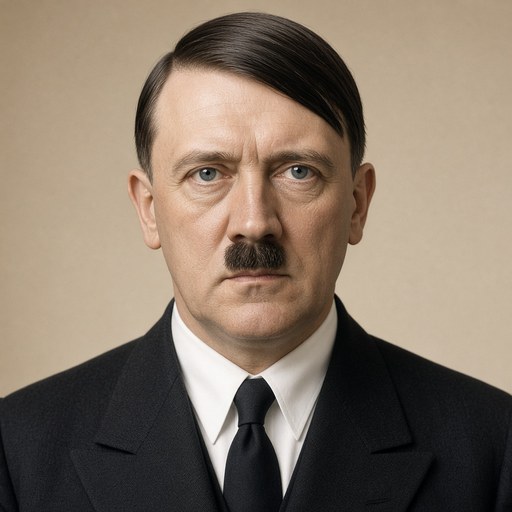
- Hitler addressed the Reichstag in Berlin on October 6, 1939, reviewing the Polish campaign, announcing the German-Soviet division of Poland and offering a conference on European security while warning Britain and France against continuing the war.
- Main themes
- Victory in the Polish campaign, German casualty figures, surrender of Warsaw, German-Soviet Boundary and Friendship Treaty, partition of Poland and spheres of interest, resettlement of ethnic groups and the Jewish question, revision of the Treaty of Versailles, claim to German colonies, relations with neighbouring states, appeal for a European security conference, criticism of Britain, France and Churchill, limits on air warfare and armaments
- Duration
- ~81 min
- Words
- 9,675
- Sentences
- 445
- Readability
- 51
- Grade
- 11.3
- Syntax
- 2.97
- Vocabulary
- 2.32
The broad sphere of national life a sentence belongs to. Every sentence has an Arena, so it is the denominator the other indices are read against.
Other445 sentences in 107 paragraphs
Deputies, Men of the German Reichstag!
In a most fateful hour, my Deputies, you met here on September 1 of this year as the representatives of the German Volk. At the time, I had to inform you of the difficult decisions forced on me by the intransigent, provocative attitude of a certain state.
Five weeks have passed since. When I asked you to come here once more today, I did so in order to render account of the past and to afford you the necessary insight into the present situation and the future, insofar as this is possible.
For two days now, the flags and symbols of our new Reich have decorated our cities, markets, and villages. With bells ringing, the German Volk celebrates this great victory, which, in its own way, is unique in history. After all, a state of thirty-six million inhabitants stood up against us, with an army of fifty infantry and cavalry divisions. Its goals were farreaching ones, its confidence in the destruction of the German Reich was seen as a matter of course.
Only eight days after the beginning of this war, the dice fell. Wherever Polish troops clashed with German units, they were either repelled or beaten.
The daring structure of Poland’s offensive strategy against German Reich territory pitifully collapsed after the first forty-eight hours of the campaign. After death-defying attacks and unrivaled marches, the German divisions-the Luftwaffe, Panzer force, and units of the Navy-took the initiative. Not for one moment could it be wrestled from them again. After only fourteen days, the majority of the Polish Army had either dispersed, had been taken prisoner, or had been encircled. In this period, the German armies had covered distances and occupied territories whose mastering, twenty-five years ago, had necessitated more than fourteen months.
While a number of particularly spirited newspaper strategists elsewhere in the world have sought to portray the speed of this campaign as a disappointment for Germany, we all nonetheless know that, to date, there has hardly been a greater achievement testifying to such high soldiership recorded in the history of war. That remnants of the Polish armies were able to hold on until October 1 in Warsaw, Modlin, and Hela, was not a result of their capabilities, but of our cool prudence and our sense of responsibility.
I forbid the sacrifice of more men than absolutely necessary. This means: I consciously freed the German leadership in the war of the view, which was still prevalent in the World War, that, for reasons of prestige, certain tasks have to be solved within a certain time at all costs. What absolutely needs to be done will be done, irrespective of sacrifice. What can be done without, will remain undone.
It would not have been a problem for us to break the resistance in Warsaw by September 10 or September 12, as we did break it from September 25 to September 27. For one thing, I sought to spare the lives of Germans. Second, I still cherished the hope, though it was a deceptive on, that, for once, a sense of responsibility and reason would prevail over this irresponsible madness on the Polish side.
On a small scale, the same drama repeated itself here, which we had already been forced to witness before to a larger extent. The attempt to convince the person responsible for the leadership of the Polish troops-insofar as he even existed-of the senselessness, the craziness, of resistance in a city of millions, failed. A Generalissimo, who himself took to flight in a less-than-glorious fashion, forced on the capital of his country a resistance which could only lead to its destruction.
When it had been realized that the fortifications would not withstand a German assault, the entire city was transformed into a fortress, with barricades crisscrossing it. Batteries took up position in all squares, all streets, and all courtyards. Thousands of machinegun hideouts were mounted and the citizens were called on to take part in the fighting. Out of pity for the women and children, I offered the ruling powers in Warsaw to permit at least the civilian population to evacuate the city. I had hostilities suspended and the necessary exit routes secured. And we all waited in vain for a parliamentarian to appear, as we had waited in vain for a Polish negotiator at the end of August. The proud Polish commandant of the city did not even honor us with a reply.
I had the deadlines extended just in case. I instructed bombers and heavy artillery to attack only purely military objects. I repeated my request. It again was futile. I then offered not to shell one part of the city, Praga, and instead to reserve it for the civilian population, so that it might have the opportunity to withdraw there. The Poles again showed their contempt for this suggestion.
Twice I made an effort to remove the international colony from the city. Only after encountering numerous difficulties, this attempt finally succeeded, although, in the case of the Russians, only at the last minute.
I then ordered the attack begun on September 25. The same defenders, who had first felt it was beneath their dignity to even consider these humanitarian proposals, then swiftly shifted their ground. On September 25, the German attack began, and on September 27, they capitulated.
With over 120,000 men, they did not have the courage-as our German General Litzmann once had lying before Brzeziny with much inferior forces- to make a daring sortie. Instead, they chose to lay down their arms. One should not make a comparison between this and Alcazar.There, for weeks, the Spanish heroes heroically braved heavy attacks and rightly gained immortality thereby. Here, however, a great city was unscrupulously left to destruction only to capitulate after forty-eight hours. While the individual Polish soldier fought bravely in some locations, his leadership can only be described, from top to bottom, as irresponsible, unscrupulous, and incompetent.
Outside of Hela, I ordered the sacrifice of not a single man without thorough preparation. There, too, the city surrendered only after the German attack had finally been announced and had actually begun.
I am making these statements, my Deputies, to preclude the creation of historic myths. For, if this campaign should ever generate such a myth, then this myth should only tell the story of the German musketeer who, both in the offensive and on the march, has added yet another page to his own eternal, glorious history. This myth should form around the heavy weaponry which, after exertions beyond words, came to the rescue of this infantry. Worthy of this myth also are the black-clad men (schwarze Manner) of our Panzer forces whose bold determination, without regard to the superior strength and resistance [of the enemy], brought the attack up to the front time and time again. Finally, this myth should glorify our airmen who, undaunted by death, knew that every downing which did not kill them in the air would lead to a terrible massacre on the ground. Nevertheless, they persevered steadfastly and persistently, attacking with bombs and machine guns when ordered to do so and when a target came into view. The same holds true for our U-boat heroes. When, within four weeks, a state of thirty-six million inhabitants and of such military force is completely destroyed, and when, during this period, the victor does not experience a single setback, then this is evidence not of fortune’s favor, but of the most excellent training, the best leadership, and the most deathdefying valor.
German soldiership has once more firmly clasped the laurel wreath, which had been craftily snatched from the German soldier in 1918 and presses it onto its head. In profound gratitude and deeply moved, we all stand before the many unknown and indescribably brave men of our German Volk. For the first time, they have taken their place, coming from all of the Gaus of Greater Germany.
The blood shed together will bind them even more closely together than any construction of constitutional law ever could.
The consciousness of the strength of our Wehrmacht fills all of us with selfassured calm since it has proven its power not only in the attack, but also in the retaining of what has been acquired. The excellent training of the individual officer and man has stood the test to the utmost. The exceedingly low casualty figures are to be ascribed to this. While individually painful, the losses in sum are far below what we believed we had to expect. And yet the casualty total does not draw an accurate picture of the toughness of the individual battle. After all, there are regiments and divisions whose blood sacrifice was heavy because either superior Polish units attacked them or they encountered them in the course of their own attack. From the rapid succession of battles and struggles, I will cite only two episodes as examples for many: Just as the divisions of the Army of General von Blaskowitz were moving in echelon against Warsaw along the left flank of the Army of General von Reichenau, who was charging in the direction of the Weichsel river, with the mission of repulsing the attack of the Central Polish Army on his flank, its full thrust suddenly hit the marching armies of General von Blaskowitz at a moment when the Polish armies were assumed to be retreating to the Weichsel river. This was a desperate attempt by the Poles to break out of the ring surrounding them. Four Polish divisions and several cavalry units threw themselves against the German lines formed by one active German division spread out along a front of nearly thirty kilometers. In spite of the enemy outnumbering it five to one, even six to one, and in spite of the great weariness of the troops, who had been fighting and marching for days, this division countered the attack. At several points, it repulsed the enemy in bloody hand-to-hand fighting. It neither yielded nor retreated until the necessary reinforcements had been brought up. And while enemy radio was already triumphantly disseminating news of a breakthrough at Lodz, the division’s general, with his shot-apart arm in splints, reported to me on the course of the attack, on the prevention of the breakthrough, and on the brave conduct of his soldiers. Of course, the losses here were great.
Together with small additional units, a German Landwehr division had the task of forcing the Poles into the northern section of the Corridor, to take Gdingen and to advance in the direction of the Hela peninsula. Facing this Landwehr division were Polish elite forces, shore-based naval troops, schools of officer cadets and non-commissioned officers, sailors, artillery, and cavalry.
With calm resolve, this German Landwehr division approached the fulfillment of its mission, even though this meant facing a numerically far superior opponent. Within the next few days, the Poles were forced to retreat from one position to the next: 12,600 prisoners were taken, Gdingen was liberated, Oxhoeft was taken by storm, another 4,700 men were pushed back to the Hela peninsula and surrounded. The scene which met one’s eyes as the prisoners marched off was truly touching: there stood the victors, mostly elderly men with medals of the Great War on their chests, and past them marched the columns of prisoners of war, many of them young men between twenty and twenty-eight years of age.
I ask you to rise, as I now proceed to announce the number of our dead and wounded. While their numbers are but one-twentieth of the figure which we believed we had to anticipate at the beginning of this campaign-thanks to the training of the troops, thanks to the effectiveness of our weaponry, and thanks to the leadership of our units-we should not forget that every single one of those who gave their lives here has sacrificed the greatest good for his Volk and our Reich which a man can give his people.
According to the figures of September 30, 1939, which cannot be expected to be greatly altered subsequently, casualties in the Army, Navy, and Luftwaffe, officers included, amount to: 10,572 fallen on the battlefield; 30,322 wounded; 3,409 men missing. Of those missing in action, regrettably, we must consider a part as having been massacred or killed. We owe gratitude to those who sacrificed themselves during the campaign in Poland, care to the wounded, sympathy and assistance to their families.
The campaign in Poland has come to an end with the fall of the fortresses of Warsaw and Modlin, and the surrender of Hela. The protection of the country against stray marauders, bands of robbers, and single terrorists, is being pursued with determination. The outcome of the battle was the destruction of all Polish armies. This led to the dissolution of the state. 694,000 prisoners have set out on the march to Berlin. The amount of the captured material cannot yet be ascertained.
Ever since the outbreak of the war, the German Wehrmacht has been standing in calm readiness in the West also, awaiting the enemy. The Reich Navy has done its duty in the battle for the Westerplatte, Gdingen, Oxhoeft, and Hela; in the securing of the Baltic Sea and of the Bay of Heligoland. Our U-boats meanwhile are fighting in a manner worthy of the unforgotten heroes of yesterday.
In view of the historically unique collapse of this so-called body politic, the question no doubt arises for everyone how such a development could come about. The cradle for the Polish state stood at Versailles. Not Poles, but Germans and Russians, made the immeasurable blood sacrifice from which this entity was born. What had proven unfit for life centuries before was now artificially inseminated by a German state leadership, equally unfit for life, in the year 1916, and, no less artificially, was born in 1920.
No, to extend a guarantee to this state and this state leadership in the manner this was done, could only lead to the greatest of misfortunes. Neither the Polish government, the clique propping it up, nor the people of this Polish state, were capable of assessing the extent of the obligation half of Europe undertook on their behalf. The conduct of the Polish government in the period from April to August of last year was based, on the one hand, on this passion that had been incited, and, on the other hand, on the sense of the security that had been guaranteed the Poles under all circumstances. The reaction to my proposals for pacification also was caused by this.
The government rejected these proposals because it felt that public opinion backed it, perhaps even urged it on. And public opinion backed it and urged it on in this direction because the government did not set the public right and, above all, because it felt sufficiently secure externally at every stage. All this had to lead to an increase in frightful acts of terror against ethnic Germans, to the rejection of all settlement proposals, and, finally, to ever greater incursions into Reich territory.
Given such a mentality, it was understandable that German forbearance was seen as weakness, i.e. that every time Germany yielded this was seen as proof of the opportunity of further forays. The warnings issued to the Polish Government to refrain from harassing Danzig with further ultimatums and, above all, from strangling the city economically in the long run, did not lead to an easing of the situation. To the contrary, it led to the city being cut off from traffic. The warning to finally stop, that is to counter, the eternal shootings, abuse, and torment of ethnic Germans, led only to an increase in gruesome acts, and to an aggravation of the appeals and inflammatory speeches by the Polish voivodes and military rulers. A general mobilization was the answer to the German proposals for arriving, at the last minute, at an acceptable and reasonable settlement. The German request to send a negotiatorin accordance with a suggestion made by England-was not complied with. On the second day, a response arrived in the form of a most injurious declaration.
Under the circumstances, it was clear that, in the event of further attacks on Reich territory, Germany’s patience was bound to end. What the Poles mistakenly interpreted as weakness was in reality our sense of responsibility and my will to arrive at an understanding, if this was still possible. However, since they believed that this patience and forbearance, this weakness, allowed them everything, there was no choice but to instruct them of this error and to strike back at them with the same weaponry they employed themselves over the last years. Under the impact of these strikes, this state disintegrated within a few weeks, and was swept away. One of the most nonsensical deeds of Versailles was thus disposed of. That a community of interests with Russia ensued from this German action was due not only to the similarity of the problems regarding both states, but also to the similarity of the conclusions both states arrived at in the course of reworking their relations with one another. In my speech at Danzig, I already declared that organizational principles different from our German ones govern Russia. However, since Herr Stalin no longer views these SovietRussian principles as an impediment to entering into friendly relations with states of different convictions, National Socialist Germany can no longer see any reason for employing a different means of assessment. Soviet-Russia is Soviet-Russia, National Socialist Germany is National Socialist Germany. One thing is certain: the minute both states agree to respect their different regimes and their respective principles, then there is no longer any cause for animosity to exist between them.
In long periods of history, it has been proven that the peoples of these two greatest states within Europe were the happiest when they lived in friendship with one another. The Great War in which Germany and Russia once struggled against one another has become the misfortune of both countries. It is understandable when the capitalist states of the West today have a vested interest in pitting these two states and their principles against each other, if possible. To this end, they would be willing to regard Soviet Russia as sufficiently presentable, of course, to enter into advantageous military alliances with it. And yet they regard it as perfidious if their most honorable advances are rejected, and if instead those two powers, which have all the more cause to be interested in peaceful cooperation, approach one another to expand their economic relations and thereby to pursue the happiness of their peoples.
Speaking before the Reichstag one month ago, I already declared that concluding the German-Russian Non-Aggression Pact represented a decisive change for German foreign policy in general. The new Boundary and Friendship Treaty concluded between Germany and Russia will secure not only peace for both states, but also render possible a happy, lasting cooperation. Germany and Russia will jointly divorce one of the most dangerous spots of Europe of its threatening character. In this area, they will contribute to the welfare of the human beings living there, and thereby make a contribution to European peace. If certain circles today see in this cause to hope for the ready defeat of Russia or Germany, then allow me to respond: for many years, German foreign policy goals have been credited with characteristics which could only spring from the mentality of a high school student. At a moment when Germany is struggling to consolidate a Lebensraum which encompasses little more than 100,000 square kilometers, saucy newspaper journalists in other states, which rule forty million square kilometers, claim that Germany strives for world supremacy in this struggle. The German-Russian agreements should necessarily have an enormously calming effect on these disquieted advocates of world freedom. For these agreements present authentic proof that allegations of Germany’s drive towards the Ural Mountains, the Ukraine, Rumania, and so on, are but the outgrowth of an overwrought Martian fantasy (Marsphantasie). In one respect the resolution of Germany remains unchangeable, namely: to bring about peaceful, stable, and hence tolerable conditions also in the East of our Reich. And here especially German and Soviet Russian interests and wishes are completely compatible. Both states have resolved not to allow problematic situations to arise between them which might bear within them the seeds of internal unrest and, therefore, of external disruptions, or which might detrimentally effect the relationship between these two great powers. Germany and Soviet Russia have clearly delineated their respective spheres of interests. Each has resolved to see to peace and order in its part of the world and to prevent everything which might possibly be to the detriment of its partner.
The goals and tasks resulting from the disintegration of the Polish state are approximately the following, insofar as the German sphere of interest is concerned: 1. The establishment of a Reich frontier which renders justice to the historic, ethnographic, and economic conditions.
2. The pacification of the entire area in the service of the establishment of a tolerable form of law and order.
3. The absolute guarantee of security not only for Reich territory, but for its entire sphere of interest.
4. A new order, a new structuring of economic life and traffic there, and hence of cultural and civilized development.
5. As the most import task, however: a new ordering of ethnographic relations, which means a resettlement of the nationalities so that, after the conclusion of this development, better lines of demarcation are given than is the case today.
In this sense, this is not a problem restricted solely to this area. It is a task going far beyond this. For all of Eastern Europe and its southeastern part are filled with intolerable splinters of German ethnic groups. In this we see a reason and a cause of persistent international friction. In the age of the principle of nationalities and of racial thought (Rassegedanken), it is utopian to believe that these members of a superior people could be assimilated without further ado.
And hence it is one of the missions of a farseeing new order of European life to see to these resettlements in order to diffuse at least part of the potential for conflict in Europe. Germany and the Union of Soviet Socialist Republics have agreed to assist each other in this. The German Reich Government will therefore not allow the developing Polish remnant-state (Reststaat) to irritate the Reich or to become an irritant in the relations between the German Reich and Soviet Russia.
As Germany and Soviet Russia undertake this redevelopment project, both states can rightly point out that the attempt to resolve this problem with the methods of Versailles has completely failed. And it had to fail since these tasks cannot be resolved at a green table or through simple directives. Most of the statesmen who gave their opinion on this most complicated matter at Versailles did not have any training in history; indeed, often they did not even have the faintest idea of the essence of the task that had been posed. They bore no responsibility for the consequences of their actions.
Recognition that their work was not correct was of no significance, as there was no way of obtaining an actual revision in practice. While the Versailles Treaty provided for the possibility of such revisions, all efforts to obtain revisions failed in reality. They had to fail all the more since the League of Nations, as the highest authority in this instance, ceased to have the right to carry through such a procedure. Once America declined to sanction the Peace Treaty of Versailles or to so much as join the League of Nations, and other peoples soon followed suit, as they no longer regarded their presence in this group as compatible with the interests of their countries, this association deteriorated more and more, to become a circle for those with an interest in the Diktat of Versailles.
The fact remains that none of the revisions deemed necessary from the outset was ever carried through by the League of Nations. Now it is becoming a custom to consider a government on the run still existent, even if it has but three members, so long as these three have brought enough money not to become a financial burden for the democratic host countries. It is to be assumed that the League of Nations will bravely continue to exist even if the nations united therein number only two. Perhaps even one alone would suffice! In accordance with the statutes of this union, any revision of the provisions of Versailles would be left to the judgment of this illustrious association, or in other words, would be impossible for all practical purposes.
Now, the League of Nations does not live, but is something dead, while the concerned peoples are not dead, but live. And they will continue to pursue their vital interests even if the League of Nations is incapable of seeing, comprehending, or considering them. Hence National Socialism is not a phenomenon whose growth in Germany can be attributed to its mischievous plan to hinder the League of Nations in its attempts at revision, but a Movement which came into being because for fifteen years there has been no revision of the suppression of the most natural human and ethnic rights of a great nation. And, for my part, I won’t stand for foreign statesmen stepping up to declare I went back on my word because I saw to this revision! To the contrary, I gave the German Volk my word to eliminate the Treaty of Versailles and to restore to a great nation its natural right to life. The extent to which I secured this right to life is a modest one. When forty-six million Englishmen on the Isles appropriate for themselves the right to reign over forty million square kilometers of this earth, then it is not an injustice when eighty-two million Germans demand the right to live on 800,000 square kilometers, to tend the land and to ply a trade. Further it is not wrong for them to demand restitution of colonial possessions which were once their own and which they did not take from others by theft and war, but which they legally purchased, bartered in, or obtained through entering into contracts.
And, moreover, in all the demands I make I try to obtain the desired revisions by negotiation. I have always declined, however, to submit Germany’s vital interests as a most obliging plea to the jurisdiction of some form of inappropriate international consortium. As little as I presume Great Britain must plead for respect to be accorded its vital interests, one should not expect this of National Socialist Germany.
I feel compelled to note here and to pronounce in the most solemn manner that I have always limited Germany’s demands. In every instance where I felt the vital rights of my Volk threatened, I counseled the Volk to exercise restraint and to relinquish. These eighty million must live somewhere, however. The Treaty of Versailles has not been able to eradicate this fact of life: while it dissolved states in the most senseless of manners, tore apart economic units, severed traffic lanes, etc., the peoples, the living substance of flesh and blood, still exist and will continue to exist in the future. There is no denying that since the German Volk has received and realized its resurrection through National Socialism, a clarification of German relations to the surrounding world has taken place to a high degree.
The insecurity burdening the coexistence of peoples is not the result of German demands, but rather has resulted from the widely publicized accusations in the so-called democracies. The German demands presented were concrete and precise in nature. They were fulfilled, thanks not to the League of Nations in Geneva, but to the dynamics of natural evolution. At no time did the Reich’s foreign policy which I conducted aim at anything but the securing of existence and hence life for the German Volk, to eliminate the injustice and insanity of this Treaty which not only destroyed Germany economically, but which equally brought ruin to the victorious nations.
And, besides this, the entire work aimed at the rebuilding of the Reich was inwardly oriented. Yearning for peace was greater in no other country of the world, was no more vibrant than within the German Volk. Mankind should rejoice, not despair, that I succeeded in eliminating in a peaceful manner the most insane impossibilities of the Treaty of Versailles, and cast off the burdens foreign statesmen had imposed on Germany. That this process of elimination may have been a painful one for certain interest lobbies is understandable. And all the greater yet is the merit earned in peacefully arriving at this new order in all instances, with the sole exception of the latest, and without bloodshed. The latest revision could well have been equally bloodless had not the two circumstances I mentioned earlier come to pass and had they not brought about the contrary.
To blame for this are primarily those who knew not how to rejoice in the earlier peaceful revisions, but to the contrary lamented having to witness the peaceful rebuilding of a new Central Europe, a Central Europe which increasingly could give its inhabitants work and bread once more.
I mentioned the intent of the Reich Government to lend clarity to its relations with our neighbors earlier. And here I may cite a few facts which cannot be erased by the lies spread throughout the world by international press scribblers.
1. Germany has entered into non-aggression pacts with the Baltic States. German interests there are of an exclusively economic nature.
2. Germany has never had conflicts of interests with the Nordic States, not even in the past. There have never been any bones of contention and the same holds true today. Germany offered to enter into non-aggression pacts with Sweden and Norway; they refused simply because they felt no need to in the absence of any real threat.
3. In its relations to Denmark, Germany has not drawn any consequences from the cession of territory dictated in the Treaty of Versailles. Instead, it has established loyal and friendly relations with Denmark. We have not demanded a revision, but instead have entered into a non-aggression pact with Denmark.
Relations with this state are unalterably based on loyal and friendly cooperation. 4. The new Reich has endeavored to continue friendship with Holland. It has neither taken up any differences from the past nor created new differences.
5. Immediately after taking over the affairs of the state, I labored to fashion relations with Belgium in a friendly manner. I abstained from revision and from expressing as much as a desire for revision. The Reich has not made any demands that might be construed by Belgium as a threat of any kind.
6. Germany assumes the same stance toward Switzerland. The Reich Government has not allowed any doubts as to its desire for a loyal form of relations between the two states. And it has never complained about any aspect of relations between the two countries.
7. Immediately after concluding the Anschluss, I informed Yugoslavia that hereafter Germany regarded the border with this state as unchangeable. We wished only to live in peace and friendship with this state.
8. For many years traditional bonds of close and heartfelt friendship have tied us to Hungary. Here also the borders are unchangeable.
9. Slovakia itself addressed Germany with its desire for assistance after the foundation of its state. The Reich respects Slovakia’s independence and shall not infringe upon it. Yet it was not only with these states that Germany sought to clarify and regulate relations, which had partially suffered great strain due to the imposition of the Treaty of Versailles, but also with the great powers.
In concert with the Duce, I have brought about a change in the relations between the Reich and Italy. Both have solemnly recognized the borders separating the two empires as unchangeable. The potential for conflicts of interest of a territorial nature was eliminated. Between the two foes of the World War a heartfelt friendship has developed in the meantime. A normalization of relations was supplemented by the subsequent conclusion of a pact, based on weltanschaulich and political principles, which has evolved into a strong influence on cooperation in Europe.
Above all, I undertook to make clear our relationship with France, to render it bearable for both nations. As much as possible, I clarified and specified the German demands. I have not distanced myself from this clarification. The return of the Saar territory was the only demand which I saw as essential for the creation of prerequisites for a German-French understanding. After France itself undertook to solve this problem in a loyal manner, all other demands were rendered obsolete. No further demands exist and no additional demands shall ever be made.
In other words: I have declined even to bring up the question of Alsace- Lorraine, not because I was forced to do so, but because this affair is not a problem which should trouble German-French relations. I accepted the 1919 settlement. I declined to let a problem drive us into a bloody war, a question which stands in no relation to Germany’s vital interests. The only thing it is fit for is to plunge every other generation into a renewed fruitless war. France is aware of this. It is simply impossible for a French statesman to rise up now and to declare that, at one point or another, I made any demands on France which could not be reconciled with France’s honor and its interests.
Instead of placing demands on France, I have addressed to it the one wish to let us forget about the animosity of the past once and for all. I wished our two nations with their great, historic past to find the way to one another once more.
I have labored to wring a change in the German Volk, to eradicate even the thought of an inevitable archenemy. Instead, I sought to instill in the German Volk respect for the great attainments of the French people, for their history, and for the attainments of the French armed forces, which every German soldier highly respects.
No less were my endeavors to obtain a German-English understanding, yes, going further yet, to strive for friendship between Germany and England.
Never, and in no instance, have I ever really stood in the way of British interests. Only too often, regrettably, I was forced to ward off British intervention in German interests, even in instances where England’s interests were not concerned in the least. I have come to almost regard it as the mission of my life to bring both peoples closer together, not only in terms of reason, but in terms of sentiment above all. The German Volk willingly followed my lead in this. That I did not succeed in this is to be attributed to a hostility, one I personally was greatly shaken by, of some of the British statesmen and journalists. They had few qualms about openly proclaiming their sole ambition to engage Germany in another war at the first opportune occasion. The reasons for this we fail to understand.
The less these men have factual reasons for this undertaking, the more they resort to empty phrases to improvise a motivation supposedly justifying their actions. Yet, on this day still, it is my conviction that a true pacification of Europe and of the world can be attained solely if Germany and England arrive at an understanding. This conviction repeatedly compelled me to take steps towards such an understanding. It is truly not my fault if the desired result eluded us.
And finally, I have attempted to obtain a normalization of relations with Russia and to lend these a basis in friendship. Thanks to a similar line of thought in Stalin, I succeeded in this. And we now enjoy durable, friendly relations with this state, the consequences of which will entail blessings for both peoples.
In summary, the revisions of the Treaty of Versailles that I implemented have not created chaos in Europe. To the contrary, they constituted prerequisites for the creation of clear, stable and, above all, tolerable conditions here. Only he who hates this putting into order of Europe, and who desires disorder instead, only he can oppose these steps. And to whoever believes that he, acting ever so innocent, must reject the methods employed to secure a tolerable order in the lands of Central Europe, I can only reply that, in the last instance, what is decisive is not so much the methods used but the beneficial results obtained. Before I took office, Central Europe had succumbed to the misery of sheer endless unemployment lines. This affected not only Germany, but the surrounding states as well. Production fell, and this led forcibly to a decline in consumption. The standard of living declined; misery and destitution were the consequences. Not one of these criticizing foreign statesmen can deny that we have succeeded in eradicating these signs of decay not only within the Old Reich, but also in the areas now united with it. And we did so under the most difficult of circumstances.
This has proven that the lands of Central Europe make up a viable structure only if they are united. Those who saw to their division committed a crime against humanity. To have expunged this crime does not constitute a promise broken by me; rather it is a great honor for me which I take pride in, an accomplishment of truly historic proportions. Neither the German Volk nor I have been sworn to the Treaty of Versailles. I am sworn solely to defend the welfare of my Volk whose representative I am, and the welfare of those whom Fate has placed within our Lebensraum and has thereby inextricably bound up with our own welfare. To secure existence and hence life for all of you, this is my only care.
Attempts to criticize, judge, or reject my actions from the lecturer’s desk of international dilettante righteousness are both unhistorical and leave me, personally, cold as ice. The German Volk has called upon me through its vested trust in me. This has strengthened me against the attempts at foreign critique or intervention. For the rest, I have prefaced every single one of my revisions with proposals. I have attempted, by negotiation, to secure and obtain only what was absolutely necessary. In this I have succeeded in several cases. In other cases, regrettably, my willingness to negotiate and the limited nature of my demands, the modesty displayed in my proposals, have been interpreted as signs of weakness. And it has been thus that my proposals have been rejected.
I myself have regretted this more than anyone else. Alas, there are necessities in the lives of peoples which cannot be realized by peaceful means, but here strength (Kraft) must find its application.
Though this may be regrettable, it applies to the life of the community as it applies to the life of the individual citizen. Undeniably, there is some truth to the maxim that the stubbornness of the individual or the ill-will of individuals or communities must not, by necessity, contradict the greater common good. I have put forth reasonable proposals to the Poles. They met not only with rejection; they were met with a general mobilization order in this state. The rationale for this mobilization revealed how the modesty of my proposals was held to reaffirm my weakness-yes, even my fear.
Actually these past experiences should make one shy away from bringing forth any more reasoned and weighed proposals. Still, these days I read in certain papers that any attempt at the peaceful settlement of the relations between Germany on the one hand, and England and France on the other, was doomed to failure from the beginning. Any step in this general direction merely proved that I feared an imminent collapse of Germany. Cowardice or a guilty conscience was supposedly driving me to make such an offer.
And so, as I continue to render account of my thoughts on the subject, I risk being seen as either a coward or a desperado. This I take upon myself. I can do this because these miserable little scribblers will not be the ones to write history, thank God; instead my life’s work will speak for itself. And I am able to do this also because I am indifferent to the judgment passed upon me by these folks at this moment.
My prestige is great enough to permit me something of this kind. The further course of events shall prove whether or not the thoughts I will promptly enumerate owe their conception to fear and despair.
Today all there remains for me to do is to express my regret that these folks who cannot get enough of war cannot squelch their thirst for blood by actually being at the site where the war is being fought. In the past, too, they were never on location for the shooting. I understand quite well that certain people have a vested interest in war as they earn more in wartime than in times of peace. I further understand that there exist deviants among international journalists who find it far more interesting to report on a war than to describe events in peacetime, much less to discuss peacetime’s cultural attainments, which defy their understanding. And finally it is clear to me that a certain Jewishinternational capitalism and journalism cannot feel with the peoples whose interests they purport to represent. Rather these glory-seeking vandals (Herostraten) of human society conceive of arson as the greatest attainment of their lives.
There is yet another reason I feel I must raise my voice on this occasion. When I read certain organs of the international media today or listen to the speeches of various, hot-blooded glorifiers of war, then I feel called upon to speak and answer in the name of those who are forced to constitute the living substance of the mental occupation of these authors of war aims; this living substance of which I formed part for over four years as an unknown soldier in the World War. It truly sounds grandiose when a statesman or journalist steps up to proclaim, in glowing terms, the necessity of eliminating a regime in another country for the sake of democracy or something of that kind. The implementation of these glorious phrases looks decidedly different, however.
Today newspaper articles are written which are certain to inspire enthusiastic acclaim in a well-to-do readership. The realization of the demands contained therein is far less inspiring, however.
I will not discuss the power of judgment or the mental capacities of these people here. Whatever they may write, the essence of what comes to pass in reality is left untouched. Before the Polish campaign, these scribblers declared the German infantry to be “not bad.” The Panzer force, especially the motorized units, were inferior and would undoubtedly fail us miserably in actual battle. Now-after the defeat of Poland-the same people callously write that the Polish armies broke down only because of the German Panzer force and the remaining motorized units owned by the Reich. Further they write that the German infantry has declined in a truly remarkable manner and, in every encounter with the Poles, it lost out. “In this,” so one of these writers recently remarked verbatim, “we can rightly see a comforting sign for the conduct of the war in the West, and the French soldier shall take note.” I believe this also, insofar as he actually gets to see as much and is able to recall it later. In all likelihood, he will then want to pull this military prophet up by the ears. Regrettably, he will probably not be able to do this for these folks never actually venture out on the battlefield to test their theory on the superiority or inferiority of the German infantry. They just describe it in their editorial offices.
Six weeks-oh no, fourteen days of drumfire would suffice for these war propagandist gentlemen to quickly arrive at different conclusions. They always speak of the necessary occurrences in global politics, but they know nothing of the military course of things. Alas, I know it much better. And hence I hold it to be my duty to speak here even with the danger that these warmongers will once more interpret my speech as an expression of my fear and the extent of my desperation.
Why should there be war in the West? To restore Poland? The Poland of the Treaty of Versailles shall never rise again! This two of the world’s greatest states guarantee. The final structure of this area, the question of the restoration of a Polish state, are problems which cannot be resolved through war in the West, but rather solely by Russia on the one side and Germany on the other. Besides, exclusion of these two powers from the areas in question would not lead to the formation of a new state, but to complete chaos. The problems which need to be solved there will not be solved at the conference table or in editorial offices, but only through the work of decades.
For it does not suffice that a few statesmen, uninterested in the fate of those immediately concerned, come together at the conference table and arrive at resolutions. Instead, it is necessary that someone, who shares in the life of these areas himself, works to restore an enduring situation there. The Western democracies have done nothing, at least in recent times, to prove their capacity to work for the establishment of such orderly situations. The example of Palestine amply proves that it is better to attend to current tasks and to solve these in a reasonable fashion, than to preoccupy oneself with problems which lie within the vital interests and spheres of interest of other peoples who are better equipped to deal with them.
In any event, Germany has not only seen to restoring law and order in its Protectorate of Bohemia and Moravia, but, most important, has laid the basis for a renewed blossoming of the economy and for an ever closer relationship between the two nations. England has yet much to do until it can point to similar successes in its Palestinian Protectorate. Moreover, it is common knowledge how senseless it is to destroy millions of human lives and hundreds of billions in terms of material value only to once more prop up a structure which, already at the time of its inception, was termed a miscarriage by all non- Poles.
What is the reason then? Has Germany placed demands on England which might threaten the British world empire or might have placed into question its existence? No. To the contrary, Germany has not addressed any such demands to either England or France. Should this war really be waged only to institute a new regime in Ger-many, then this would mean the destruction of the present Reich; the creation of a new Versailles; the senseless sacrifice of millions of human beings.
Neither will the German Reich fall apart nor will a new Versailles rise up. And even if this should be attained after a war of three, four, or eight years, a second Versailles would only bear within it the seeds of renewed conflict for subsequent years. In any case, a settlement of the problems of the world in disregard of the vital interests of its strongest peoples will not end a whit differently in, say, five or ten years from now than this attempt of twenty years ago ended today. No, this war in the West will not settle any problems, with the possible exception of the ruined finances of a few armament industrialists and newspaper owners, or other international war profiteers.
Two problems are up for discussion today:
1. The settlement of the questions arising from the disintegration of Poland, and 2. the problem of the removal of those international concerns which burden the political and economic lives of all peoples.
What are the goals entertained by the Reich Government with regard to a settlement of the situation in the lands west of the German and Soviet-Russian line of demarcation, recognized as the German sphere of influence?
1. The establishment of a Reich border which, as stressed already, renders justice to the historic, ethnographic, and economic conditions; 2. the ordering of this entire Lebensraum by the criteria of nationalities, i.e. the resolution of the minorities questions which not only concern this area, but all southern and southeastern European states; 3. in this context: the attempt at putting into order and regulating the Jewish problem; 4. the rebuilding of the infrastructure and the economy to the benefit of all peoples living in this area; 5. the guarantee of the security of this entire area, and 6. the establishment of a Polish state, the structure and leadership of which affords us a guarantee that it shall not become yet another source of fire against the German Reich, nor a central office for intrigues spun against Germany and Russia.
Beyond this, we must immediately undertake to eliminate or at least assuage the direct effects of the war, i.e. to attempt through practical help to alleviate the existing, overwhelming suffering. These tasks can well be discussed at the conference table-as stated earlier-but they can never be resolved there. Should Europe truly value law and peace, then the European states should be grateful that Germany and Russia are ready to restore peaceful development to this zone of unrest, and that these two countries are taking upon themselves responsibility for this, and the sacrifices necessary. For the German Reich this mission, which cannot be regarded as an imperialist one, means an occupation for fifty to a hundred years. The justification for this German mission lies in the political ordering of these areas as well as in their economic development. In the end, all this benefits Europe.
The second task, which in my eyes is the far more important of the two, is the creation not only of a feeling, but of a knowledge of European security.
To this end it is necessary:
1. to clarify the foreign policy goals of all European states. Insofar as this regards Germany, the Reich Government stands ready to provide complete and final clarity on its foreign policy ambitions. It prefaces this declaration with the statement that the Versailles Treaty has been rendered obsolete in its eyes.
The German Reich Government and with it the entire German Volk see neither cause nor occasion for further revisions of any nature, with the exception of a demand for appropriate colonial possessions for the Reich, i.e. first and foremost the restoration of Germany’s colonies. The claim to these colonies is founded not only on a historically argued legal right, but above all on an elementary right to partake in the earth’s raw material resources. This claim is not made in the form of an ultimatum. Force does not stand behind this claim, but political justice and economic common sense.
2. Demands for a true blossoming of the international economy, in connection with an increase in trade and traffic, require the establishment of order in the various domestic economies and within the production process in individual states. A new order of markets must be established to facilitate the exchange of products. Equally necessary is a final regulation of the currency system in an effort to slowly dismantle the barriers now encumbering free trade.
3. The most important prerequisite for a true blossoming of the European economy, and the economies outside of Europe, is the establishment of an absolutely guaranteed peace. The individual peoples must enjoy a feeling of security. This is only possible in the context of a final sanctioning of the European state, and, above all, through a reduction of armament to a reasonable and economically viable level. A clarification of the range of application and use of certain modern weapons will also have to contribute to this feeling of security. For their effectiveness allows one people to strike at the heart of another, at any time. This is largely responsible for the feeling of insecurity prevalent today. In previous speeches before the Reichstag I already made several advances in this direction. They were rejected largely because I initiated them.
I believe, however, that the feeling of national security in Europe will not set in until we have obtained, in this sphere, clear international and final regulations and a definition of the terms of permissible and impermissible resort to arms.
As the Geneva Convention once managed, in relations among civilized states, to prohibit the killing of the injured, the maltreatment of the ill, and fighting against nonbelligerents; and as it gained in respect over time; so it must equally be possible to define the deployment of the Luftwaffe, of poison gas, etc., of submarines, as well as the term “contraband of war,” in such a manner as to divorce war of the horrid character of a fight against women and children, and against non-belligerents. The condemnation (Perhorreszierung) of certain methods will render obsolete, in and of itself, certain weaponry that has become superfluous. In this war against Poland, I have endeavored to restrict the application of the Luftwaffe to so-called strategically important objects or, as the case may be, when active resistance was mounted in one specific location. It must nevertheless be possible to attain a universally accepted international regulation of these issues, in the fashion of the Red Cross perhaps.
Only given these prerequisite steps can our densely populated continent enjoy a peace freed of distrust and fear. Only then are the prerequisites for a blossoming of our economic life satisfied. I believe there is no truly responsible European statesman who does not wish, in the depth of his heart, for the economic welfare of his people.
Realization of this wish is possible only within the framework of general cooperation between the nations of this continent. To secure this cooperation alone must be the supreme goal of every man sincerely involved in the struggle for the future of his own people. And in order to attain this great goal, the great nations of this continent shall have to come together once again to provide for a comprehensive regulation, to draw up a statute, to accept and to guarantee it. Only this can afford them a feeling of security and quietude and thereby peace. It is impossible that such a conference should convene without extensive preparation, i.e. without clarification of individual points and without thorough preparatory work. It is equally impossible that such a conference, to determine the fate of this continent for decades to come, should set to work against a background of roaring cannons and under pressure from mobilized armies. Should this problem sooner or later demand clarification, then it would surely be best to approach this resolution before millions of men senselessly bleed to death and billions in assets are destroyed.
Maintaining of the present situation in the West is unthinkable. Every day will demand ever increasing sacrifices. Perhaps, one day, France will aim at Saarbrucken for the first time and demolish it. The German artillery then, for its part, will take revenge and shatter Mulhouse. France will then point its cannons at Karlsruhe in retribution. Germany will then take on Strasbourg.
Then the French artillery will target Freiburg, and the German Colmar or Schlettstadt. Then guns with greater range will be drawn up, and on both sides the destruction will reach ever farther into the countryside. What cannot be reached by long-range projectiles will be destroyed by aircraft. And all this will be of great interest to certain international journalists, and beneficial for producers of aircraft, weaponry, ammunition, etc. But it will be a gruesome affair for the victims.
And this struggle unto destruction will not remain restricted to the Continent. No, it will reach across the Sea. There are no more islands today. The wealth of Europe’s peoples will burst beneath a rain of grenades. The strength of these peoples will drain onto the battlefield. A frontier shall separate Germany and France once again some day, but fields of ruins and endless cemeteries will populate the stretch once home to blossoming cities. Let Mr. Churchill and his cohorts interpret these convictions of mine as weakness or cowardice. I am not concerned with their opinions. I am making this declaration because, as is only natural, I wish to spare my Volk suffering.
Should, however, the attitudes of Mr. Churchill and his entourage prevail, then today’s declaration will have been my last one. We will have to fight then. Neither the force of weapons nor time will bring Germany to its knees. A November 1918 will not repeat itself in German history. Hopes staked on a division of our Volk are childish.
Mr. Churchill may be convinced that Great Britain shall be the victor. I doubt not for a minute that Germany will be the victor. Providence shall determine who is right. One thing is sure, however; in world history, there have never been two victors, while far too often there have been only losers. To me, this seems to have been the case in the last war already. May those people and their leaders rise up to speak who share this conviction. And may those push my hand back who believe themselves forced to regard war as the preferable option.
At this moment, as Fuhrer of the German Volk and as Chancellor of the Reich, I can only thank the Lord for so miraculously bestowing His blessings on us in this our first, difficult struggle for our rights. I implore Him to allow us and all others to find the proper path so that not only the German Volk, but all of Europe, may rejoice in the new happiness of peace.