




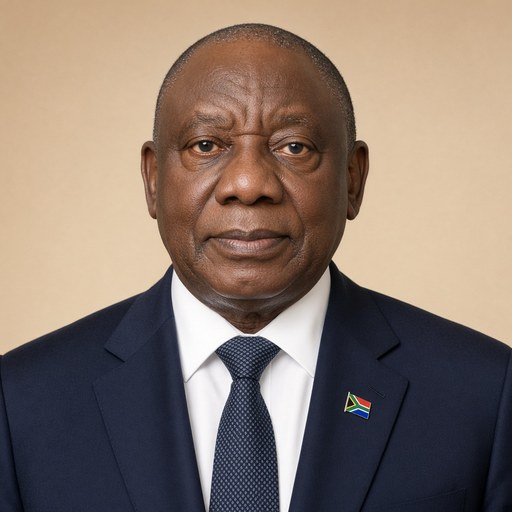
Closing statement by President Cyril Ramaphosa before the Judicial Commission of Inquiry into allegations of State Capture, Corruption and Fraud in the Public Sector including organs of State
 Cyril Ramaphosa · President of South Africa
- Context
- Ramaphosa delivered his closing testimony before the Zondo Commission of Inquiry into State Capture on 12 August 2021 in South Africa.
- Main themes
- State capture, corruption and accountability, cost to South Africa's economy and society, public trust in institutions, democratic resilience, rule of law, Zondo Commission findings, public sector integrity, consequences for wrongdoers, civil society resistance, rebuilding governance, transparency and reckoning
- Duration
- ~10 min
- Words
- 1,233
- Sentences
- 49
- Readability
- 42
- Grade
- 13.7
- Syntax
- 3.14
- Vocabulary
- 2.12
The broad sphere of national life a sentence belongs to. Every sentence has an Arena, so it is the denominator the other indices are read against.
Other49 sentences in 13 paragraphs
Chairperson, Thank you once again for the opportunity to make a brief closing statement as I conclude my testimony in my capacity as the President of the Republic.
Despite the evidence that has been presented before this Commission, and despite the excellent work by many investigators, academics and the truly outstanding journalists in our country, we may never know the true cost to our country of state capture. We may be able to establish how much of public funds has been stolen, by how much costs for public goods and services may have been inflated, and what it has cost to investigate these cases and prosecute those responsible. It may be possible to quantify the infrastructure and services that could have been provided to the people of our country with the funds that were stolen and wasted as a result of state capture. We could quantify this in terms of hospital beds, commuter trains, houses, social grants, water reticulation, maintenance of roads and any number of other public goods and services that state capture robbed our people of.
But what is more difficult to measure is the broader cost to our economy and our society. It is difficult to measure the effect of state capture on business and consumer confidence, on the loss of investment. We similarly cannot quantify the impact of state capture on our standing and image internationally. State capture led to the departure from the public service of highly qualified and experienced people, either because they refused to be part of it or because they presented a threat to those who were part of such activities. It is likely that State capture also discouraged many talented young people from joining government, which has significant implications for the public service of tomorrow.
By weakening our security forces and law enforcement agencies, the actions associated with state capture placed the security and integrity of our country at risk. Perhaps the most devastating and lasting cost of state capture and corruption is its effect on the confidence of the people of South Africa in the leaders and officials in whom they placed great trust and confidence and responsibility. State capture has damaged people’s confidence in the rule of law, in public institutions, in law enforcement agencies and, even to some extent, in the democratic process.
That is what makes the work of this Commission so important and so essential. The people of South Africa look to this Commission to uncover the truth, to identify those responsible, and to recommend measures that should be taken against those who are responsible and to prevent it from happening again. It is a vital part of a broader process of reckoning, of acknowledging mistakes and of ensuring accountability. As a young democracy, it is vital that we are willing and prepared to confront mistakes and correct them. The work of this Commission will help us to make a clear and decisive break with the corrupt practices that have cost our country so much.
It is important to acknowledge that we would not have reached this point – that this Commission would not be sitting now – had it not been for the determined actions of South Africans, many of whom marched in the streets of our country protesting against corruption and demanding clean government. It was the people of this country who, in their various formations, stood up to what they saw as acts of gross wrongdoing and abuse of power. They were not prepared to allow their hard-won democracy to be eroded or for the wealth of the nation to be squandered. And in so doing, they demonstrated that despite the damage caused by state capture, our democracy remains robust and resilient. They have shown the value of our Constitution, the institutions that support our democracy, our independent judiciary, our free media, our vibrant civil society and our active citizenry.
The experience has also shown that within our state owned entities, within our public service, within Parliament, legislatures and councils there are women and men of integrity and capability – people who resisted the pressure on them to participate in wrongdoing or to be its willing accomplices. It is the essential honesty and decency of these people – and indeed of South Africans across society – that will enable us to rebuild and recover.
I applaud the commitment and courage of the many witnesses who appeared before this Commission to give an account of what went wrong. While there have been certainly been systemic failures, governance lapses and errors, the fundamental reality is that state capture happened because certain individuals each made a deliberate decision to engage in acts of corruption and criminality. It is just, correct and necessary that they face the consequences of their actions.
Having born witness to the crimes of state capture, the worst thing we can do is to allow it to ever happen again. We have a shared responsibility to leave the era of state capture firmly behind us, and to act together to prevent corruption in all its forms.
This means, among other things, that we must reinforce the checks and balances within our democratic dispensation that are meant to prevent the abuse of power. We must strengthen the institutions established to support democracy, and effectively capacitate our law enforcement agencies. We need to safeguard the freedom, independence and diversity of our media. We must professionalise the public service and we must attract skilled people back into public service. We need to give whistle-blowers better protection, both in law and in practice. Without whistleblowers, we will not be able to tackle corruption effectively. We need to entrench the new approach to the funding of political parties. We need to protect the judiciary from interference and ensure that the courts continue to be accessible to all South Africans. Above all, we need to celebrate and encourage active citizenship, for that is our greatest defence against the abuse of power and the theft of public resources.
In my statement to the Commission and in the course of my testimony, I have sought to indicate my personal knowledge of the events under investigation, the decisions I took, and the considerations that informed those decisions. As a person who occupied a position of authority during the state capture era, I take full responsibility for the choices I made and the actions I took. I will not run away from those decisions. I have also sought to outline some of the measures this administration has taken to end state capture and to put in place corrective measures. The progress that has been made over the last two-and-a-half years should, I hope, stand as testament to my own commitment and the commitment of the administration I lead to deal decisively with corruption and state capture.
Finally, I wish to express, on my behalf and on behalf of all South Africans, sincere gratitude to the Commission, to the evidence leaders, to the staff and to you, Chairperson, for the great service you are doing for our nation. As a country, we are emerging from a difficult period. Together, we have chosen a path of rebuilding, a path of renewal, a path of transparency and accountability, a path of justice and the rule of law. I have every confidence that, no matter the challenges, we will walk this path together and we will prevail.
I thank you.