




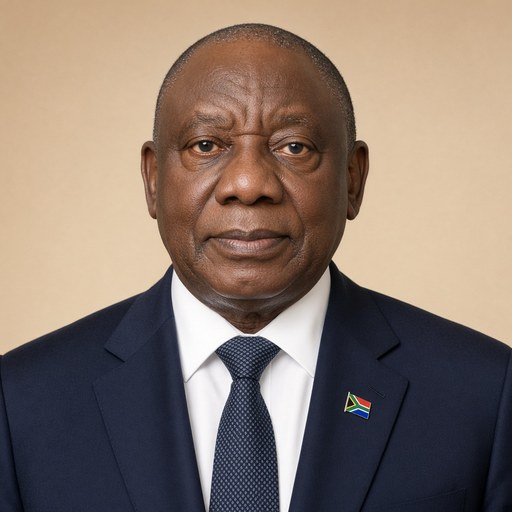
Media briefing remarks by President Cyril Ramaphosa during the Germany Official Visit, Union Buildings, Tshwane
 Cyril Ramaphosa · President of South Africa
- Context
- Ramaphosa addressed a joint media briefing at the Union Buildings in Tshwane on 24 May 2022, during an official visit by German Chancellor Olaf Scholz.
- Main themes
- South Africa-Germany bilateral relations, trade and investment, just energy transition, green hydrogen, climate action, COVID-19 pandemic response, vocational training, Ukraine conflict, African peace and security, vaccine access for Africa
- Duration
- ~4 min
- Words
- 440
- Sentences
- 21
- Readability
- 34
- Grade
- 13.8
- Syntax
- 3.14
- Vocabulary
- 2.25
The broad sphere of national life a sentence belongs to. Every sentence has an Arena, so it is the denominator the other indices are read against.
Other21 sentences in 21 paragraphs
His Excellency Olaf Scholz, Chancellor of the Federal Republic of Germany, Ambassadors, Ministers and senior officials, Members of the German and South African media,
It is an honour to receive Chancellor Scholz and his delegation this morning.
Germany is one of South Africa’s most valued strategic partners.
It is our second largest trading partner, a major investor and a big market for inbound tourism.
South Africa is currently home to around 600 German companies and bilateral trade between our two countries is growing.
We have discussed avenues to increase trade and investment of German companies in South Africa, but also of South African companies into Germany.
Germany is committed to support our efforts towards industrialisation, infrastructure development and job creation as laid out in the Economic Reconstruction and Recovery Plan.
Germany has been a partner in development since the establishment of diplomatic ties between our two countries and the inauguration of the Bi-National Commission in 1996.
This cooperation has been in a range of fields, including good governance and strengthening democracy, HIV prevention, climate actions and energy.
On the latter, we have discussed the next steps in the Just Transition Partnership concluded between South Africa, Germany, France, the United Kingdom, the United States and the European Union last year.
This historic partnership will support our just transition to a low-carbon economy and climate resilient society in a manner that leaves no-one behind.
Later today, Chancellor Scholz and his delegation will be visiting Sasol, where we will be launching a historic partnership for the development of carbon emissions reduction technologies, including green hydrogen.
Another important area of cooperation between our two countries is that of vocational training and how young people can be more effectively integrated into the world of work.
The Federal Republic of Germany has been a dependable supporter of our efforts to manage the COVID-19 pandemic.
We have expressed our gratitude to Chancellor Schulz for the assistance Germany has given not just to South Africa, but the entire African continent.
We also discussed the support Germany can lend to our efforts to ensure that vaccines produced in Africa are given greater market share in developed countries, and that vaccines destined for African populations should be procured locally.
Chancellor Scholz and I also discussed a broad range of international issues.
These included the pursuit of peace and security on the African continent.
We also discussed the conflict in Ukraine and the need for the international community to encourage dialogue and negotiation towards a peaceful resolution.
With these remarks, Your Excellency, I wish to welcome you again to South Africa, and invite you to make your remarks.
I thank you.