




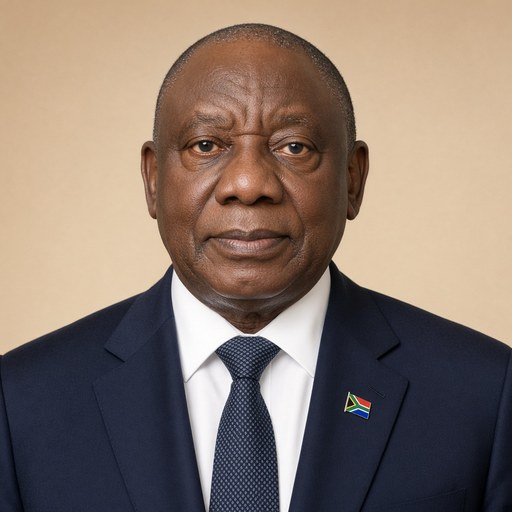
Remarks by President Cyril Ramaphosa at the handover of the Just Transition Framework
 Cyril Ramaphosa · President of South Africa
- Context
- Ramaphosa spoke at the handover ceremony of South Africa's Just Transition Framework, presented by the Presidential Climate Commission on 5 July 2022.
- Main themes
- Just transition framework, low-carbon economy, climate change, renewable energy, social justice and equity, stakeholder consultation, green jobs and skills development, energy transition partnership, social protection for displaced workers, evidence-based policymaking, economic diversification, capital mobilisation
- Duration
- ~6 min
- Words
- 776
- Sentences
- 38
- Readability
- 32
- Grade
- 13.8
- Syntax
- 2.94
- Vocabulary
- 2.27
The broad sphere of national life a sentence belongs to. Every sentence has an Arena, so it is the denominator the other indices are read against.
Other38 sentences in 10 paragraphs
Allow me to begin by congratulating the Presidential Climate Commission on its production of this important work that will guide our transition to a low-carbon, inclusive, climate resilient economy and society. In doing so, we are meeting our international obligations as part of the global climate change effort, and also securing our country’s future. The Presidential Climate Commission was created in 2020 to engage with stakeholders to develop a framework for a transition that takes into account the principles of justice and equity. We have been consistent that we are developing country that must be allowed its developmental space, and that no-one should be left behind.
As this Just Transition framework underscores, combating climate change is not only an environmental imperative, but an economic one as well. This Framework is an evidence-based document and a victory for evidence-based policymaking. It draws on a sizeable body of local and international research on the policies and practices related to the transition to a low carbon economy. It lays out the pathway towards a sustainable, cleaner and more inclusive economy that we envisage for our country.
Though robust, it is still an organising framework, and will need a detailed implementation plan and action schedule. Its strength is its broadly consultative nature. It incorporates a wide range of stakeholder views including those of government departments, business, small business, civil society, traditional leadership, epistemic communities, workers, and communities. This consultative process has ensured that broader society has made input on the document. The consensus achieved around its production means we will be able to take the transition forward in sync with all these stakeholders. This is especially insofar as it impacts sectors such as mining, automotive, tourism and agriculture.
It is encouraging that the Framework encompasses the principle of social justice and promotes equitable access to environmental resources. The Framework is also premised on the ethos of inclusion, public participation and the integrated approach to governance. It also includes and complements international best practice.
Going forward, this Framework calls for the whole of government to adopt a comprehensive plan, accompanied by a set of activities to achieve a low-carbon economy and society. I would like to highlight in broad strokes some of the expectations and challenges as we go forward.
Among the most important recommendations is that government should ensure that the Just Transition must find expression in various plans such as the Medium-Term Strategic Framework, Annual Performance Plans as well as in the budget processes of every department. It sets out the skills development, economic diversification, social support, governance and finance mechanisms required to make low carbon economy a reality. It advocates for a massive expansion of renewable energy, battery storage, new energy vehicles, green minerals and the hydrogen economy. It calls for the creation of long term decent work that mitigates losses from the decline in fossil fuel usage. Green as the common expression goes, is the new gold.
In education, one of the immediate implications is re-skilling and upskilling the workforce, so that they are able to adapt to new technologies. The challenge we face is to overhaul the education system from basic education level, so that learners are thoroughly prepared for green jobs as part of the new economy. Also important is the need to provide comprehensive social security safety for displaced workers and communities. We envisage that this support will include mechanisms that promote entrepreneurship and self-employment where possible, complemented by social protection funds. There will be need for significant capital mobilisation from both public and private sources.
Now that we have this Framework we will be able to proceed apace with harnessing the benefits of the Just Energy Transition Partnership we concluded with the governments of the US, United Kingdom, Germany, France and the EU last year. The publication of this Framework must now serve as a call to action to each of us to embrace the opportunities presented by a low-carbon, inclusive, climate resilient economy and society. As the Nobel Prize laureate Wangari Maathai exhorts us: “We owe it to ourselves and to the next generation to conserve the environment so that we can bequeath our children a sustainable world that benefits all.”
This Framework is the culmination of efforts from government, business, civil society, labour, academia and other stakeholders. It gives true meaning to social compacting, and you have delivered on your mandate. Once again, congratulations to all social partners on this effort. You have done our country proud. Let us now look to the next phase, namely a detailed action plan, and from this, implementation.
Media enquiries: Vincent Magwenya, Spokesperson to the President – 082 835 6315 Issued by: The Presidency Pretoria