




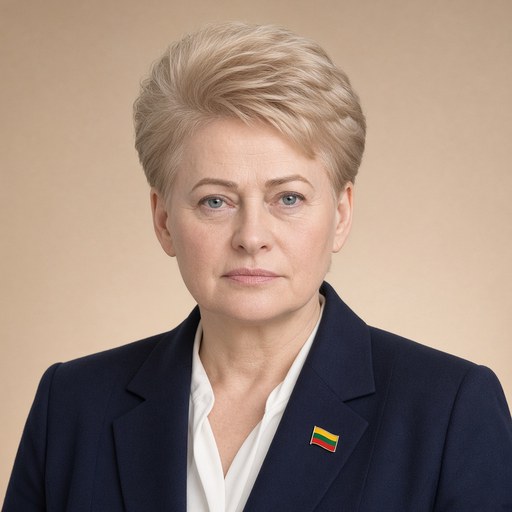
Lithuania — Statement to the General Debate of the 70th Session of the United Nations General Assembly (2015)
 Dalia Grybauskaitė · President
- Context
- Dalia Grybauskaitė delivered the statement of Lithuania in the general debate of the 70th session of the United Nations General Assembly in 2015.
- Main themes
- UN Charter principles and their violations, Russian annexation of Crimea and aggression in eastern Ukraine, consequences of ignoring territorial integrity breaches, Security Council veto abuse and credibility crisis, Syrian conflict and humanitarian failures, global refugee and displacement crisis, root causes of conflict and migration, adapting the UN to twenty-first century threats, prevention and mediation capacity
- Duration
- ~7 min
- Words
- 798
- Sentences
- 39
- Readability
- 46
- Grade
- 11.9
- Syntax
- 2.87
- Vocabulary
- 2.26
UN General Assembly Translated from Lithuanian
The broad sphere of national life a sentence belongs to. Every sentence has an Arena, so it is the denominator the other indices are read against.
Other39 sentences in 8 paragraphs
The seventieth anniversary of the United Nations offers us an opportunity to renew our commitments to the ideals and principles of the Charter of the United Nations. Today, those ideals and principles are threatened in so many ways around the globe. We are witnessing the largest displacement of people since the Second World War. As of last year, nearly 60 million people were displaced by war, conflict or persecution. Violent extremism is on the rise, with terrorist groups demonstrating new levels of brutality and barbarity. In the twenty-first century, women and girls are sold in slave markets by the criminals of Islamic State in Iraq and the Sham (ISIS) and abused in unspeakable ways. We have entered an era where the most primitive and brutal executions coexist with the most sophisticated information warfare, hybrid warfare and cyberwarfare.
The Charter of the United Nations has been breached in the middle of Europe, with no consequences. Last year, Russia annexed Crimea, and the Kremlin seeks to rewrite history and redraw the borders of post-war Europe. Even in the context of the multiple crises and security challenges the world is facing today, the annexation of Crimea and military aggression in eastern Ukraine stand out because of their implications for the future of international peace and security. These acts strike at the very core of international law and at universally accepted norms of behaviour that have allowed the world community to survive without world wars for seven decades.
We cannot pledge respect for the Charter of the United Nations and ignore its breaches at the same time. Our collective failure to stand up for the underlying principles of the independence, sovereignty, unity and territorial integrity of Ukraine will have far-reaching negative repercussions for international order. The occupied territories of Ukraine, Georgia or Moldova are full of red lines that we ourselves have drawn but never acted upon. Again, we are reminded that if one closes one's eyes to crimes, they do not disappear. They spread, grow and finally they take over. That is why it is our duty to uphold international humanitarian and human rights laws and to seek accountability when these laws are violated. Vetoing a Security Council resolution to commemorate the Srebrenica massacre or to set up a tribunal for the downing of Flight MH-17 is unjustifiable and is an insult to the memory of the victims. It also raises questions about the relevance, in the twenty-first century, of the Security Council as it is today.
For the Council to maintain its credibility, the least it can do is put an end to the use of the veto in cases of genocide, atrocity crimes, crimes against humanity and war crimes. Where would we be today had the Council been able to secure proper humanitarian access in Syria, had it taken measures to stop the use of barrel bombs and ensure accountability for gross human rights violations and abuses? The Security Council failed to do so, and millions of Syrians had to flee. By protecting the criminals, the four vetoes of resolutions pertaining to Syria did nothing to resolve the situation.
As a result, today we have the largest humanitarian crisis in the world. It is a global crisis that requires a global response. Unless we address the causes that make people flee their homes — such as lawlessness, repression and grave human rights abuses, corruption and poor governance, massive inequalities and marginalization — these flows of refugees will not stop. Conflicts will continue. Lawlessness breeds the worst of the worst — extremism, radicals and terrorists. We simply cannot afford for this to happen.
20/26 15-29437
We live in an era when challenges and threats are enhanced by new ones. At 70, the United Nations must adapt to the realities of the twenty-first century and have the tools necessary to operate. The United Nations must do much better, tackling the underlying causes of the problems and conflicts at hand, and not merely the symptoms. It must be equipped and staffed to operate in environments of asymmetric and hybrid warfare, information wars and the growing threat of terrorism. It must also do a lot better at prevention and mediation, in order to save lives, as well as resources.
In the twenty-first century the world will need a strong United Nations that has been renewed in every sphere. Either we act now and shape globalization through cooperation and partnership, or the crises and conflicts of the globalized world will force us to respond at a much greater cost to all of us. The United Nations will cease to exist if people stop believing in it. Through our activities, 70 years after the founding of the United Nations, we must show that we continue to believe firmly in this Organization, which we all share.