




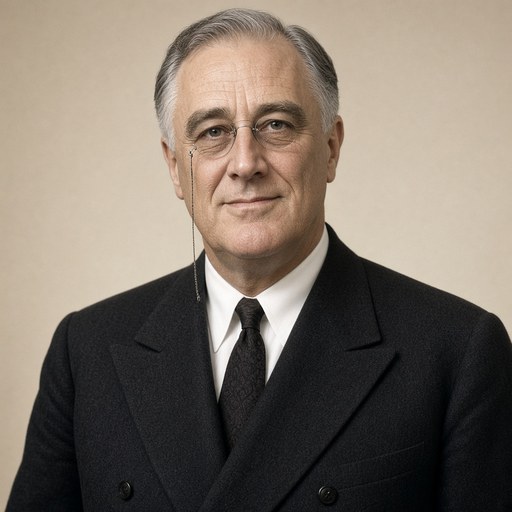
Address at a Testimonial Dinner for James A. Farley. Washington, D.C.
 Franklin D. Roosevelt · President of the United States
- Context
- Roosevelt addressed guests at a testimonial dinner for James A. Farley in Washington, D.C., on February 15, 1937, paying personal tribute to Farley's loyalty, courage, decency and faith in democratic processes.
- Main themes
- Tribute to James A. Farley, loyalty and friendship in public life, honor and decency in public service, Farley's good temper and courage, Farley's service as Postmaster General and Cabinet member, the 1936 election landslide, faith in democratic processes, non-partisan Americans gathered, history's judgment of public servants
- Duration
- ~7 min
- Words
- 837
- Sentences
- 28
- Readability
- 52
- Grade
- 13.4
- Syntax
- 3.26
- Vocabulary
- 1.96
Source: The American Presidency Project ↗
The broad sphere of national life a sentence belongs to. Every sentence has an Arena, so it is the denominator the other indices are read against.
Other28 sentences in 10 paragraphs
Mr. Vice President, Jim Farley: I am not going to say "Fellow Democrats," I am going to say "Fellow Americans," because in this gathering are represented those whom the voters in the United States and in all the states of the Union have called upon to take part in the government of all the people of the country, no matter where they may be. . . .
This dinner to Jim Farley is on the part of all of us a very personal affair. It is not one of those official banquets with a formal list of formal speakers, talking on formal subjects into the small hours of the morning. It is not a political gathering, or a party gathering, or a victory gathering, or even a gathering to hatch some mysterious plot or pull off a coup d'etat. The only label appropriate for the occasion is a very simple one which, with my permission, the cartoonists may copy: "Jim Farley and his friends."
Many of us have known him through the years. Some of you have been associated with him for only a short time—but all of us, old and young alike, have a common regard, a common affection for Jim Farley, an affection that transcends formality because it is based on the man himself.
History has already recorded, and will continue to record, a great many interesting facts about Jim. In due time history will talk out loud about his younger days of public service to his town on the Hudson River and his country and his state. It will talk about his organizing of campaigns in state and nation; it will speak of his fine service as a member of the Cabinet of the United States, as an administrator of an important Department of the Federal Government. It may even add his name to the distinguished list of major prophets. Some of us old people remember 1896; and even as the name of William Jennings Bryan sometimes suggests the arithmetic of sixteen to one, so perhaps the name of Jim Farley will suggest the more modern arithmetic of forty-six to two.
But when history is written, after all of us have passed from the scene, there will be something more important than the mere chronicle of success in public office. In the book of history there are going to be other things written. Loyalty will be written there—that loyalty to friends which results in loyalty from friends. Honor and decency will be written there—the honor and decency which have done much to raise the standards of public service in the American Nation. Good temper will be written there—the kind of good temper which is based on a sense of perspective, a sense of humor and a sense of forgiveness.
In all my years of association with Jim Farley I have never once heard him utter one mean syllable about any human being. I have never heard him suggest revenge or reprisal-except once- and that was after a particularly vicious and mean attack that was made on him personally. Jim went to this extent and said to me; "Governor"—he has always called me Governor—he said, "Governor, that fellow's mother ought to spank him."
On the Saturday before election, in speaking to the workers at headquarters, I praised Jim Farley for the way he had taken things on the chin and had come up smiling every time. That means courage; and there is not a man in the United States who has more deep-seated, thoroughgoing courage than he has.
Back of it all, ultimate history will analyze the causes of human actions and human qualities. That element of history will, I think, agree with my analysis when I say that Jim Farley is not just a Democrat with a big "D"—he is a democrat in the sense that he has faith in his fellowman. He likes to believe, and he does believe, that men and women in every part of our country are fundamentally decent and fundamentally honest, and that if they are given a chance through democratic processes, their decisions will be fundamentally sound. Because of this belief he has made in his short span of life- because he is only a child—and I know he is going to make through all the years to come, a definite contribution to the success of the democratic processes of American institutions.
Jim would not like it if I were to say, "We love him for the enemies he has made," because Jim does not think in terms of human enmity; but I can tell him that we love him for the friends he has made- men and women and children, regardless of party—men, women and children in every community of every one of our forty-eight states, including Maine and Vermont.
So I know that you will join with me in wishing health and happiness through all the years to come to my friend and your friend, a faithful servant of the people of our Republic, Jim Farley.