




Address at the Cornerstone Laying of the Federal Building at the New York World's Fair.
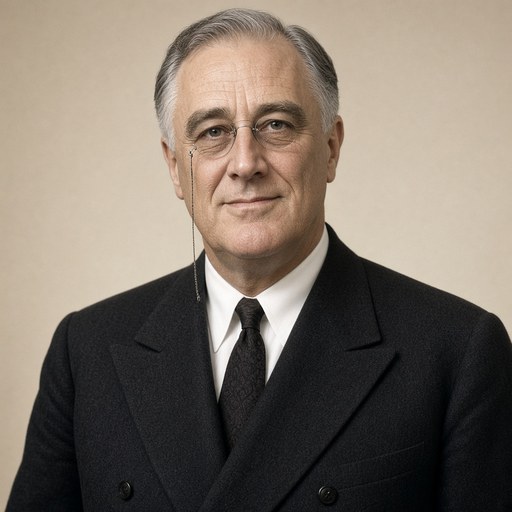
 Franklin D. Roosevelt · President of the United States
- Context
- Roosevelt addressed Governor Lehman, Mayor LaGuardia, fair officials and representatives of other nations at the cornerstone laying of the Federal Building at the New York World's Fair on June 30, 1938, announcing the US Fleet would attend the 1939 opening.
- Main themes
- Cornerstone of the United States Government building, New York World's Fair of 1939, participation of sixty-two nations, reciprocity in international travel, policy of the Good Neighbor, peace in the Western Hemisphere, trade and cultural exchange, San Francisco Fair, US Fleet at the 1939 opening, world's fair as symbol of world peace
- Duration
- ~6 min
- Words
- 766
- Sentences
- 33
- Readability
- 53
- Grade
- 11.6
- Syntax
- 3.16
- Vocabulary
- 2.12
Source: The American Presidency Project ↗
The broad sphere of national life a sentence belongs to. Every sentence has an Arena, so it is the denominator the other indices are read against.
Other33 sentences in 8 paragraphs
Governor Lehman, Mayor LaGuardia, Commissioner Flynn, Commissioner Whalen, Distinguished Guests: The Master Mason certifies that the cornerstone is well and truly laid and, in turn, I have assured him that I hold a union card. I am glad that Mr. Whalen has spoken of his visits to Washington. He has never left Washington empty-handed. He is the most persuasive salesman in all the world.
On this occasion we formally commence the construction of the building of the Government of the United States at the New York World's Fair of 1939. I gladly express the appreciation of that Government to the representatives of sixty-two other nations who have graciously decided to take part in the Fair. Already the plans for their participation are drawn, and to them I want to stress my hope that many of their countrymen will come to the Fair next year. To those countrymen a hearty welcome will be given. I emphasize this on the ground of reciprocity, because for many years the visiting balance has been somewhat uneven. Far more Americans have been traveling to the shores of other continents, especially Europe, than visitors from the other nations to our shores. I encourage all of my compatriots to learn all that they can at first hand about other nations and to make friends there, but I wish that more of the citizens of other nations would visit us and make friends here.
All of us realize, of course, that the affairs of many parts of the world are, to put it politely, somewhat distraught at this time. Such a condition necessarily accompanies wars and rumors of Wars. We in this Hemisphere are happily removed, in large measure, both from fear and from the controversies which breed it. In a larger sense, however, we cannot remain unconcerned, especially because it is our fortune to enjoy friendship and good relations with all nations.
You who represent the other nations here today have heard of what is known as the policy of the Good Neighbor. To that policy we have steadily adhered, and it may well be said that it is the definite policy of all the American Republics. It is a policy which can never be merely unilateral. In stressing it the American Republics appreciate, I am confident, that it is a bilateral, a multilateral policy, and that the fair dealing which it implies must be reciprocated. It is a policy which was not in its inception, or subsequently, limited to one hemisphere. It has proven so successful in the Western Hemisphere that the American Republics believe that it could succeed in all the rest of the world if the spirit which lies behind it were better understood and more actively striven for in the other parts of the world.
Furthermore, the policy of the Good Neighbor is, as we know, not limited to those problems of international relations which may result in war. We are against war and have agreed among ourselves quietly to discuss difficulties in such a way that the possibility of war has become remote. But the policy involves also matters of trade and matters affecting the interchange of culture between nations. In these modern days when so many new economic and social problems call for the revision of many old economic and social tenets, closer personal contacts are an essential to the well-being of nations of the world.
That is why the New York World's Fair and the San Francisco Fair are well-timed for 1939. They will encourage that interchange of thought, of culture, and of trade which is so vital today. They will give to the opposite ends of our country an opportunity to see the exhibits and the visitors from all the rest of the world—and they will give to those visitors a splendid chance to see something of the length and breadth of the United States.
All of us who are here today are looking forward to April, 1939, when this great Exposition will be formally opened. Although the plans were made some time ago, I do not think that it has yet been announced that the United States Fleet this coming winter will come to the Atlantic Ocean and will be present at the opening of the World's Fair. Yes, we are looking forward to that day, a day of meeting and of greeting.
It has been well said that you cannot hate a man you know. Therefore, this Exposition will stand as a symbol of world peace for, without doubt, it is a useful advance on the patient road to peace that America treads.