




Address at the Groundbreaking for the Thomas Jefferson Memorial, Washington, D.C.
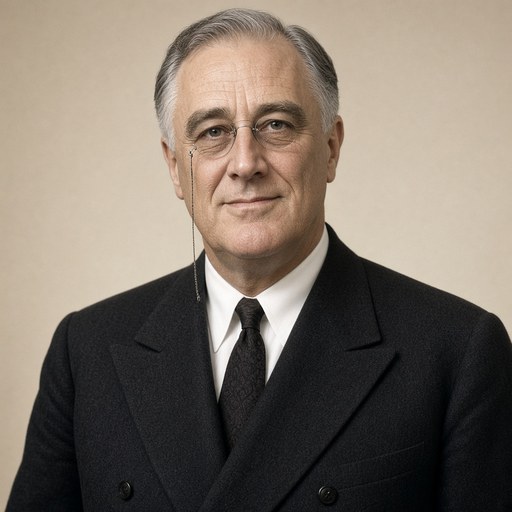
 Franklin D. Roosevelt · President of the United States
- Context
- Roosevelt addressed the Thomas Jefferson Memorial Commission at the groundbreaking ceremony for the Jefferson Memorial in Washington, D.C., on December 15, 1938, noting Congress's choice of the site and first appropriations.
- Main themes
- Groundbreaking of the Thomas Jefferson Memorial, Thomas Jefferson's legacy, Declaration of Independence, Virginia statute for religious freedom, democracy versus autocracy, Washington Monument, Lincoln Memorial, cross-axis plan for the National Capital, Thomas Jefferson Memorial Commission, Congressional appropriations and public demand
- Duration
- ~4 min
- Words
- 453
- Sentences
- 11
- Readability
- 21
- Grade
- 20.5
- Syntax
- 3.67
- Vocabulary
- 2.11
Source: The American Presidency Project ↗
The broad sphere of national life a sentence belongs to. Every sentence has an Arena, so it is the denominator the other indices are read against.
Other11 sentences in 5 paragraphs
Mr. Gibboney, Members of the Thomas Jefferson Memorial Commission: Nearly a hundred years ago, the Congress of the United States, in response to a general public demand, undertook to provide a memorial in the Nation's Capital to the first President of the United States, George Washington.
There followed many years of controversy both as to the type of memorial and as to its location. The Washington Monument emerged as the result of Congressional action.
Half a century ago, again in response to public demand, the Congress began the consideration of a monument to the memory of Abraham Lincoln, the preserver of the Union. Years went by and a distinguished committee, following the broad objectives of the original plan for the development of the National Capital, recommended the creation of two broad axes in the general form of a cross—one axis from the Capitol through the Mall past the Washington Monument to the river bank, and the other axis from the White House past the Washington Monument to another point near the river. In line with this well considered plan, the Congress erected the Lincoln Memorial at the end of the longer axis and it was then the clear intention both of the Congress and of the many planning committees and commissions who studied the subject to complete the other axis from the White House to the river by the erection of a public monument at the fourth corner of the cross.
For far more than fifty years, Thomas Jefferson, the third President of the United States, has been recognized by our citizens not only for the outstanding part which he took in the drafting of the Declaration of Independence itself, not only for his authorship of the Virginia statute for religious freedom, but also for the services he rendered in establishing the practical operation of the American Government as a democracy and not as an autocracy. For very many years, it has seemed appropriate that with Washington and Lincoln, his services should be held in memory by the erection of a monument of equal dignity.
We are breaking ground, today, for such a memorial. The Congress of the United States, through a distinguished Commission, has, after long consideration, chosen this site and made the first appropriations for the creation of the Thomas Jefferson Memorial. In the days to come, the millions of American citizens who each year visit the National Capital will have a sense of gratitude that at last an adequate permanent National Memorial to Thomas Jefferson has been placed at this beautiful spot because as the Joint Resolution of the Congress says: "The American people feel a deep debt of gratitude to Thomas Jefferson" and "honor the services rendered by him."