




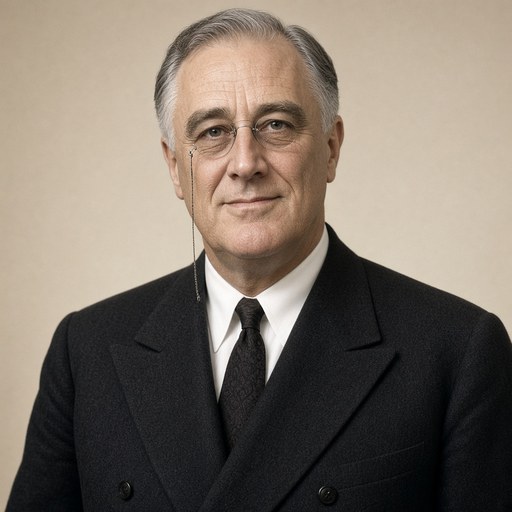
Address at the United States Naval Academy Graduation
 Franklin D. Roosevelt · President of the United States
- Context
- Roosevelt addressed graduating officers of the United States Naval Academy on June 1, 1933, urging them to avoid clannishness and to remember they serve all the American people.
- Main themes
- Avoiding a clannish exclusivity among graduates, service to the American people, discipline and loyalty of Naval Academy graduates, understanding the average citizen, esprit de corps and its limits, naval officers' commissions, graduates entering civil life, the tradition of honor and efficiency, one hundred and twenty million citizens in forty-eight States, voluntary study after graduation
- Duration
- ~6 min
- Words
- 772
- Sentences
- 28
- Readability
- 52
- Grade
- 12.8
- Syntax
- 3.13
- Vocabulary
- 2.01
Source: The American Presidency Project ↗
The broad sphere of national life a sentence belongs to. Every sentence has an Arena, so it is the denominator the other indices are read against.
Other28 sentences in 8 paragraphs
I am not going to talk to you of the many heroic examples that have been set by those who in past years have received their commissions on occasions such as this. I am not going to give you a lecture on the uniqueness of your position as the first line of the Nation's defense against aggression. I am not going to dilate on the duties and responsibilities that fall upon you in war and in peace. These things you have learned from your own studies and from your instructors who have participated in them. You should, and I assume you do, know more about them than I can know and are fully appreciative of their importance and the grave consequences with which the manner of your performance of these duties is involved. Knowledge of these things I must assume you have learned in the course of your term at the Academy. Otherwise you would not be here awaiting the diplomas which certify your fitness to be naval officers of the United States.
You have an advantage over many other young men, not alone in having survived the tests requisite to your receiving your diplomas, but especially in that you have learned discipline, responsibility, industry and loyalty—the very elements upon which, in every walk of life, every worth-while success is founded. Others on the threshold of active life must demonstrate their reliability; yours, because you have graduated from the United States Naval Academy, is taken for granted.
There are, however, other lessons which cannot be taught in the class rooms of the service colleges or of civilian colleges-lessons which can come only through voluntary study and voluntary practice on your part after you have graduated. These are lessons that have to do with your relationship to your fellow man in your contacts with your associates in your chosen profession of Government service or of private endeavor.
A columnist complained the other day that I had overestimated the importance of understanding of, and sympathy with, the point of view and the general well-being of what might be called the average citizen, and he intimated that a man could be highly successful in any profession without studying that point of view. Nevertheless, when you make a close examination of any profession, you will find very few successful men, or for that matter women, who do not take into consideration the effect of their individual efforts on humanity as a whole. Esprit de corps, pride of profession, is as delightful and imperative an element in the making of a good officer as it is in the making of a good professional or business man, but when it is carried to the point of assuming that only the holder of an Annapolis commission or diploma, or the possessor of a college degree, is a valid member of the aristocracy of life, it becomes a hindrance instead of a help to your service, to the Government and to your fellow citizens.
So I ask you to avoid an exclusive relationship to your own clan—to your clan of the Navy or to some other special Government service or to the clan of your profession in civil life. Remember to cultivate the friendship of people, not alone your own class or profession, but the average run of folks, the same folks you would have known and liked and affiliated with had you not been chosen to enter and to graduate from a highly specialized institution of higher education. This I ask of you, not only for your own sakes, but for your country's sake.
You who become today officers of the United States Navy are not set apart as a clique with different interests and different ideas from those of the rest of the country. Those of you who are to enter civil life are, in the same way, in no sense a clique. You have, and should rightly have, pride in graduation from our splendid, historical Naval Academy. You inherit the tradition of honor and of efficiency. You inherit as well the tradition of service to the people of the United States.
You will, I am confident, think of those people not as an abstract, theoretical mass, but as one hundred and twenty millions of men and women and children in forty-eight States—on sea coast, on plain and among the mountains; in city, in village and on farm; rich people, people of moderate means, poor people; people employed and people out of jobs. You represent them all. They have given you a glorious opportunity.
Make good. Keep the faith. Good luck to you in the days to come!