




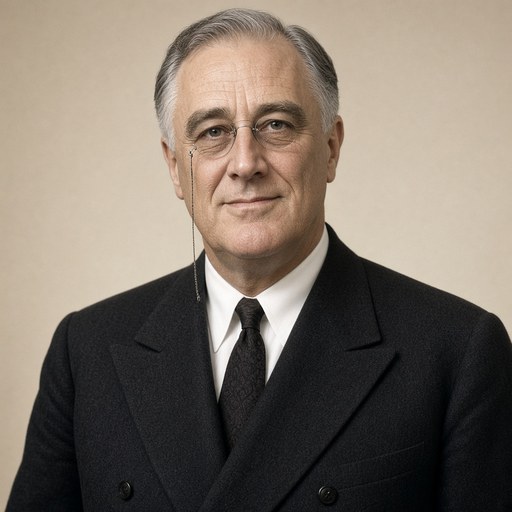
Address on Accepting the Four Freedoms Award from the Italian-American Labor Council
 Franklin D. Roosevelt · President of the United States
- Context
- Roosevelt accepted the Four Freedoms Award from the Italian-American Labor Council on October 12, 1944, pledging American help to the Italian people and promising them self-government once military objectives were achieved.
- Main themes
- Four Freedoms Award, liberation of Italy from Fascism, Mussolini's rule, Italian resistance within the Allied armies, American soldiers of Italian descent as liberators, Italian self-determination after the war, removal of enemy alien status from Italians, relief for Italian civilians, coordination with Britain on civilian administration, remittances and mail to Italy, restoration of trade and religious freedom
- Duration
- ~4 min
- Words
- 439
- Sentences
- 24
- Readability
- 42
- Grade
- 11.9
- Syntax
- 2.82
- Vocabulary
- 2.14
Source: The American Presidency Project ↗
The broad sphere of national life a sentence belongs to. Every sentence has an Arena, so it is the denominator the other indices are read against.
Other24 sentences in 6 paragraphs
For over twenty years we in America have watched with anxious eyes the steps taken by the Fascist gangsters to enslave the Italian people. The Italian people were thrown into an alliance which they detested. They were ordered, against their will, to fight on the side of their traditional enemies against their traditional friends. Mussolini, the would-be Caesar, underestimated the will of his people. Large numbers of them were brave enough to rally to our ranks. And as part of the Allied armies, and behind the German lines, they have carried on our common fight for liberty.
The American Army—including thousands of Americans of Italian descent- entered Italy not as conquerors, but as liberators. Their objective is military, not political. When that military objective is accomplished—and much of it has not yet been accomplished—the Italian people will be free to work out their own destiny, under a government of their own choosing. The act of the Attorney General—removing the status of enemy alien from Italians- has been justified by their corresponding effort to help us wage war.
Of course, the people of Italy have suffered terribly and it will not be humanly possible this winter to take wholly adequate measures to relieve all suffering until Germany has been finally and decisively defeated. But the United Nations are determined that every possible measure be taken to aid the Italian people directly, and to give them an opportunity to help themselves. The civilian administration has been fully discussed by me with the British Prime Minister. The British Government is agreed that as the problem is great- so also is our responsibility to help.
For example, the mails have been opened for letters to the liberated provinces. Facilities are now available for small remittances of funds from this country to individuals in Italy for their individual support. Shipments of food and clothing have been delivered, and much more is on the way. Normal life is being gradually introduced. We are taking every step possible to permit the early sending of individual packages by Americans to their loved ones and relatives in Italy. Our objective is to restore all avenues of trade and commerce and industry, and the free exercise of religion, at the earliest possible moment.
I am deeply grateful, therefore, for this award. It represents your appreciation both of the problems and the efforts of the American Government.
The Charter from which this award takes its name—the Four Freedoms- is a firm bond between the great peace-loving Nations of the world, among which we count Italy. To the people of Italy we have pledged our help—and we will keep the faith!