




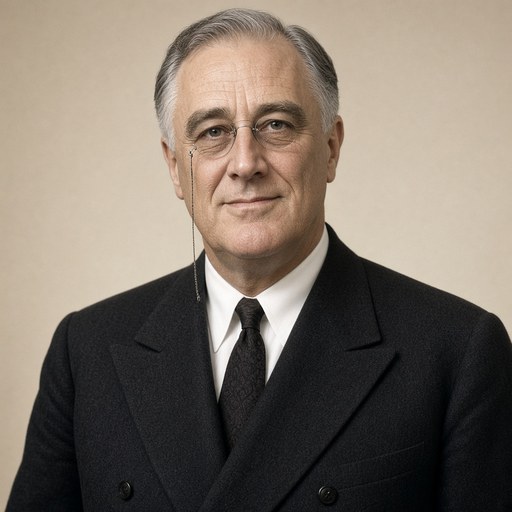

- Context
- Roosevelt spoke from the rear platform of his train at Creston, Iowa, on October 10, 1936, during his tour of drought-hit areas, defending New Deal spending as having raised national income and purchasing power.
- Main themes
- Drought conditions in Iowa, Henry Wallace as Secretary of Agriculture, national economy, railroad recovery and jobs, rising purchasing power, federal deficit and national debt, increase in national income, federal railroad loans, future drought prevention, federal cooperation with states, campaign figures and the federal budget
- Duration
- ~4 min
- Words
- 480
- Sentences
- 23
- Readability
- 65
- Grade
- 9.2
- Syntax
- 3.04
- Vocabulary
- 1.78
Source: The American Presidency Project ↗
The broad sphere of national life a sentence belongs to. Every sentence has an Arena, so it is the denominator the other indices are read against.
Other23 sentences in 6 paragraphs
I am glad to get into this section of the State. I understand that you good people were pretty hard hit by the drought this year. As you know, I have been going around the United States trying to get first-hand information in regard to drought conditions and a lot of other conditions.
I am glad to come here for another reason. I understand that Henry Wallace was born about fourteen miles from here. Down in Washington we have never had a Secretary of Agriculture, certainly not in our generation, who has understood farm problems as well as Henry Wallace, and who has tied them into the national economy as well as he has.
Creston is a pretty good example of what I mean when I speak about national economy. There are a lot of railroad men in this town; and there are more jobs on the railroads. The railroads of the country are picking up. We have helped them with Federal loans, which, by the way, they are paying back, but their prosperity is caused more by the fact that a greater volume of goods is moving over the tracks. That involves national economy in the best sense. It means more food products, more manufactured products, and, most important of all and behind it all, more purchasing power. Looking at you people, I should say that, in spite of the drought, you have more purchasing power than you had in 1932.
At the very beginning of my Administration the Federal Government undertook to help in raising purchasing power. Yes, we incurred a deficit in doing it, but I shall put it to you this way: Suppose I were to say to anybody in this crowd, "If you, by borrowing $800, could increase your annual income $2,200 every year, would you do it?" Well, that, in effect, is what happened in this country. We increased the national debt a net of a little less than eight billion dollars but we increased the annual national income over twenty-two billion dollars. Of course, in a campaign, all kinds of figures are presented, but most of them are presented by people who have never read the budget of the United States Government. And you can take my word for it—as one who has read .it a great many times—and it is bigger than a Sears Roebuck catalogue- that what I am telling you is strictly according to the figures.
I am glad to have been here. I wish I could get out and drive around and see conditions.
As you know, we are using every means at the disposal of the Federal Government to prevent droughts as serious in the future. We cannot regulate the weather altogether, but we are cooperating with the different States and the local governments in trying to prevent future droughts from being as disastrous as they are today.