




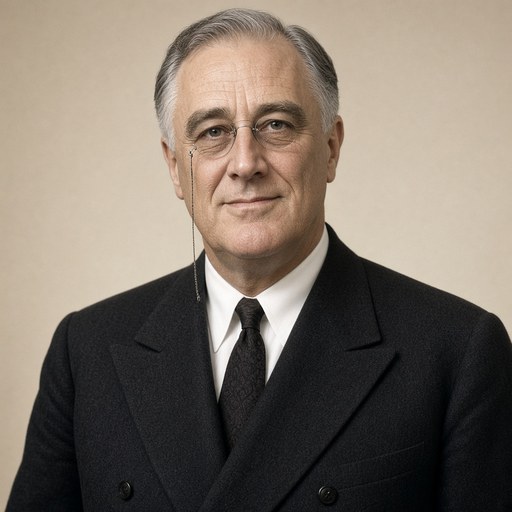
Rear-Platform Remarks at Jacksonville, Ill., during a Drought Inspection Trip.
 Franklin D. Roosevelt · President of the United States
- Context
- Roosevelt spoke from the rear platform of his train at Jacksonville, Illinois, on September 4, 1936, during a drought inspection trip, arguing that all regions' prosperity is linked and defending national planning.
- Main themes
- Interdependence of national regions, drought inspection trip, prosperity of steel workers in Gary, cotton and cattle country economies, national planning, lasting economic recovery, travel across the United States, conference with Governor Horner, cooperation with state governments, Illinois visit before November election
- Duration
- ~4 min
- Words
- 435
- Sentences
- 17
- Readability
- 63
- Grade
- 10.6
- Syntax
- 3.24
- Vocabulary
- 1.72
Source: The American Presidency Project ↗
The broad sphere of national life a sentence belongs to. Every sentence has an Arena, so it is the denominator the other indices are read against.
Other17 sentences in 5 paragraphs
MY FRIENDS, I am a little bit rusty on local history but I hope that Jacksonville was named after Andrew Jackson.
We have been having a marvelously interesting trip, a trip on which I have learned a great deal about many sections of the country that have been going through this drought. I am more and more convinced that the country is beginning to understand that if one part of the Nation suffers, every other part suffers also. When I was passing through Gary, Indiana, I said from the back of the train that the prosperity of the steel workers in Gary was very much influenced by the ability of people out on the prairies to buy automobiles and harvesters. And when I was out in the cattle country I told them that the prosperity of the cotton growers of the South had a very direct effect on the prices that they were getting for their cattle. I don't think they saw it for a minute; but then I pointed out that if the people down in the cotton country had a good crop and got good prices for their cotton they would buy more Western beef.
That is the spirit with which we are seeking our objective in our national Government—to bring all parts of the country in together so that every part will be prosperous. It is going to take planning; and I am not the least bit afraid of that. If we had started planning a generation ago, we would not have had so much trouble today. Prosperity is coming back, and when it comes back we want to be quite sure that it does not disappear again overnight.
I am glad to have had the chance to stop here. I always wish that instead of going through at thirty or forty miles an hour on the train I could go through a little more slowly by automobile and get to see more of the country and more of the people living in it. It is a great experience, going through the United States. It is one of the great privileges of being President.
Now we are going on to Springfield to have a conference with Governor Horner, my old friend, and with officials of the State Government of Illinois. I am quite certain that I am going to get the same cooperation from them that I have found in the other States I have visited. I am looking forward to an interesting afternoon and I hope to come back to this State again—what shall I say?— before the third of November.