




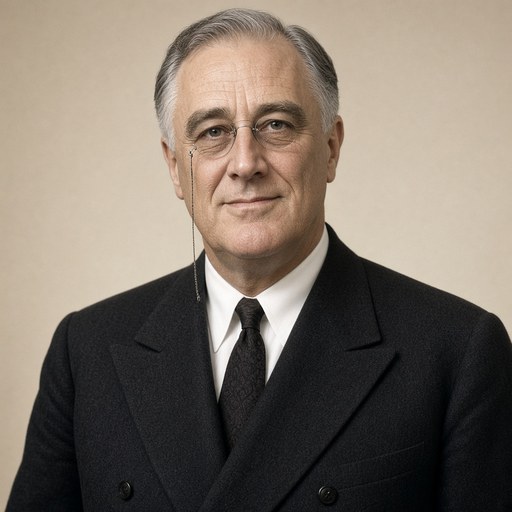
Rear-platform Remarks at Wilmington, Delaware
 Franklin D. Roosevelt · President of the United States
- Context
- Roosevelt spoke from a train's rear platform at Wilmington, Delaware, on October 23, 1940, during his re-election campaign, quoting Lincoln on liberty and urging Delaware voters to reaffirm their 1936 choice.
- Main themes
- Lincoln's definition of liberty, the sheep and the wolf parable, the Liberty League in Wilmington, opposition to the New Deal, the 1936 election result in Delaware, 1940 election appeal to Delaware voters, loss of liberty in other countries
- Duration
- ~5 min
- Words
- 540
- Sentences
- 23
- Readability
- 59
- Grade
- 10.3
- Syntax
- 3.42
- Vocabulary
- 1.96
Source: The American Presidency Project ↗
The broad sphere of national life a sentence belongs to. Every sentence has an Arena, so it is the denominator the other indices are read against.
Other23 sentences in 7 paragraphs
I have come back to Wilmington again. I very well remember the short stop I made here in 1936. You know, some of the political experts of those days were a little amused at the thought that I could carry Delaware and I think they were surprised at the splendid result.
Four years ago Wilmington was the home town of the famous Liberty League. We remember that that League was created for several purposes, but its major objective was to defeat the New Deal and drive it from office. That purpose still lives in other forms.
In view of that fact I thought four years ago, and I still think, that Wilmington is a good place to read from a speech made by President Abraham Lincoln, his definition of the word "liberty." This year I think the definition is of even greater significance.
Here is what President Lincoln said: The world has never had a good definition of the word liberty, and the American people, just now, are much in want of one. We all declare for liberty; but in using the same word we do not all mean the same thing. With some the word liberty may mean for each man to do as he pleases with himself, and the product of his labor; while with others the same word may mean for some men to do as they please with other men, and the product of other men's labor. Here are two, not only different, but incompatible things, called by the same name, liberty. And it follows that each of the things is, by the respective parties, called by two different and incompatible names—liberty and tyranny.
And then Abraham Lincoln used this example. He said: The shepherd drives the wolf from the sheep's throat, for which the sheep thanks the shepherd as his liberator, while the wolf denounces himfor the same act, as the destroyer of liberty. . . . Plainly, the sheep and the wolf are not agreed upon a definition of the word liberty; and precisely the same difference prevails today among us human creatures . . . and all professing to love liberty. Hence we behold the process by which thousands are daily passing from under the yoke of bondage hailed by some as the advance of liberty, and bewailed by others as the destruction of all liberty.
And then, finally, Lincoln. said this: Recently, as it seems, the people . . . have been doing something to define liberty, and thanks to them that, in what they have done, the wows dictionary has been repudiated. In 1936, almost four years to the day, the people of the United States took definite action to define what they intended liberty to mean in this country for the next four years. They repudiated the wows dictionary.
I am sure that this year the people, not only of Delaware but of the United States, are all taking a renewed interest in that word "liberty." There are not so many countries left where the word has any real meaning. I hope that by their votes on election day the people of the State of Delaware will reaffirm their own definition of "liberty"-the same definition they made four years ago.