




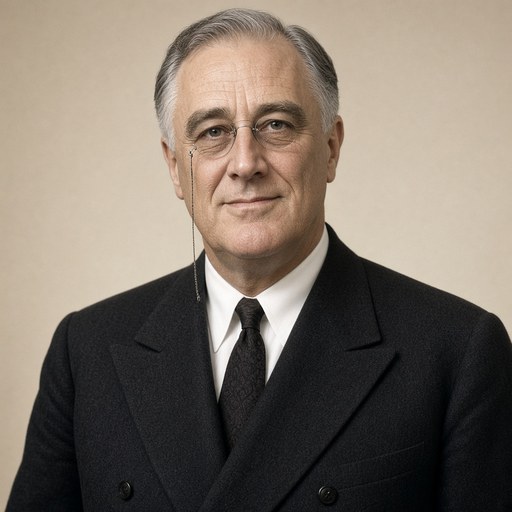

- Context
- Roosevelt spoke informally to Texans at his son Elliott's ranch near Fort Worth on July 10, 1938, on his way to Colorado, urging national agricultural planning, better land use and industry built on decent wages.
- Main themes
- Family visit to son Elliott's ranch in Texas, better land use, all-weather crop program, Roosevelt's New York agricultural work as Governor, national interdependence of farm economies, cotton and wheat and cattle relationships, universal rather than spotty prosperity, new industries for Texas, opposition to cheap industrial wages, purchasing power and public services, spirit of Texas
- Duration
- ~6 min
- Words
- 710
- Sentences
- 25
- Readability
- 55
- Grade
- 12.7
- Syntax
- 3.30
- Vocabulary
- 1.97
Source: The American Presidency Project ↗
The broad sphere of national life a sentence belongs to. Every sentence has an Arena, so it is the denominator the other indices are read against.
Other25 sentences in 7 paragraphs
My friends of Texas: I am glad to be back in Texas—and especially to have a nice quiet family day at my son Elliott's ranch. I always remember that when he first decided to build a house here on top of the hill, he was attracted by the fact that the wide view from here is a little like the view from our old home, far up the Hudson River. This is a grand part of the country and I am glad indeed to have such a close family connection with it.
Tomorrow, on my way to Colorado, I shall pass through a part of Texas I have never been to—Wichita Falls and Amarillo—and I am glad to know that this year the rainfall has greatly improved conditions in the Panhandle. That makes me remember one of the objectives of the national administration—better land use and an all-weather crop program.
Nine years ago, when I was Governor of the State of New York, I started my interest and efforts in the better use of land. People are apt to think of New York State as a vast metropolis; but outside of the city at the southern end of the State, more than six million people live on farms and in villages and small cities. Indeed, New York State ranks in the value of its agricultural products as the fifth or sixth state in the Union. A survey showed us that much of the farming land was being used in an uneconomical way, that thousands of acres were being badly eroded, that reforestation was a great need, that we had to plan for the help of stranded communities, for improving rural schools, bringing in electricity and good roads, and stopping the waste and the poverty that so often attended the older methods of doing business.
When I was working on these problems in Albany, I was struck by the fact that agriculture cannot be thought of or worked for just on state lines. Every crop on every farm in every county and every state has a definite tie-in—a relationship with similar crops in other states. That is why, since I have been in Washington, I have been working on the agricultural and cattle program from a national angle. For example, not only does cotton in Texas have a definite relationship to cotton in Georgia, but cotton in the South and Southwest is clearly connected with the economics of the wheat grower in the Dakotas, the cattleman of Wyoming and the potato grower of Maine. When one has a poor year, his lack of prosperity hits all of the others. When one is prosperous, all the others are helped.
In one sense, Texas is a great empire in itself—you can produce almost everything needed by man. But what gratifies me most of all is that the people of the Lone Star State are cooperating so well with all the other states of the Union in working out our mutual national problems. In this way we will get away from spotty prosperity, and work toward universal prosperity.
You need more industries in Texas, but I know you realize the importance of not trying to get industries by the route of cheap wages for industrial workers. Cheap wages mean low buying power. Low buying power means low standards of living; and that means low taxable values, and, therefore, difficulty in maintaining good schools, highways, sanitation and other public improvements. I know from all that I have seen that new industries can and will be developed in this state because of your access to raw materials, because of the efficiency of your labor, because of the growing purchasing power, and because of the spirit of the people.
Yes, I am proud of the spirit of Texas, the spirit of all of its people. I have fished your coasts, I have seen your fields, your oil wells, your cattle, your waterways, your schools and colleges. And now, as I sit here in a garden on top of a hill, with a breeze blowing and a sunset coming, surrounded by a very delightful gathering of Texans, all I can think of is that I want to come back again many, many times in the days to come.