




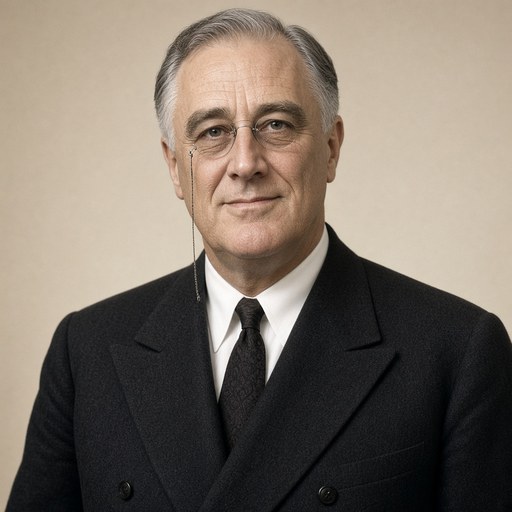
Remarks at the Dedication of the Franklin D. Roosevelt Library at Hyde Park, New York.
 Franklin D. Roosevelt · President of the United States
- Context
- Roosevelt dedicated the Franklin D. Roosevelt Library at Hyde Park, New York, on June 30, 1941, accepting it for the nation and announcing the Board of Trustees that would take over at midnight.
- Main themes
- Dedication of the Franklin D. Roosevelt Library, library as an act of faith, faith in the past and future, democracy under attack, dispersal of historical collections, public access to records, Board of Trustees under Act of Congress, transfer of the Library to the federal government, local friends and neighbors as trustees, swearing in of trustees by Judge Conger
- Duration
- ~7 min
- Words
- 818
- Sentences
- 30
- Readability
- 60
- Grade
- 10.9
- Syntax
- 3.15
- Vocabulary
- 1.83
Source: The American Presidency Project ↗
The broad sphere of national life a sentence belongs to. Every sentence has an Arena, so it is the denominator the other indices are read against.
Other30 sentences in 8 paragraphs
It seems to me that the dedication of a library is in itself an act of faith. To bring together the records of the past and to house them in buildings where they will be preserved for the use of men and women in the future, a Nation must believe in three things. It must believe in the past. It must believe in the future. It must, above all, believe in the capacity of its own people so to learn from the past that they can gain in judgment in creating their own future.
Among democracies, I think through all the recorded history of the world, the building of permanent institutions like libraries and museums for the use of all the people flourishes. And that is especially true in our own land, because we believe that people ought to work out for themselves, and through their own study, the determination of their best interest rather than accept such so-called information as may be handed out to them by certain types of self-constituted leaders who decide what is best for them. And so it is in keeping with the well-considered trend of these difficult days that we are distributing our own historical collections more widely than ever before throughout our land. From the point of view of the safety—the physical safety- of our records, it is wiser that they be not too greatly concentrated. From the point of view of accessibility modern methods make dissemination practicable.
This particular Library is but one of many new libraries. And so, because it happens to be a national one, I as President have the privilege of accepting this newest house in which people's records are preserved—public papers and collections that refer to our own period of history. And this latest addition to the archives of America is dedicated at a moment when government of the people by themselves is being attacked everywhere. It is, therefore, proof—if any proof is needed—that our confidence in the future of democracy has not diminished in this Nation and will not diminish.
As all of you know, into this Library has gone, and will continue to go, the interest and loving care of a great many people. Most of you who are here today are old friends and neighbors of mine- friends and neighbors throughout the years. And so all of you, my friends and neighbors, are in a sense Trustees of this Library through the years to come. We hope that millions of our citizens from every part of the land will be glad that what we do today makes available to future Americans the story of what we have lived and are living today, and what we will continue to live during the rest of our lives. And so I am grateful to all of you for all that you have done.
I think that the ceremonies are now over, except for one very important addition that relates to the future. Under an Act of the Congress of the United States, there was authorized to be appointed a Board of Trustees, who will be responsible for this Library from midnight tonight, through the years to come. I am glad that you have come today, because as I suggested at lunch to some of the Trustees, this is the last chance you have got to see this Library free of charge. At midnight tonight the Government of the United States takes over, and they take over through this Board of Trustees, of which Dr. Connor, the National Archivist of the United States, is to be the Chairman, and on which will serve ex officio our own neighbor from this County, the Secretary of the Treasury of the United States-Henry Morgenthau, Jr. And incidentally, I have appointed a number of very old friends of mine to serve as additional Trustees: My old law partner, Basil O'Connor from New York; and Frank Walker, who in addition to being a very old friend is also the man who carries your mail; and Dr. [Samuel Eliot] Morison, an old seafaring friend of mine.
And now let us see, who else is there? Oh, I asked Harry Hopkins but he couldn't get here today. He was terribly sorry, but he said, quite frankly, that Long Island was cooler than Hyde Park. Another old friend, whom you have seen here many times with me—Harry Hopkins.
And so I am asking the first Federal Judge to be appointed from Dutchess County for I don't know how many generations, our old friend Eddie Conger of Poughkeepsie, to step forward when I give out these- I won't call them diplomas, but they look like diplomas- to these new Trustees. I am going to ask Federal District Judge Conger to administer the Oath of Office.
Now I hope you will all feel very welcome to come in and see the building and what is in it.