




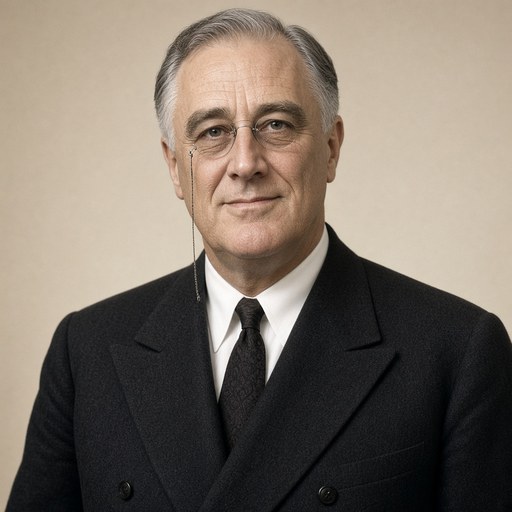
Remarks to Members of Kiwanis. The White House, Washington, D.C.
 Franklin D. Roosevelt · President of the United States
- Context
- Roosevelt addressed members of Kiwanis at the White House in Washington, D.C. on June 24, 1936, praising their work for crippled children and urging the good neighbor principle be extended within American communities.
- Main themes
- Kiwanis International and its work, care for crippled children, civilian organizations sharing responsibility with government, citizen action in local communities, public education and understanding of problems, talking problems over around a table, national unity across localities, force of example, good neighbor policy in the Americas, extending the good neighbor idea within US borders
- Duration
- ~4 min
- Words
- 481
- Sentences
- 23
- Readability
- 64
- Grade
- 9.5
- Syntax
- 2.89
- Vocabulary
- 1.83
Source: The American Presidency Project ↗
The broad sphere of national life a sentence belongs to. Every sentence has an Arena, so it is the denominator the other indices are read against.
Other23 sentences in 6 paragraphs
As A fellow member, I am very happy to greet you here. I think you know of my fairly long association with the Kiwanis; and I think you know also of my very special interest in one of the many fine things the Kiwanis is doing, and that relates to looking after crippled children. I know of the practical results of this work in a great many communities.
I think we all recognize that there are a good many fields, a good many problems in our modern life, where it is in every way best for the country that the primary and preliminary responsibilities should rest upon civilian organizations and not wholly on the Government. That is as it should be. It applies, that principle, to a great many things that we have to cope with in these days.
As we all know, there have been an advance in science, and an advance in public understanding of a great many things that, in the old days, were taken for granted. A couple of generations ago there were a great many evils about which nobody bothered their heads. In this work the more that can be done by the citizens of each community, the better it is.
That is why I am very proud of what Kiwanis International has accomplished in these years. It is through organizations like Kiwanis that we are able to spread through the communities—not merely through our own membership, but to all of our friends and neighbors—what might be called a better education among the masses of the people, a better understanding of the problem. It is the old idea of sitting around a table and talking it over. One of my jobs in Washington is to sit around a table and talk it over. I do it every day that I am here. They are talks that touch practically every phase of our national life.
One of the other things that we seem to have accomplished in these more recent years is the spread of understanding that the country is one big country and that the handling of problems in one locality affects the handling of problems in all other localities and communities. In other words, the force of example is of tremendous importance and effect in a great continent such as ours. You probably have heard the term, "good neighbor." We seem to have established the principle fairly well in our relations with all of the Governments of North, Central and South America. What I hope is that we will extend the doctrine of the good neighbor to all of the communities within our own borders.
In that work Kiwanis has accomplished much. I wish I could have attended the various meetings of this convention. Some day, when I get through with my job here, I hope you will let me come just as a delegate.