




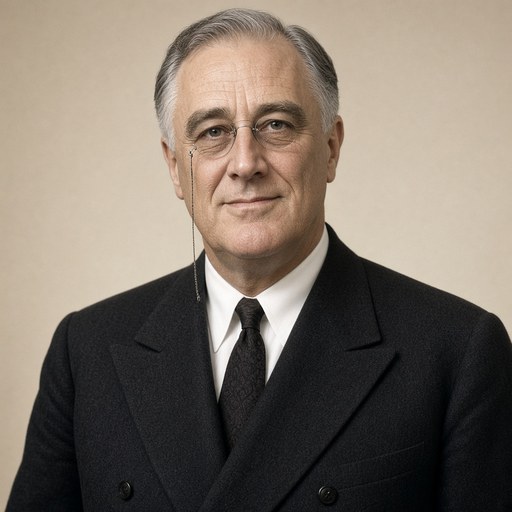
Remarks to Visiting Protestant Ministers. Washington, D.C.
 Franklin D. Roosevelt · President of the United States
- Context
- Roosevelt received more than two hundred Protestant ministers of the Washington Ministerial Union at the White House on January 31, 1938, and replied extemporaneously, linking spiritual reawakening, church missions and his social justice programme.
- Main themes
- Spiritual reawakening in America, Protestant ministers' pledge of service, 1934 address to the Federal Council of Churches, American church missions abroad, health and education through missions, human security and social justice as Christianity, progress made at home since 1934, duty to the rest of the world, strength of the churches, concern for the average man, woman and child
- Duration
- ~7 min
- Words
- 858
- Sentences
- 40
- Readability
- 61
- Grade
- 10.0
- Syntax
- 2.96
- Vocabulary
- 1.76
Source: The American Presidency Project ↗
The broad sphere of national life a sentence belongs to. Every sentence has an Arena, so it is the denominator the other indices are read against.
Other40 sentences in 9 paragraphs
(Dr. Oscar F. Blackwelder of the Lutheran Church of the Reformation, President of the Washington Ministerial Union, made the following statement [excerpts only are printed] today when he, in company with more than two hundred Protestant ministers, was received by the President in his offices at the White House.)
Mr. President: By vote of the Ministerial Union of Washington, I pray the privilege of presenting this message for our body to you. In accepting your hospitality we are confident that we come into the presence not only of our Chief Executive but of our friend and brother in the Christian Faith. . . . Mr. President, conscious of the historical contribution of Christianity to human betterment, both personal and social, we are anxious as a group of ministers to do our part today and we believe we speak in the spirit of the clergy of America.
In your address before the Federal Council of Churches in Constitution Hall in 1934, you declared, "No greater thing could come to our land today than a revival of the spirit of religion—a revival that would seep through the homes of the nation and set the hearts of men and women of all faiths to a reassertion of their belief in God and their dedication to His will for themselves and for their world. I doubt if there is any problem—social, political or economic—that would not melt away before the fire of such a spiritual awakening." That word of yours we have used nationwide. It has brought courage to the church life of America.
We pastors of the Protestant Churches of Washington, although holding many different political opinions, wish to pay our respects to you as our fellow Church man as well as Chief Executive. We desire to pledge through you our thought, our prayer, our useful service to our country in these difficult days and to request you to make any suggestion of ways and means by which we and our brethren in the ministry can be of the highest value to our day and generation.
(The President replied, speaking extemporaneously.)
I am grateful to you for this wonderful expression of faith-of faith and works. I am glad that you referred to what I said in 1934 about the need of spiritual reawakening in the country. I do not know how you gentlemen feel, but I cannot help feeling myself, from the testimony that comes to me day by day, that there has been definite and distinct progress towards a spiritual reawakening in the four years which have passed since I spoke in 1934. I receive evidences of this from all our Protestant Churches; I get it from Catholic priests and from Jewish rabbis, as well. It is a very significant thing that this awakening has come about in America. It makes me realize more fully that we do have, in addition to the duty we owe to our own people, an additional duty to the rest of the world. Things have been going on in other countries—things which are not spiritual in any sense of the word—and that is putting it mildly.
I must make a confession: I did not realize until the last few years how much influence America has in the world. I did not really, deep down in my heart, believe very much in church missions in other lands. Today I do. I have seen what the American church missions have accomplished in many countries, not only on the religious side but on the side of health and of education. After all, the three of them tie in very definitely together.
We call what we have been doing "human security" and "social justice." In the last analysis all of those terms can be described by one word; and that is "Christianity." We have made great progress at home. I believe, in making that progress, we have had a great influence in other nations of the world. We have gone far in these years toward a greater human security and a greater social justice. We don't want to stop that progress. We want to keep on. We have a task, not only for four years or eight years or twenty years to come— but a task that lasts through all eternity.
As long as we continue to make the progress we are making, we can look for a safer and better America in our own lifetime. You good people have been working toward that end. You have been rendering a great service to your Government. We still have a long way to go. Whether we like it or not, we have to think about the average man, woman and child in the United States. We are doing just that; and they appreciate it. That is one reason why the Churches are stronger today than they were four years ago. If we can continue to make the same progress in the next several years as we have in the past, we can feel we have been good and faithful servants. I appreciate your coming here and all I can say is God bless you; keep up the good work.