




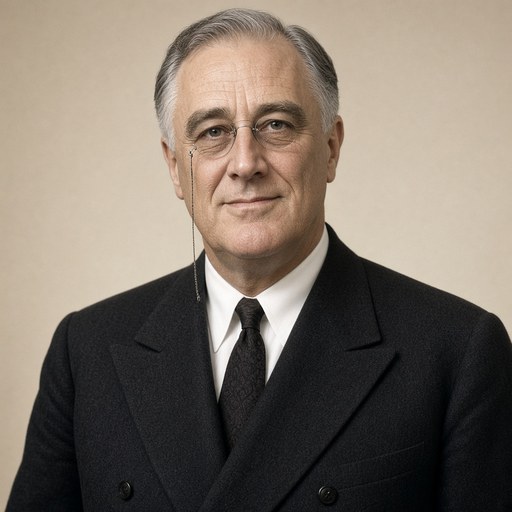
Toast to His Majesty, King George VI, at the White House, Washington, D.C.
 Franklin D. Roosevelt · President of the United States
- Context
- Roosevelt addressed King George VI and Queen Elizabeth at a White House dinner in Washington, D.C., on June 8, 1939, toasting the King and citing the joint Pacific islands arrangement as a model of peaceful dispute settlement.
- Main themes
- Anglo-American friendship, royal visit of King George VI and Queen Elizabeth, unfortified border with Canada, absence of an arms race between the two nations, dispute over Pacific islands, joint use of the islands for transpacific air routes, deferral of sovereignty question until 1989, peaceful settlement of disputes, British Commonwealth
- Duration
- ~3 min
- Words
- 371
- Sentences
- 16
- Readability
- 56
- Grade
- 11.2
- Syntax
- 3.04
- Vocabulary
- 2.13
Source: The American Presidency Project ↗
The broad sphere of national life a sentence belongs to. Every sentence has an Arena, so it is the denominator the other indices are read against.
Other16 sentences in 5 paragraphs
Your Majesties: In the life of a nation, as in that of an individual, there are occasions that stand out in high relief. Such an occasion is the present one, when the entire United States is welcoming on its soil the King and Queen of Great Britain, of our neighbor Canada, and of all the far-flung British Commonwealth of Nations. It is an occasion for festivities, but it is also fitting that we give thanks for the bonds of friendship that link our two peoples.
I am persuaded that the greatest single contribution our two countries have been enabled to make to civilization, and to the welfare of peoples throughout the world, is the example we have jointly set by our manner of conducting relations between our two nations. It is because each nation is lacking in fear of the other that we have unfortified borders between us. It is because neither of us fears aggression on the part of the other that we have entered no race of armaments, the one against the other.
The King and I are aware of a recent episode. Two small uninhabited Islands in the center of the Pacific became of sudden interest to the British Empire and to the United States as stepping stones for commercial airplanes between America and Australasia. Both nations claimed sovereignty. Both nations had good cases. To have entered into a long drawn out argument could have meant ill-will between us and delay in the use of the Islands by either nation. It was suggested that the problem be solved by the joint use of both Islands by both nations, and, by a gentleman's agreement, to defer the question of ultimate sovereignty until the year 1989. The passage of fifty years will solve many problems.
If this illustration of the use of methods of peace, divorced from aggression, could only be universally followed, relations between all countries would rest upon a sure foundation, and men and women everywhere could once more look upon a happy, prosperous and a peaceful world. May this kind of understanding between our countries grow ever closer, and may our friendship prosper.
Ladies and gentlemen, we drink to the health of His Majesty, King George VI.