




- Context
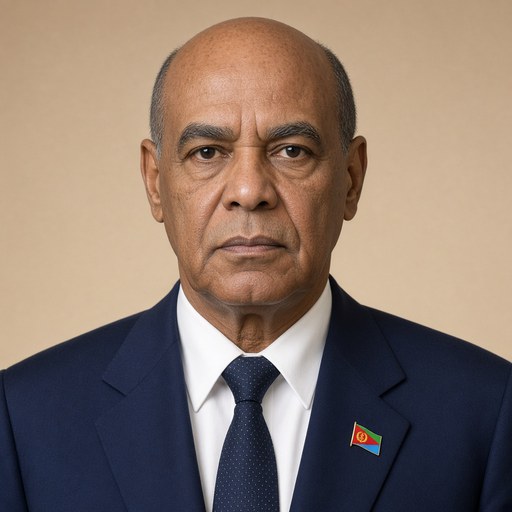
- Afwerki gave a wide-ranging interview to local Eritrean media in January 2012, discussing Africa's political situation and external interference in continental affairs.
- Main themes
- African sovereignty and independence, external interference in African affairs, corruption of African leaders, resource exploitation, American national security strategy in Africa, Pan-Africanism and African unity, proxy governance through regional representatives, Cold War legacy in Africa, Eritrean independent foreign policy, African Union failures, neocolonialism
- Duration
- ~16 min
- Words
- 1,873
- Sentences
- 106
- Readability
- 55
- Grade
- 10.0
- Syntax
- 2.84
- Vocabulary
- 2.16
This is an interview, press conference or exchange with other speakers. It is split into sentences and counted in the corpus, but its sentences are not tagged on the twelve indices.
106 sentences in 5 paragraphs
Your Excellency, are there any other African countries that follow an independent line like what Eritrea does? And what do they say?
It’s of two things. There is no one who totally contends to my agreement saying “no, this is not good thing; it is unacceptable.” Even those who otherwise, spend their time bowing for their lords day and night, talk on stages about the freedom and unity of Africa, sovereignty of countries and peoples’ dignity. They speak, “our economic benefits and resources are being exploited.” But on the ground they do otherwise. Instead of being the owner of your resources and working to improve the livelihood of your people, you order your dish from “Paris Restaurants”, you buy houses there, you open Bank Accounts there…, while letting your land and belongings to be robbed, and as a result your people live in handouts. All you can say is that why, in the last 30-40 years of the Cold War, many African leaders were said to save hundreds of billions in the Swiss Banks and other European Banks; where did they bring that much amount of money? Or who gave them? Why didn’t they invest it for their peoples’ benefits? Who backed them to steal this innumerable amount of money and save it in Banks? How did they use to govern their peoples? Why did they let them live in destitute? Or why did they inflict such monotonous torments to their own people? Anyway, with the ever-changing world in mind, this will have its own time. Because, how long this unfair treatment of people will continue on? For how long could their resilience be sustained? A lot of questions could be raised but the good thing here is we known we are in the situation where: on one side peoples are tortured and on the other side the few sub-servants of external powers and their benefits are mocking in the name of their peoples. As long as this situation sustains without any change that represents the true self of these peoples, it is meaningless of talking about peace, complacence and stability in Africa. This has been described in different occasions and many have been written about it, even books have been published. The world’s present situation itself is not the same with that of the past. Before World War II, information of one environment used to take days, weeks, even months to reach another environment or community; to date, it is instant, and as such, there is nobody who doesn’t know on what level Africa is. Above all, Africans know about their live situations much better than anyone else. It is not, therefore, necessary to lament on the externally inherited complex issues that caused to their present mishaps. The peoples, as their major objectives, thus have to control and supervise their resources and benefits so as to be able to cope up with the present world. The present situation will never sustain long.
How is Africa being administered? There are many new and dominant documents published in 2000. These documents might have many things in side; nevertheless, the theme is all about American National Security Strategy. This document elucidates that Africa is administered through the so called “Anchor Representatives”. Although the issue of North Africa is not clearly explained so far, it is crystal clear in the other regions. You can administer these regions with some, they say, representatives as Nigeria to the West Africa, South Africa to the Southern Region, and Kenya and Ethiopia to East Africa. This is their constant strategy. It means nothing but dividing the continent into regions and sub-regions so as to administer it through representatives. Despite dangerous, it is a strategy engineered for the purpose of National Security. Although this document was issued in 2000, the idea had passed through many years of development. We dare say that “it was existent before the end of Cold War.” This huge strategic external interference is thus one of the factors that smashed down the continent of Africa. It has been operating under different pretexts of National Security and many others. Such a representative system of administration that put the regions and sub-regions into crisis has been a crystal clear observation, in the yet unable to exploit its resources and didn’t realize the fulfillment of its development infrastructures, to disturb the internal management system through inflicting such unjust strategies. It was also an explicit experience how much this strategy itself, when it was first introduced to Africa as an extension of the already existed colonialism or as a new one, had affected to the objective plan of the Pan Africanism. Why did the AU paralyzed? Was it only because of the internal weaknesses or it had external interferences? Why also did the last AU meetings that took 12 years of discussions fail in the end? There is a need to revise these strategies. What is the strategy of Europe on this regard? There are A.C.P.U. relations run under the European Union. There are different European Aid Organizations and NGOs, big mining companies, different multinationals under the pretext of investment activities, but what have they been doing on the ground? There still needs a careful internal and external inspection to better understand how the existing issue of Africa has been introduced.
Your Excellency, as you have said earlier, the Horn of Africa where, Eritrea is included, is a very fragile region in which its true image goes worse and worse. Also in accordance with your words in the New York Forum that says, “…Eritrea is committed to economic development and integration in the wider Horn of Africa and Red Sea regions. We are convinced that no country can succeed in a turbulent environment…” supports it is apparent that the situation would influence Eritrea too. When and how could, therefore, the Horn of Africa be an unprejudiced region? Could you explain on the possible measures to normalize the region in accordance with their priority? And what about the role of IGAD?
You always have to use the bigger picture as a reference. We already have discussed about the major issues that could reveal clear pictures; but for us, we need to first assess if the end of the Cold War was positive or not. And we can measure this in reference to history. One great change was scored in Sudan in 1989. However announced in 1991, Eritrea’s struggle for independence was about to conclude. We can also say that the people of Ethiopia was almost transferred into a new stage of history; either being independent or moved into a new chapter of their own people. Siad Barre’s rule failed and Somalia fall in to crisis and dis-integrity. If we see all those peoples’ power together in addition to our own situation, their each other’s historical relations, when you see it in relation to their geographical, economic and security interests, the end of Cold Was, indeed, a great advantage to this region. But now, if we are to see the last 20 years, we can say it is the lost chance, however, the chances existed in the early ‘90s were incomparable. Peoples of the region have had good relations among each other that extend for thousands of years. These peoples are not to be seen lightly; they outmaneuver to one another. As these peoples had many factors in common that help them integrate to each other with huge amount of resources and, are located in the most strategic corner of the world, it was natural for them to use the opportunity. And everybody was on the same idea. If you see to our own case, why, despite those many years of struggle, did we continue making relations with different peoples of this region? That was not for the sake of “relations” only. During the Cold War, all the interferences of the American represented ‘Western Bloc’ and the Soviet Union’s ‘Eastern Bloc’ in this region and their scar was not an easy experience. All the process along with the peoples’ road map for multilateral relations and their implementation policies was a self-evident itself. But, for this dream to be realized, there still needs a ground for its implementation. There was nothing hindrance for its possibility, if you look back through the process. Over time, the condition came to IGAD. What was the reason behind the establishment of IGAD? Why did then it changed name? Why did it revived along with the rise of new opportunities? Of course it was natural thing. Where is IGAD today? It is a long history. It had its own domestic problems. We can see it issue by issue. But most importantly, it was the destructive external interference that interrupted it. We can take the issue of Somalia for example. There is also our own issue that they call boarder conflict; how was it developed at first, how it then became this much complicated, and in what stage is its present condition? This is another elucidation. What are all the commotions surged in Sudan within the past 20 years? How did all these prevailing new external military bases enter to our region? Where did the existing piracy come from? Where did the issue of ‘terrorism’ come from? To see it collectively, the opportunity is interrupted before it begins—basically due to external interferences. You cannot say that this entire prevalent crisis among peoples, countries, even peoples against their own countries is caused only because of the weaknesses of the indigenous peoples. It is, indeed, the root cause of the external interferences that disrupted this opportunity by engineering such turbulent crisis and distress. But for us, what was our policy in the past, what is in the present and what will be in the future? Everything is developed through history. No brilliant peoples have engineered it and it is must. In the ever-accelerating world, it is impossible to bypass such an opportunity without paying due attention for the creation of coherent integrity. But why, with all these opportunities and ambitions, did the journey-not only ours but the whole region’s- interrupted? We should not jump them under the pretext of new developments of the past 20 year, but rather, if we are to outline a new roadmap, we need to carefully access all the 20-year developments one by one. But instead of despairing that our dreams remained unachieved and our opportunities went sporadic, we need to learn from our past experiences so as to progress forward with more redoubled perseverance and hard work. There is nothing substitute for the irreversible common goal stronghold. Do you think there could be a substitution for the ideology and friendship pre the end of Cold War as well as the yet unachieved basic interests of these peoples? Not only Africa but also all regions of the world which, have faced many problems and their opportunities have been interposed like what is happening in Africa, need to exert strives for further securing their dreams. The situations in all parts of the continent of Africa, therefore, could be normalized and the peoples of the continent would realize their dreams with ease, and thereby would extend to the realization of the whole continent, as a result of the entire process.