




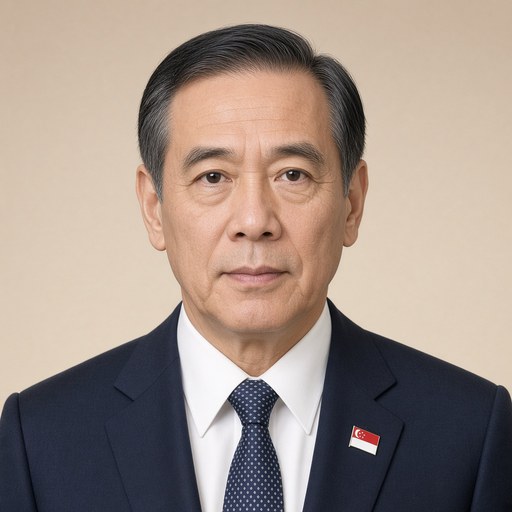
PM Lee Hsien Loong at Taoist Federation's Silver Jubilee Dinner (Harmony Dinner)
 Lee Hsien Loong · Prime Minister of Singapore
- Context
- Lee addressed the Taoist Federation of Singapore's 25th anniversary celebration in April 2015, coinciding with Singapore's Golden Jubilee of independence.
- Main themes
- Taoist Federation of Singapore anniversary, religious harmony, Dao De Jing philosophy, governance and virtue, Singapore's golden jubilee, accumulation of virtue, intergenerational leadership renewal, Taoist culture promotion, international religious exchanges, national resilience and resource management
- Duration
- ~7 min
- Words
- 831
- Sentences
- 44
- Readability
- 44
- Grade
- 11.8
- Syntax
- 2.98
- Vocabulary
- 2.21
Translated from Multiple languages
The broad sphere of national life a sentence belongs to. Every sentence has an Arena, so it is the denominator the other indices are read against.
Other44 sentences in 16 paragraphs
Distinguished guests, Taoist believers,
Good evening, everyone!
Congratulations to the Taoist Federation of Singapore on its 25th anniversary.
This year marks the Golden Jubilee of Singapore's independence, and it is also the Silver Jubilee of the Federation, so we can say it is a double celebration, a joy upon joy.
Since its establishment, the Federation has united the strengths of Taoist temples, priests, practitioners, and other Taoist organizations to promote Taoism, while also cooperating with the government to implement the principles of religious harmony, serving society and benefiting the people. This brings me great comfort.
Under the leadership of President Tan, along with the care of many believers and the active support from all sectors of society, coupled with the tireless efforts of past councils, the Federation's affairs can be said to be thriving.
In addition, President Tan is also focused on renewing the leadership of the Federation and nurturing a new generation of leaders. He mentioned this in his speech just now. Under his leadership, the Federation has established a youth group, providing opportunities for the younger generation to learn and to express themselves.
The Federation has done a lot of work in promoting international exchanges of Taoist culture and in engaging with other local religious groups. In this process, the Federation has also made many good friends, creating numerous positive connections. Tonight, many representatives from other religious groups have come to support and congratulate the Federation. This reflects the fruitful results of the Federation's efforts over the years and has laid a solid foundation for promoting religious harmony in our country.
This also demonstrates that the Federation has concretely implemented the concept mentioned in Chapter 59 of the Dao De Jing, which states, "He who accumulates virtue will have no obstacles." I am not very familiar with the Dao De Jing, but I will do my best to read the original classical text tonight:
To govern people and serve heaven, nothing is better than frugality. Only frugality is called early preparation; early preparation is called accumulating virtue; accumulating virtue means there will be no obstacles; if there are no obstacles, one cannot know the limits; if one cannot know the limits, one can have a country; the mother of a country can endure for a long time. This is called having deep roots and a solid foundation, the way to long life and longevity.
I asked my teacher what it means. Translated into modern language, this classical text means:
In governing the people and nurturing the body and mind, nothing is more important than cherishing the spirit. Therefore, the most important thing is to cherish the spirit. By cherishing the spirit, one can prepare early. What is early preparation? It is the continuous accumulation of "virtue." If one can continuously accumulate "virtue," there will be nothing that cannot be overcome. If there is nothing that cannot be overcome, then one cannot measure its strength. With this immeasurable strength, one can take on the heavy responsibility of governing a country. Therefore, it is said, "He who accumulates virtue will have no obstacles; if there are no obstacles, one cannot know the limits; if one cannot know the limits, one can have a country." Thus, there must be immeasurable strength. With the principles and reasoning for governing a country, the country can endure for a long time. A long-lasting national fortune is called having deep roots and a solid foundation, in line with the way of long-lasting maintenance.
This is a small excerpt from the Dao De Jing. I find it very meaningful because the government's way of governing the country is very similar to this concept in the Dao De Jing. Our governance also involves continuously accumulating "virtue" for the country and its people, building new capabilities, accumulating resources, and innovating continuously to prepare for the future of the country.
Some may feel that the resources we have accumulated are already sufficient, and we can afford to relax for a while, without needing to manage the country's resources so cautiously. However, to achieve what the Daoists call "no obstacles," we must "not know the limits," and we must have immeasurable strength and resources. Therefore, rather than assuming we need a certain amount of resources and that once we reach it, we no longer need to accumulate, it is better for us to stay in our positions, do our utmost to prepare for the future, and accumulate "virtue" for future generations.
To safeguard Singapore, to make life better for our people, and to ensure that Singapore continues to achieve remarkable results, we must work together and fulfill our responsibilities. In fact, the philosophy mentioned by Mr. Lee just now is also a fundamental factor.
The Federation has also made many contributions over the past 25 years to ensure social and religious harmony in the country. I hope the Federation will continue to promote the virtues of Taoism and contribute to building a better Singapore, benefiting society and the people. Thank you!
The original Multiple languages. The tags above are read on the English translation's sentences.
各位来宾、道教善信
大家晚上好!
恭喜新加坡道教总会庆祝成立25周年。
今年是新加坡建国金禧之年,同时也是道总的银禧之年,可以说是双喜临门,喜上加喜。
自从道总成立后,道总就把道教宫庙、道士、道教徒还有其他道教组织的力量团结起来,一起宣弘道教,同时配合政府落实宗教和谐的准则,服务社会,造福人群。这令我感到非常欣慰。
在陈会长的领导下,还有广大善信的关爱和社会各界的积极支持下,再加上历届理事会同仁的不懈努力,道总的会务可以说是蒸蒸日上。
此外,陈会长也关注道总领导层的更新和栽培新一代领袖的工作。他刚才演讲中就提到了这一点。在他领导下,道总成立了青年团,让年轻一代有学习的机会和发挥的空间。
道总在促进国际间的道教文化交流以及与本地其他宗教团体的交流方面,都做了很多的工作。在这个过程中,道总也结交了许多好朋友,可说是广结善缘。今晚,前来支持和祝贺道总的各位,就包括了许多来自其他宗教团体的代表。这就反映了道总多年来的努力,取得了丰硕的成果,并为促进我国宗教的和谐,打下了深厚的根基。
这也显示道总具体落实了道德经第 59 章所提到的“重积德则无不克” 的理念。我不很熟悉道德经,可是我今晚尽力读一读原来的古文:
治人事天,莫若啬。夫唯啬,是谓早服;早服谓之重积德;重积德则无不克;无不克则莫知其极,莫知其极,可以有国;有国之母,可以长久。是谓根深固柢,长生久视之道。
我问老师是什么意思。翻译成白话文,这段古文的意思是这样的:
治理百姓和养护身心,没有比爱惜精神更为重要的了。所以最重要的是爱惜精神。爱惜精神,得以能够做到早作准备。什么是早作准备?就是不断地积“德”。如果能够不断地积“德”,就没有什么不能攻克的。如果没有什么不能攻克,那就无法估量他的力量。具备了这种无法估量的力量,就可以担负治理国家的重任。所以说,“重积德则无不克;无不克则莫知其极,莫知其极,可以有国”。所以,必须有无法估量的力量。有了治理国家的原则和道理,国家就可以长久维持下去。国运长久,就叫做根深柢固,符合长久维持之道。
这就是道德经的一小段。我读了这一段,觉得很有意义,因为政府的治国之道, 跟道德经里的这个理念很相似。我们治国,也是不断地为国家、为国人积“德”,累积新的能力,累积资源,不断创新,为国家的未来未雨绸缪。
有些人可能觉得我们积累的资源已经足够了,可以暂时松懈一下,不需要那么谨慎地管理国家资源。不过,要达到道家所说的“无不克”,我们就必须“莫知其极”,必须有无法估量的力量和资源。所以,与其假定我们需要多少的资源,达到就不需要再去累积了,倒不如我们守好岗位,尽全力未雨绸缪,为后人积“德”。
要守护新加坡,让国人生活更美好,并且确保新加坡不断取得耀眼的成绩,我们就必须齐心协力,各尽其责。其实,刚才陈会长所说的李先生的理念,这个也是一个基本的因素。
道总也一样,为确保国家社会宗教和谐,在这25年来,作出了许多贡献。我希望道总继续弘扬道教的美德,为建设更美好的新加坡尽一份力,让社会和人民受惠。谢谢!
Friends and fellow guests,
I am very happy to join you this evening to celebrate the Taoist Federation’s Silver Jubilee.
The Taoist Federation, led by Mr Tan Thiam Lye, has worked hard to foster good relations between the different religious groups in Singapore. It is part of the Inter-Religious Organisation and it is also on the National Steering Committee on Racial and Religious Harmony. This evening, it has invited guests of all races and religions to celebrate its Silver Jubilee, and share a meal for the occasion. I was very happy this evening, when I came in, to be greeted by two performers performing on traditional Indian instruments and to have a kompang group and a Chinese dance group to welcome me and bring me in. It reflects our religious integration, our racial harmony, and the way Singapore society is and should be, and not just at an abstract national level, but on a personal, direct person-to-person level. Through such interactions, we build trust and goodwill amongst our religious leaders, amongst our different religious groups, and bring the communities closer to one another. So thank you, the Taoist Federation, for your very good work!
The religious and racial harmony that we enjoy in Singapore is a very unusual and in fact, unnatural state of affairs. They are studies of different societies and there was one study, called the “Global Religious Diversity” report, looking at how mixed different societies were. They ranked Singapore as the most religiously diverse country out of all the countries they studied. They studied 232 countries in the world, and we were the most religiously diverse – the most different religions, the most intermingled. All the world’s major faiths are present in Singapore and many smaller faiths too. And yet, we enjoy racial and religious harmony, and we live peacefully and happily side by side every day. I think that is something we can be very proud of, and it is something which has been important for us right from the beginning, when we became a country.
A multi-racial and multi-religious society is a key ideal upon which Singapore has been founded. As Mr Lee Kuan Yew said, and I quote him, “we make the model multiracial society. This is not a country that belongs to any single community – it belongs to all of us.”
According to the Dao De Jing – the sacred book, the scripture of the Taoist, it is said that in governing people and serving heaven, there is nothing like parsimony. The Chinese word was ‘啬’. Dao De Jing describes parsimony – that means being very careful with your resources – as storing up virtue, because for virtue you can never have too much of it. As you accumulate, the more you have, the stronger you can be. And the more people cannot fathom how much you have, the less likely they are to challenge you and to put it to the test, and the more peacefully we can live.
To govern well, we need as big a store of virtue as possible. Virtue, in the sense of capabilities, in the sense of resources; virtue, in the sense of good conduct and high standards of behaviour and of government, so that we can hold our heads high and we can say, we are doing the right thing and it has produced good results for Singapore.
We have done well in Singapore, but our mindset should be to keep on building, to keep on saving, to keep on being good stewards, to keep Singapore going for a long time to come. We must not to think that perhaps we have done enough, or saved enough, and we can afford to ease off, do less, and enjoy more. This is how we have developed and built ourselves up steadily over the last 50 years, and this is how society should carry on.
We also, of course, need to keep our society open and inclusive. We can be any race, any religion, but we are also at the same time, all Singaporeans together. And we have learnt to trust and respect our different races and religions, and to live peacefully with one another.
As religious leaders, you lead by example. Your communities look to you as role models. How you counsel and lead your congregations, your flocks, will shape religious relations in Singapore. So I am very happy that so many of our religious leaders are committed to building trust and friendships with other communities, and are continuing the good work which has brought us here today.
Tonight, we have this happy dinner. I hope it will be an opportunity for all the religious leaders and disciples and followers here to renew old ties and forge new friendships.
I wish the Taoist Federation a very happy Silver Jubilee. Thank you very much indeed.
Explore related topics