




Launch of construction work on the Regional Express Train (TER) project
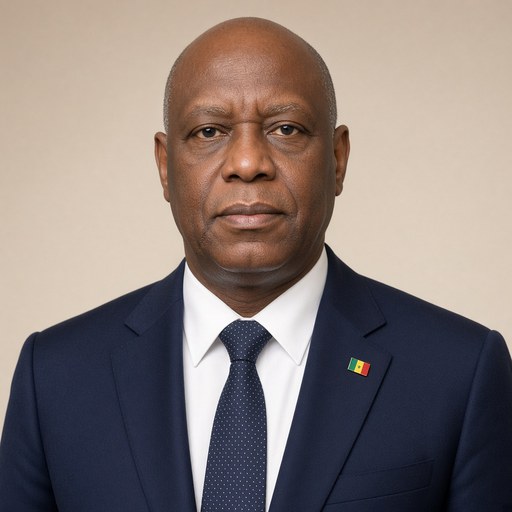
 Macky Sall · President of Senegal
- Context
- Sall addressed dignitaries and officials on December 14, 2016, in Diamniadio, Senegal, to launch construction of the country's first modern electric regional express train.
- Main themes
- Regional Express Train (TER) project launch, infrastructure development, Emerging Senegal Plan, decongestion of Dakar, modernization and technological revolution, Diamniadio new city, connectivity and transportation, West Africa railway innovation, public-private international partnerships, national development and emergence
- Duration
- ~17 min
- Words
- 2,007
- Sentences
- 102
- Readability
- 39
- Grade
- 12.6
- Syntax
- 3.07
- Vocabulary
- 2.49
The broad sphere of national life a sentence belongs to. Every sentence has an Arena, so it is the denominator the other indices are read against.
Other102 sentences in 86 paragraphs
Ladies and Gentlemen, Ministers,
Ladies and Gentlemen, Deputies,
Ladies and Gentlemen, members of the High Council of Territorial Communities,
Ladies and Gentlemen, members of the Economic, Social, and Environmental Council,
Excellency, Ambassador of the French Republic to Senegal,
Mr. Representative of the Islamic Development Bank,
Mr. Representative of the African Development Bank,
Ladies and Gentlemen, representatives of partner companies,
Ladies and Gentlemen, members of the diplomatic corps,
Ladies and Gentlemen, administrative and territorial authorities,
Religious and traditional authorities,
My dear compatriots, both here and in the diaspora,
Today, December 14, 2016, our country takes a significant step forward at full speed in its resolute march toward emergence. At full speed, because we are launching the construction of an express train.
As you know, we have included infrastructure as one of the strategic sectors of the Emerging Senegal Plan, because without infrastructure, there can be no emergence, no development, no prosperity.
Without infrastructure, the movement of people, goods, and services is reduced to its simplest form; transportation is paralyzed, and we remain isolated from one another.
That is why infrastructure is so fundamental for a country that aspires to progress.
And that is the entire meaning of this groundbreaking ceremony for the Regional Express Train (TER) project, the largest project in independent Senegal’s history.
The history of railways in Senegal dates back to the 19th century, with the Dakar – Saint-Louis railway line, inaugurated in 1885.
This metric-gauge railway, undoubtedly modern for its time, has served its purpose.
Today, 131 years later, we are here in Diamniadio, driven by an unshakable will to change the paradigm; a desire to live in our time, to embrace modernity, and to look to the future with confidence and ambition.
We are here to offer our country the best of what the world has to offer, and that is my vision and ambition for an Emerging Senegal. To achieve this, we have mobilized our expertise and resources, along with those of our partners, in service of our ambitions.
This is the vision behind the Regional Express Train project.
The goal is to build an electric-powered, modern, fast, and standard-gauge railway; the first of its kind in West Africa.
More than an evolution, it is undoubtedly a technological revolution that we are embarking on today.
We observe that Sub-Saharan Africa is skipping a technological generation.
Senegal is proud to be at the forefront of this movement, which includes joint ventures where French, Turkish, Chinese, Senegalese, and other industries collaborate together.
The TER, which will soon become part of our daily vocabulary, corresponds to our legitimate aspiration for well-being and addresses multiple needs.
First, the TER responds to the imperative need to decongest Dakar and its surroundings.
With less than 0.3% of the national territory, the Dakar region hosts more than 66% of our country’s economic activity and nearly 25% of the Senegalese population.
Added to this is the density of its vehicle fleet: each year, the Dakar region registers about 40,000 new vehicles.
The TER will therefore help solve the inconveniences related to this excessive concentration of economic activity, demographics, and road traffic.
Secondly, the TER addresses the logical need to better connect Dakar, the urban hub of Diamniadio, and the rest of the country. Thirty kilometers from Dakar, the new city of Diamniadio is taking shape.
With its International Conference Center, hotels, City of Knowledge, including Dakar’s second university, its multifunctional stadium, industrial park, housing, and administrative buildings, to name just a few infrastructures, Diamniadio, a crossroads city, is gradually becoming a beating heart, irrigating the arteries between Dakar and the deeper regions of Senegal.
To fulfill its natural and vital role as a relay city, Diamniadio must have the most advanced infrastructure and avoid the trap of poorly conceived and poorly managed modernity.
Diamniadio is already served by a highway.
But a projection into the future, five, ten, twenty years or more, shows us that this infrastructure, while indispensable, will be largely insufficient to support all the ambitions of an emerging Senegal.
Governance is about foresight. This is also the meaning and rationality of the TER: to complement the highway by decongesting Dakar and its suburbs, connecting them to Diamniadio, and opening new horizons toward the center, east, north, and south of our country.
Thirdly, and finally, the TER is in line with the upcoming commissioning of the Blaise Diagne International Airport (AIBD) next year.
The construction of the AIBD is in its final phase. By 2017, the airport should be operational, accommodating approximately three million passengers per year, according to initial estimates—likely much more in the future.
An airport is more than just a runway, a control tower, halls, and parking. An airport is an entire infrastructural environment that must meet the most demanding international standards, including easy access and connection to fast and comfortable transportation routes.
That is the price to pay if we want our new airport to fully fulfill its role as a modern and dynamic air hub.
This is the third rationale behind the TER project.
Today, we are launching the first phase of the project, between Dakar and Diamniadio, over 36 km.
With a total cost of 568 billion CFA francs, including all infrastructure, the construction of this first phase will last two years and be completed in 2019.
It is Wednesday, December 14, 2016. I am setting a date with our partner companies for Monday, January 14, 2019, to inaugurate the line and make the first Dakar-Diamniadio trip on the TER.
Nearly ten thousand (10,000) people will work on the project, in both direct and indirect jobs.
The project will also have other ripple effects, including enhancing the value of the areas it crosses, reducing traffic congestion, and cutting road accidents.
Additionally, it will facilitate a transfer of technology through the creation of a training center dedicated to urban mobility, aimed at training and improving the human resources essential for the renewal of the railway system in Senegal.
As for its technical specifics, the TER will have a standard gauge, with bi-mode traction, both thermal and electric.
It will span a total distance of 55 km, from Dakar to AIBD, and will serve 14 stations.
With a top speed of up to 160 km/h, it will connect downtown Dakar to AIBD in 45 minutes.
Its transport capacity will be far greater than what we currently have: the TER will be able to carry up to 115,000 passengers per day, compared to only 15,000 today with the Petit Train de Banlieue.
Furthermore, it will be combined with other intercity transport systems, particularly the Bus Rapid Transit (BRT); with an integrated ticketing system, the same ticket will allow passengers to make a trip on both the TER and the BRT.
Ladies and gentlemen, these are the broad outlines of this first phase of the TER, between Dakar and Diamniadio.
Out of anticipation, we have already been working on future stages because the TER is designed to serve AIBD and, later, Saly, Mbour, and Thiès.
And it won’t stop there, because we also intend to revive the Dakar-Tambacounda-Bamako railway line, with the same standard gauge as the TER.
I am fully committed to reviving the Dakar-Bamako railway because it is an economically viable project, a project of integration, connecting us to Mali—a country more than a neighbor and brother, with whom we share history and a common destiny.
Moreover, if we have a sense of history and a shared destiny, we cannot achieve less in the 21st century than what was done in the 20th century.
The Dakar-Bamako railway dates back to the last century. It provided immense services, but it can no longer meet our needs in terms of transporting people and goods between our two countries.
Just the freight alone mobilizes over 400 trucks per day, with the direct consequence of rapid road degradation, leading to costly maintenance and repairs.
I would now like to make a special mention of the partners who are supporting us in financing the TER project: France, the Islamic Development Bank, and the African Development Bank.
By trusting us with the loans they have granted, our partners are also making an optimistic bet on our ambitions and vision for development.
That is why I warmly thank them for this pioneering partnership, at the forefront of progress.
I congratulate all the companies that, following a rigorous selection process, have been awarded the different contracts for the TER project. There was intense competition, and those that won undoubtedly made the best technical and financial offers, in line with the project’s requirements.
I am particularly pleased that Senegalese companies are participating in the implementation of the project, not as subcontractors, but as partners in joint ventures.
I also commend the Senegalese expertise that worked tirelessly for two years, with the support of our partners, to put together this complex project from technical, financial, and legal perspectives.
I want to express my pride to everyone involved. I congratulate the Minister of Infrastructure, Land Transport, and Opening Up, the Minister of Economy, Finance, and Planning, and their teams, the Secretary of State in charge of Railways, as well as the Director General of APIX and the Director of the National Railway Agency of Senegal (SYSTRA) for the quality of the work accomplished.
I urge all the partner companies and all the authorities involved at various levels in the implementation of the project to continue to demonstrate the same diligence in the execution of the works. Together, we made commitments; together, let’s honor our commitments.
So, let’s get to work and move forward with the next steps. And believe me, I will often make unannounced site visits!
We have, finally, another challenge to tackle: adapting to the TER environment. The milestone we are laying today introduces a revolution in our public mass transportation system and will have profound impacts on our way of life.
The TER combines speed and precision. You know exactly when the train enters the station and when it departs.
All the accompanying infrastructure is designed to meet these two imperatives.
That is why the TER must also inspire, more than an evolution, a revolution in mindsets. To keep pace with this new era of modernity that we seek for our country with such projects, we will need new attitudes; we will need individual and collective discipline, a spirit of method and organization, as President Senghor used to say.
That is why I requested the creation of a TER Information Center as part of the project.
This platform, whose prototype I just visited at the Dakar station, will serve as a place for welcoming, informing, and exchanging ideas on all aspects of the project, from design to commissioning.
I invite future train users to visit the TER Information Center to learn about all facets of this new mass transportation system, familiarize themselves with the technological features of the electric rail system, the ticketing system, and the services linked to the TER’s operation.
My dear compatriots,
After this ceremony dedicated to the TER, I invite you to other project launches in other places because, more than ever, with the implementation of the Emerging Senegal Plan (PSE), we are in a time of action. Our actions match our promises.
We have delivered with completed projects like the extension of the VDN, the Emergence interchange, and the Diamniadio-AIBD-Sindia highway.
We have delivered with ongoing projects like the flagship Ila Touba highway project.
We recently delivered with the inauguration of the Bokhole, Malicounda solar power plants, and last Friday with the ICS project in Darou Khoudos.
We are delivering today with the launch of the TER works.
And we will continue delivering tomorrow, with other projects in agriculture, livestock, fisheries, tourism, air transport, and many other sectors.
That is the PSE—a plan supported by a vision and carried out in actions for a Senegal that moves, a Senegal that advances, a Senegal that is ever more prosperous, a Senegal for all!
See you on Monday, January 14, 2019, for the inauguration!
Thank you for your kind attention.