




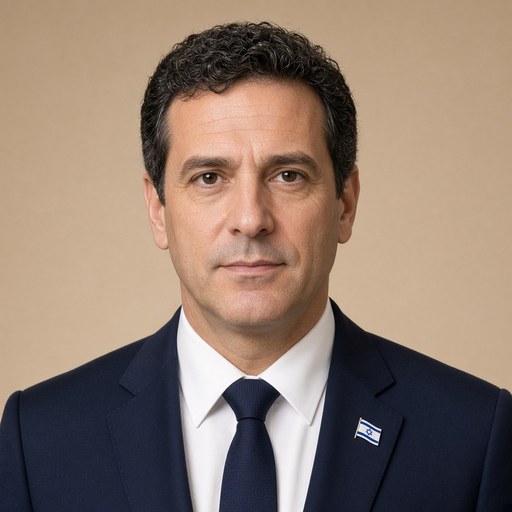
Statements by PM Bennett and US Secretary of State Antony Blinken
 Naftali Bennett · Prime Minister of Israel
- Context
- Bennett and Blinken spoke jointly in Israel on March 27, 2022, covering Ukraine, Israeli-Palestinian affairs, and regional normalization ahead of the Negev Summit.
- Main themes
- Russia's aggression in Ukraine, Israeli humanitarian aid to Ukraine, Israeli-Palestinian relations, two-state solution, Abraham Accords and normalization, regional diplomacy, Passover-Ramadan-Easter tensions in Jerusalem, Palestinian economic measures, US-Israel friendship, Middle East peace initiatives
- Duration
- ~6 min
- Words
- 737
- Sentences
- 29
- Readability
- 42
- Grade
- 13.5
- Syntax
- 3.11
- Vocabulary
- 2.09
The broad sphere of national life a sentence belongs to. Every sentence has an Arena, so it is the denominator the other indices are read against.
Other29 sentences in 8 paragraphs
We appreciate all efforts by allies and partners to stop the catastrophic suffering that Russia's aggression is causing for the people of Ukraine. And I have to say, we're also grateful for the Israeli government's efforts to provide humanitarian aid to Ukraine, including more than a hundred tons of food, medicine, generators and other vital supplies. And the field hospital. I had a chance earlier today, when I was with Foreign Minister Lapid, to actually connect directly with those who are running the field hospital. We did it virtually and it was very powerful to see that in action.
This support is crucial as more and more Ukrainian men, women and child are being killed, maimed, displaced by Moscow's attacks. More are trapped in barbaric sieges where they are denied food, water, medicine and where people are starving to death. Fully half the children of Ukraine have been displaced by Russia's aggression. Half the children in the country.
I also made clear the conviction that the United States has that Israelis and Palestinians deserve to enjoy equal measures of freedom, security, opportunity and dignity. And that's one of the principle reasons we support a negotiated two-state solution. The Prime Minister and his government have made important efforts to address some of the challenges facing Palestinians: increasing Israeli water sales to Gaza, granting permits now to 20,000 people from Gaza to work in Israel, legalizing the status of thousands of Palestinians in the West Bank. And we very much hope to see more efforts along these lines in the near term. We're also encouraged to see members of the Prime Minister's cabinet meeting with Palestinian leaders, including Defense Minister Gantz who I will see in a short while.
Our administration is also rebuilding America's relationship with the Palestinian Authority and the Palestinian people, something I'll continue to do today in Ramallah with President Abbas, and in east Jerusalem with leaders of that community's vibrant and diverse civil society. We're increasing humanitarian assistance to the Palestinian people, totaling half a billion dollars since April of 2021.
Today, we also discussed ways to foster a peaceful Passover, Ramadan and Easter across Israel, Gaza and the West Bank, particularly in Jerusalem, a city of such profound importance to Jews, to Christians, to Muslims. And that means working to prevent actions on all sides that could raise tensions, including settlement expansion, settler violence, incitement to violence, demolitions, payments to individuals convicted of terrorism, evictions of families from homes they've lived in for decades. It's a message that I'll be underscoring in all of my meetings on this trip.
At the same time, we are increasing our efforts to foster partnerships between Palestinian and Israeli grassroots organizations, businesses, young people, other parts of society through a five-year 250 million dollar Nita M. Lowey Middle East partnership for peace act. Right after this in fact, I'll have a chance to meet with one of the program's first grantees, a project that brings together groups in Gaza, the West Bank and Israel to tackle the interconnected problem of water scarcity. Efforts like this will not only improve people's lives but build relationships that can help defuse tensions and violence and ultimately, lay a foundation for dialogue and for peace.
Finally, as the Prime Minister said, we discussed how we can continue to build on the significant progress of the Abraham Accords and normalization, including in the summit starting this evening in the Negev. The United States will continue, not only to support the work of those who have already normalized relations, but also to urge more governments to take this important step to the benefit of the people in their countries and far beyond. Mr. Prime Minister, your recent trilateral summit with President El-Sisi and Crown Prince Mohammed bin Zayed, as well as President Herzog's visit to Turkey for meetings with President Erdogan and others, these are just the latest demonstrations of broader engagement that is made possible as normalization becomes the new normal throughout the region. And again I applaud Israel's leadership, its engagement, its diplomacy in building these agreements and making them real.
So Mr. Prime Minister, thank you for hosting us today and again, for such a constructive, important exchange on everything we just talked about and more. And thank you for continuing to strengthen what is an enduring and powerful friendship between Israel and the United States. Thank you very much.