




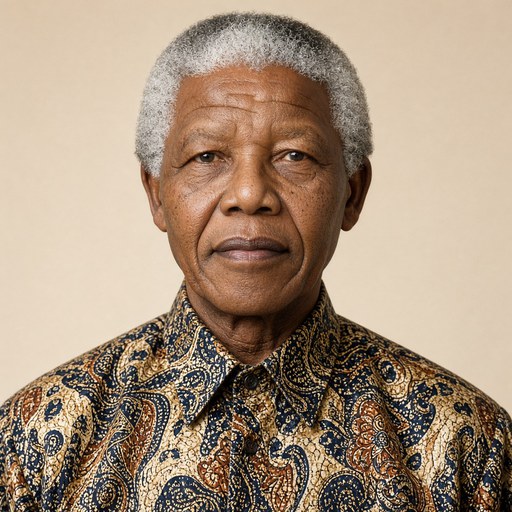

- Context
- Mandela addressed South Africans at the signing of the new constitution into law on December 10, 1996, thanking its drafters, honouring Sharpeville's victims and appealing for national unity, tolerance and joint work against poverty and disease.
- Main themes
- Signing of the new South African constitution, thanks to the Constitutional Assembly and Constitutional Court, legacy of racial domination and struggle, Sharpeville as symbol of sacrifice, national unity in diversity, good men and women in all political parties, danger of extremists in times of conflict, tolerance and respect for languages and religions, banishing homelessness, illiteracy, hunger and disease, Vereeniging and reclaimed unity
- Duration
- ~8 min
- Words
- 967
- Sentences
- 47
- Readability
- 53
- Grade
- 10.9
- Syntax
- 2.94
- Vocabulary
- 2.46
Source: GitHub DRChivers/Nelson-Mandela-Speeches-Sentiment-and-Topic-Modelling-Analysis ↗
The broad sphere of national life a sentence belongs to. Every sentence has an Arena, so it is the denominator the other indices are read against.
Other47 sentences in 31 paragraphs
Friends;
By our presence here today, we solemnly honour the pledge we made to ourselves and to the world, that South Africa shall redeem herself and thereby widen the frontiers of human freedom.
As your first democratically elected President I feel honoured and humbled by the responsibility of signing into law a text that embodies our nation's highest aspirations.
In writing the words which today become South Africa's fundamental law, our elected representatives have faithfully heard the voice of the people. To the Constitutional Assembly, and to its Chairperson and Deputy Chairperson who guided it through a complex and arduous process, we owe thanks.
We owe thanks to the Constitutional Court which has proved a true and fearless custodian of our constitutional agreements.
In centuries of struggle against racial domination, South Africans of all colours and backgrounds proclaimed freedom and justice as their unquenchable aspiration. They pledged loyalty to a country which belongs to all who live in it.
Those who sought their own freedom in the domination of others were doomed in time to ignominious failure.
Out of such experience was born the understanding that there could be no lasting peace, no lasting security, no prosperity in this land unless all enjoyed freedom and justice as equals.
Out of such experience was born the visions of a free South Africa, of a nation united in diversity and working together to build a better life for all.
Out of the many Sharpevilles which haunt our history was born the unshakeable determination that respect for human life, liberty and well-being must be enshrined as rights beyond the power of any force to diminish.
These principles were proclaimed wherever people resisted dispossession; defied unjust laws or protested against inequality. They were shared by all who hated oppression, from whomsoever it came and to whomsoever it was meted.
They guided the negotiations in which our nation turned its back on conflict and division.
They were affirmed by our people in all their millions in our country's first democratic elections.
Now, at last, they are embodied in the highest law of our rainbow nation.
This we owe to many who suffered and sacrificed for justice and freedom.
Today we cross a critical threshold.
Let us now, drawing strength from the unity which we have forged, together grasp the opportunities and realise the vision enshrined in this constitution.
Today, together as South Africans from all walks of life and from virtually every school of political thought we reclaim the unity that the Vereeniging of nine decades ago sought to deny. We give life to our nation's prayer for freedom regained and a continent reborn. I need hardly tell you that this is a speech which my bosses have drawn for me. Now I hope you'll allow me to speak from the heart for a short time. There is a message I have given in almost every meeting that I have addressed during the last three months. Many of you will have heard that message and they may be bored when I repeat it but because so many have not heard it, I want to repeat it and that is in all communities in this country amonst Africans, Coloured, Indians and whites there are good men and women without exception. In all political parties in this country without exception there are good men and women. In the African Christian Democratic Party of Reverend Kenneth Meshoe, in the Pan Africanist Congress led by Clarence Makwetu, in the Democratic Party of Tony Leon, over there, in the African Freedom Front of General Viljoen, in the Inkatha Freedom Party of Buthelezi, in the National Party of former president De Klerk, in the ANC, you'll find those good men and women. The duty of the real leaders of South Africa is to identify those good men and women in all these formations to create an environment where they can pool their talents, their knowledge, their skills, the expertise to pool it so that we can as South Africans, benefit from those skills. I have warned on a number of occasions that when there is tension and conflict it is the wrong men and women who dominate. And good men and women do not like infighting. And extremists who rely on sensation, on the raw instincts of human beings, they climb to the top and control our affairs, if there is tension and conflict. Let us give practical recognition to the injustices of the past, by building a future based on equality and social justice.
Let us nurture our national unity by recognising, with respect and joy, the languages, cultures and religions of South Africa in all their diversity.
Let tolerance for one another's views create the peaceful conditions which give space for the best in all of us to find expression and to flourish.
Above all, let us work together in striving to banish homelessness; illiteracy; hunger and disease.
In all sectors of our society - workers and employers; government and civil society;
People of all religions; teachers and students; in our cities, towns and rural areas, from north to south and east to west - let us join hands for peace and prosperity.
In so doing we will redeem the faith which fired those whose blood drenched the soil of Sharpeville and elsewhere in our country and beyond.
Today we humbly pay tribute to them in a special way. This is a monument to their heroism.
Today, together as South Africans from all walks of life and from virtually every school of political thought, we reclaim the unity that the Vereeniging of nine decades ago sought to deny.
We give life to our nation's prayer for freedom regained and continent reborn;
God bless South Africa;
Nkosi Sikelel' iAfrika;
Morena boloka sechaba sa heso;
God sëen Suid-Afrika,