




Eritrea — Statement to the General Debate of the 78th Session of the United Nations General Assembly (2023)
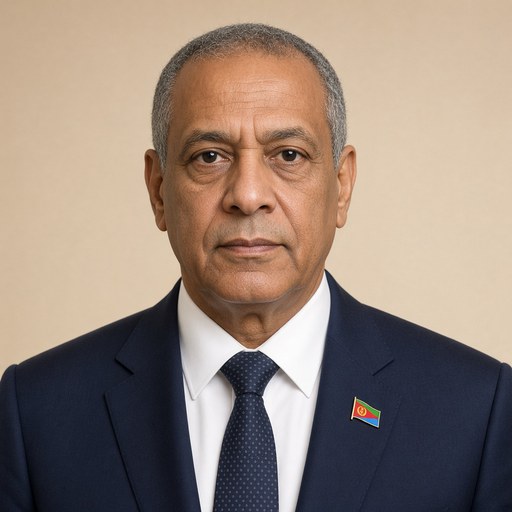
 Osman Saleh Mohammed · Minister of Foreign Affairs
- Context
- Osman Saleh Mohammed delivered the statement of Eritrea in the general debate of the 78th session of the United Nations General Assembly in 2023.
- Main themes
- Lessons from World War II and UN founding, failure of post-Cold War unipolar order, Africa's marginalization and resistance to neocolonialism, terrorist groups as instruments of hegemonic powers, sanctions on Eritrea and accountability, emerging multipolar world order, structural reform of global governance institutions, United Nations reform and efficacy, Security Council reform beyond geographical representation, criteria for Security Council membership
- Duration
- ~7 min
- Words
- 868
- Sentences
- 32
- Readability
- 29
- Grade
- 15.3
- Syntax
- 3.01
- Vocabulary
- 2.71
UN General Assembly Translated from Tigrinya
The broad sphere of national life a sentence belongs to. Every sentence has an Arena, so it is the denominator the other indices are read against.
Other32 sentences in 18 paragraphs
Allow me first to express my warmest congratulations to Mr. Dennis Francis on his election as President of the General Assembly at its seventy-eighth session.
I am indeed honoured to convey the following message of President Isaias Afwerki to the Assembly.
Seventy-eight years have elapsed since the historic establishment of the United Nations, on 24 October 1945. That historic event occurred on the ashes and in the aftermath of the Second World War. which caused unprecedented loss of life and devastation to humankind.
Unfortunately, the poignant lessons drawn from that ferocious war did not usher in an era of enduring peace rooted in legality, justice and sustainable equilibrium in global terms. The cold war. which lasted for the subsequent 45 years, gave rise to a spiral of incessant conflicts and instability in many parts of the world, with all its detrimental consequences for enduring and inclusive prosperity.
More ominously, the futile attempts to impose a unipolar world order in the last 30 years or so. in particular the crises spawned in those times aimed at reviving defunct alliances and military blocs, are increasingly pushing our global community towards the precipice of a much more perilous catastrophe.
Within that calamitous global reality, the African continent has been, and remains, marginalized, compelled as it is to shoulder the brunt of those destructive policies.
From that perspective, it must be recognized that the resistance movements unfolding in Africa — manifested in different variants — are expressions and a continuation of the struggle against colonialism. They are defiant reactions to modern slavery, unremitting plunder and domination.
Another dimension that is often glossed over is the fact that Al-Qaida. Da'esh. Al-Shabaab and other offshoots and franchise terrorist groups are criminal enterprises propped up and funded by the same forces of domination for political ends. They are ruthlessly instrumentalized to foment crises and provide plausible pretexts for military intervention.
I have dwelt at some length on the legacy of the acts of destabilization unleashed by the forces of hegemony because my country has not been spared their fallout within the overall global context. I am not referring to the distant past or the 1950s. in which Eritrea's inalienable right to decolonization was sacrificed on the altar of the geostrategic interests of those Powers. We must recognize that the sanctions imposed on Eritrea from 2009 until 2018 were another recent act of transgression and deceit that requires full redress and accountability.
Vigorous and persistent resistance — even if amorphous — by the peoples of the world have deterred the emergence and prevalence of the intended unipolar world order for global domination and hegemony.
The vibrant trend — the invigorated resistance movements that are mushrooming in different parts of the world — indicate that we are on the cusp or threshold of a new reality, a historic crossroads that will augur a new world order. Obviously, that will not transpire tomorrow. Though inexorable, the path will not be easy or attainable in a short span of time. But there is no doubt whatsoever that that destiny will ultimately be fulfilled.
The new desired global order will have to be accompanied and cemented by far-reaching structural changes in the global governance architecture as well as various international and regional organizations An avoidable pitfall in that indispensable collective effort would be a tendency to cosmetic and nominal measures that would only engender false hope and apathy among the peoples and countries of the world that seek and aspire to genuine changes aimed at bringing about enduring peace, stability and prosperity.
In tandem, the United Nations will be impelled to undergo the requisite structural changes and profound reforms. The desired changes will, hopefully, be commensurate with the aspirations to justice and the rule of law; respect for national independence and sovereignty; and the advent of a new epoch of genuine partnership and shared prosperity.
As the principal international platform, the United Nations must indeed be elevated - in terms of structure and mandate - to a cherished umbrella organization that can fulfil its historic mandate with efficacy and potency.
From that perspective, the much-vaunted reform of the Security Council should not be perceived as nominal tampering that is limited to merely increasing the number and geographical representation of new members. The architecture of veto power and other institutional distortions that incapacitate the Security Council and prevent it from exercising its responsibilities on the basis of international law with impartiality and objectivity must be examined, with its historical track record as a guiding template.
Members will agree with me that political horse-trading and the misuse of Security Council membership to advance narrow national interests are not compatible with the solemn responsibilities that they are entrusted with and that are expressly stipulated in the Charter of the United Nations.
The criteria for membership should not be confined to or determined by mere political and economic clout, population size or other factors. Membership in the Security Council must reflect the wide spectrum of Member States in the United Nations.
In that spirit, we hope that the deliberations of the General Assembly this year and in the period ahead will examine those and other associated complex parameters in all their dimensions and depth.