




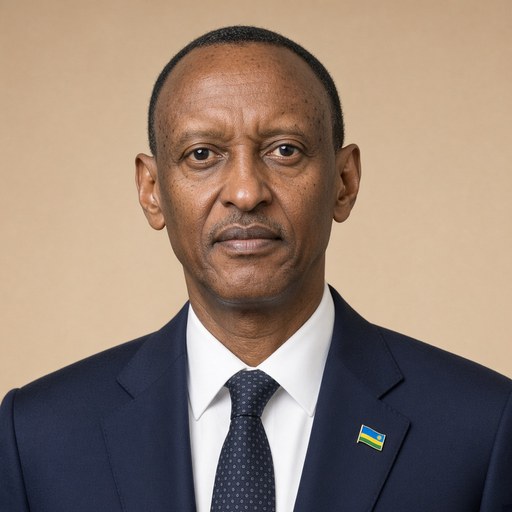
East African Legislative Assembly (EALA) Special Sitting | Remarks by President Kagame | Kigali, 1 November 2022
 Paul Kagame · President of Rwanda
- Context
- Kagame addressed the East African Legislative Assembly at a special sitting in Kigali on 1 November 2022, marking the conclusion of the 4th Assembly's term.
- Main themes
- East African Community integration, regional economic cooperation, EAC financing and accountability, non-tariff barriers and free movement, monetary union, African Union reform, division of labour between AU and RECs, youth and demographic opportunity, good governance and security, infrastructure investment, pan-African unity and prosperity
- Duration
- ~5 min
- Words
- 609
- Sentences
- 36
- Readability
- 38
- Grade
- 12.1
- Syntax
- 3.00
- Vocabulary
- 2.24
The broad sphere of national life a sentence belongs to. Every sentence has an Arena, so it is the denominator the other indices are read against.
Other36 sentences in 32 paragraphs
Let me start by asking the Honourable Member and Minister from Burundi, Nibigira, to pass back my warm greetings to President Ndayishimiye, our chair of the East African Community.
I want to welcome the rest of us to Rwanda. Karibuni sana. We want you to feel at home, and thank you for inviting me to join you for this sitting of the East African Legislative Assembly.
As you conclude the term of the 4th Assembly, allow me to congratulate you for the commendable work that has been done, over the last five years, in the service of our Community and our people.
Since its re-establishment more than twenty years ago, the East African Community has made significant progress towards the creation of a single market.
The East African Legislative Assembly is an integral part of this success.
By harmonizing laws and policies, and providing oversight of regional bodies, the Assembly helps ensure the interests of all citizens are being served.
But challenges remain.
First, the East African Community is currently underfunded, delaying the implementation of projects and programs.
As partners, we must work together to adopt a sustainable financing mechanism, and take full ownership of our development, with less reliance on external support, which we are appreciative of.
Connected to that, we must ensure that resources are spent soundly, and make financial accountability a top priority.
Second, we are far behind the timeline we set for ourselves, to achieve some of the major goals for the Community.
For example, the establishment of the East African Monetary Institute is years behind schedule. Yet this institution is necessary for achieving a monetary union.
Lastly, despite good progress in removing non-tariff barriers, many still remain.
This hinders the free movement of goods and services, which is the foundation of our region’s shared prosperity of the future.
Here, political will is the solution.
Despite these areas needing improvement, the East Africa Community ranks highly in independent reviews of Regional Economic Communities.
However, it does not suffice, for Regional Economic Communities across our continent to do well, individually.
They must collaborate, share knowledge, and learn from one another, to fulfil the wider objective of a more united and prosperous Africa.
This was the logic of the institutional reform of the African Union, which I have been honoured to lead, mandated by the Heads of State and Government of our continent.
A key pillar of the reform, was a better division of labour between the African Union, and the Regional Economic Communities.
This means that member states must give more support to Regional Economic Communities, to deliver on their mandates.
It also means that Regional Economic Communities must constantly strive to deliver tangible value to member states and citizens.
As a continent, the coming years will bring us numerous challenges, but also new opportunities.
We must face the future with a sense of urgency, working closely together.
Youth account for the vast majority of our population, and their number will continue to grow.
As a result, in the second half of this century, Africa should become the engine of the world’s growth and innovation.
But we have to make the necessary investments, right now.
Investments in people, in infrastructure, and of course, in regional integration.
Creating a bright future for today’s young people, means putting good governance and security at the center of everything we do.
Rwanda remains committed to peace and stability efforts, within agreed frameworks, at both the regional and continental levels.
Once again, asanteni sana. I hope you will enjoy your stay in our country, and come back often.
I wish you productive deliberations, and I thank you for your kind attention.