




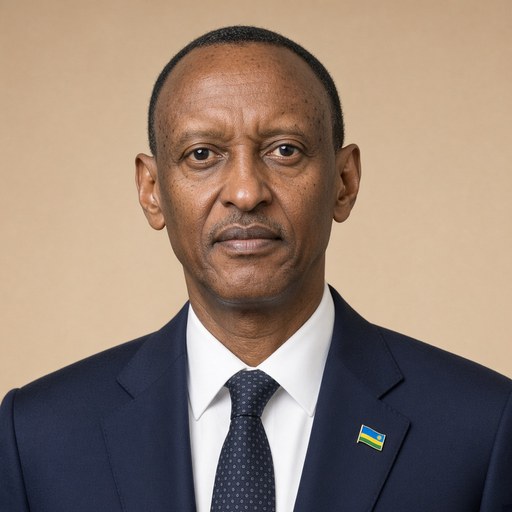
KEYNOTE ADDRESS BY PRESIDENT KAGAME ON THE OCCASION OF THE AFRICAN DEVELOPMENT BANK ANNUAL MEETING
 Paul Kagame · President of Rwanda
- Context
- Kagame delivered a keynote address at the African Development Bank Annual Meeting on May 28, 2013, outlining Africa's path to sustainable economic transformation.
- Main themes
- Structural economic transformation, sustainable development, African growth and integration, natural resource management, infrastructure development, private sector growth, state role in development, agriculture, inequality reduction, intra-Africa economic linkages, social protection, economic diversification
- Duration
- ~10 min
- Words
- 1,170
- Sentences
- 55
- Readability
- 28
- Grade
- 14.6
- Syntax
- 2.95
- Vocabulary
- 2.25
The broad sphere of national life a sentence belongs to. Every sentence has an Arena, so it is the denominator the other indices are read against.
Other55 sentences in 34 paragraphs
Distinguished Delegates;
Going forward, the issue facing us is how to scale and spread the benefits of the prevailing growth to all the citizens and sustain it. The task ahead for African countries is to shape this link between growth and socio-economic transformation of our societies.
In order to do this, we must define and chart a sustainable development path that reflects and provides answers to the specific needs as well as collective aspirations.
Structural economic transformation as a pre-condition to sustainable development is a process of continuous innovation and technology adoption, harnessing endogenous factors of production, and targeting economic sectors that employ and benefit large numbers of our people.
It is evident that meaningful economic growth must be reflected in the human and physical development of our continent – in gainful employment income, increased food security, and better health and education for all citizens.
It must also lead to greater equality and reduction in other social disparities.
The question then is: how do we achieve this all-encompassing growth? Most countries have already undertaken ambitious reforms and embraced liberal economic and political systems that in theory should make our countries attractive to investment in diverse sectors.
Yet, we still find a disproportionate concentration of investments in the exploration and extraction of natural resources, responsible largely for the impressive growth performance in recent years.
This is a blessing, and we must refuse the notion of the so-called “resource curse”. Africa’s natural resource proceeds must catalyse the desired socio-economic transformation and long-term development.
In this regard, the management and resource exploitation in the continent should be determined by the needs of Africa and for the benefit of our citizens.
Distinguished Delegates;
The prevailing progress is happening in disconnected growth centres around the continent, each linked independently to international commodity markets, with minimal intra-Africa linkages.
This is compounded by the absolute and relative lack of requisite infrastructure systems. Moreover, this infrastructure deficit leads to huge untapped productive potential, leaving many of our people behind.
Sustaining today’s good progress shall require a strong commitment and drive towards deepening economic integration through cross-border projects, such as transport corridors and transnational electric and water supplies, that in turn will expand our markets with robust and diversified economies capable of international competition.
The African people are ready, and there is a changing mindset and optimism, growing confidence and determination among the population, to lead our development. But this must be accompanied by concrete actions with result to show.
The private sector has, in fact, begun to take advantage of this and an increasingly large, local entrepreneurial class is driving our economies and creating jobs. A number of them have grown into African multi-national corporations operating across the continent especially in finance, telecommunications, tourism and other service sectors. This private sector must be facilitated to grow further and faster.
In recognising the indispensability of partnership, we have to recognise that the state has a crucial role to play in creating conditions for sustaining growth, increased participation of citizens and reduction of inequality. Evidence from other parts of the world like South-East Asia has shown that transformation cannot be left to markets alone.
The state plays a key role in setting the development agenda, attracting and channelling investment where it has the greatest impact and enabling all sections of society to participate in productive economic activity.
Experience and evidence in some countries on our continent including my own – Rwanda, show that when development programmes are tailored to local needs and all sections of the population participate, there is visible impact in reduction of inequality. We have noticed real movement towards equity, spurred by social protection mechanisms; many of them home-grown initiatives that have also wealth creation impact.
There is already a promising trend of diversification into non-extractive sectors. Some of the fastest growing economies on our continent are not resource rich countries. And in the last ten years, the service sector’s contribution to Africa’s GDP has grown to about two-thirds.
Distinguished Ladies and Gentlemen;
Agriculture remains a crucial cornerstone to Africa’s economic transformation, and there are many examples where it has been pivotal to the realised growth, including among others; Ethiopia, Ghana, Uganda and my own country,
Agriculture must however be treated as a business and not just a subsistence activity. With increased urbanisation, demand for food is expected to double in the next ten years. Yet, for instance, only 5% of cereals imported by African countries are imported from within the continent. Only 5%.
A huge market therefore exists. The potential to increase productivity, create more jobs and raise incomes is ever present. But to turn agriculture into a business dictates that we modernise it, invest in technology and research, make reforms in land tenure, and better land and water management use and develop transportation infrastructure for greater distribution and trade.
We need to adopt long-term strategies for industrialisation and manufacturing particularly in those areas that will add value to our products, and leverage our demographic dividend.
Africa has a very young population, with over two-thirds of the continent under 25 years of age and over 200 million young people aged between 15 and 24 years. In 20 years Africa’s labour force is projected to be the largest in the world.
The young people need to be equipped with vital skills and provide them opportunities to unlock their full potential. This requires increased investment in their health ofcourse, in education and technology. It is an absolute imperative if we are to make the African people our number one resource, which they are. Being all this simply what we have to do.
Clearly, Africans aspire to attain development levels that others in the world already take for granted, but few countries can undertake the needed investments on their own. We therefore need collaborative approaches that build on economies of scale and borrowing from the Millennium Development Goals experience, we need to set clear goals, targets and marshal collective support and commitment to meet them.
Ladies and Gentlemen;
Structural transformation of our economies can be achieved in a relatively short time, however, it requires a big investment outlay and the African Development Bank will need to play a very crucial part – in raising additional capital to support domestic resources to finance this transformational agenda as well as provide the very crucial technical and other advises for this agenda to be continued.
There is no doubt; development demands well-governed, efficient state that is responsive to its citizens’ needs and expectations.
And so just as we make investments in business, we must equally develop our governance systems within which transformation can take place but that also guarantee the right to make our own choices.
Let me conclude by emphasizing that African leaders have a responsibility in an accountable manner to their people, but above all they have a duty to take bold action towards a permanent turn-around of Africa’s social and economic situation, that will deliver no less than the dignity of our people.
Thank you for your kind attention.