




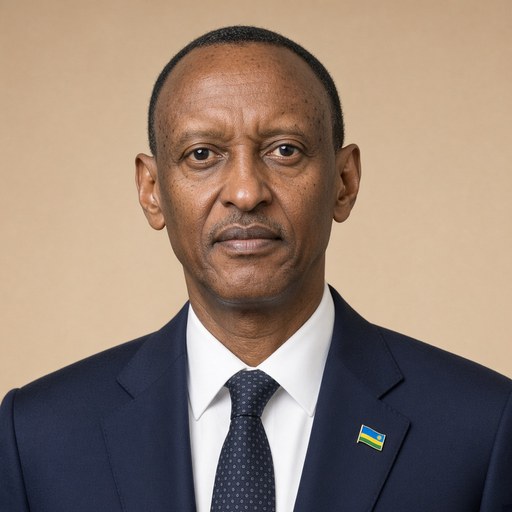
The Stern Stewart Institute Summit | Remarks by President Kagame | Kigali, 16 September 2021
 Paul Kagame · President of Rwanda
- Context
- Kagame addressed the Stern Stewart Institute Summit in Kigali on September 16, 2021, sharing leadership philosophy and Rwanda's development approach.
- Main themes
- Leadership and legitimacy, citizen-leader relationship, governance and accountability, tangible results for citizens, mindset change, youth engagement and empowerment, self-reliance and innovation, Rwanda's development gains
- Duration
- ~2 min
- Words
- 274
- Sentences
- 19
- Readability
- 61
- Grade
- 8.3
- Syntax
- 2.84
- Vocabulary
- 1.87
The broad sphere of national life a sentence belongs to. Every sentence has an Arena, so it is the denominator the other indices are read against.
Other19 sentences in 14 paragraphs
Thank you, John. Thank you also to Markus Pertl for the invitation, and the entire Stern Stewart Institute community. It is a pleasure to join you once again.
I want to leave enough time for the question-and-answer session, so let me just start with a few framing thoughts.
First, leadership has to be understood in terms of the relationship between leaders and citizens. It is not just about the characteristics of the individual who happens to be a leader.
I have two specific things in mind.
Too often, the legitimacy of leaders is judged by the process through which they arrived in office or their manner of leaving office.
What happens in between is given less attention. And yet, the good or bad results that leaders actually deliver on the ground are how citizens judge them.
So you often find a mismatch between internal and external perceptions of the performance of various leaders.
A leadership that consistently delivers tangible results for the well-being of citizens is going to be resilient and successful.
The second and final thought I have is the importance of changing mindsets. Leaders cannot lead countries alone.
They can only set the tempo and raise the level of ambition by involving the public directly.
This is a key reason why, in Rwanda, we spend a great deal of time investing in, and engaging with young people.
The goal is to make them more self-reliant, confident, and innovative than previous generations.
Otherwise, there is no way to secure the gains that our country has made in the past 25 years.
Thank you all once again, and I’m looking forward to the discussion.