




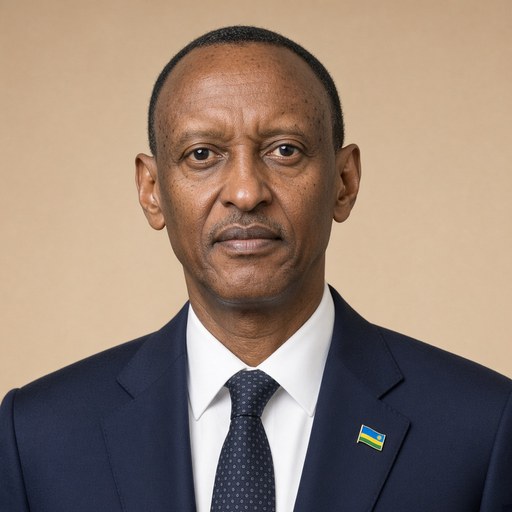
UNESCO’s Building The Bandwidth Meeting | Remarks by President Kagame | 22 July 2021
 Paul Kagame · President of Rwanda
- Context
- Kagame addressed UNESCO's Building The Bandwidth Meeting on July 22, 2021, speaking on girls' education and the digital divide amid the COVID-19 pandemic.
- Main themes
- Girls' education, digital access and skills gap, COVID-19 impact on education, gender equality, digital infrastructure investment, inclusive economic growth, UNESCO partnership, Rwanda's ICT initiatives
- Duration
- ~2 min
- Words
- 231
- Sentences
- 11
- Readability
- 37
- Grade
- 13.4
- Syntax
- 2.97
- Vocabulary
- 2.26
The broad sphere of national life a sentence belongs to. Every sentence has an Arena, so it is the denominator the other indices are read against.
Other11 sentences in 11 paragraphs
Warm greetings to all.
The COVID-19 pandemic has significantly affected all aspects of national life, and education has not been spared.
The disruption of in-person classes has exposed, more than ever, the gap in digital access, skills, and online learning for all children, especially girls.
We have the opportunity to re-engage in the cause of girls’ education so that they are not left even further behind.
In Rwanda, we continue to make significant investments in digital infrastructure and training for our young people.
For example, the Rwanda Coding Academy admits 50 percent girls and aims to resolve the shortage in engineers through a focused engineering program at high school level.
Centres of excellence in ICT, including Carnegie Mellon University-Africa, the University of Rwanda, and the African Institute of Mathematical Sciences, have dedicated scholarships for female candidates.
We must ensure that the ongoing global health crisis does not erode these initiatives, and other similar efforts around the world, aimed at bridging the digital gender divide.
Narrowing this gap also requires that we sustain efforts for inclusive economic growth, guarantee security and community safety, and continue to promote gender equality more generally.
Through partnership with UNESCO and other regional and global initiatives, Rwanda will continue to advocate and act, to ensure girls have access to the digital resources and skills they need.
Once again, I thank you and wish you a productive roundtable.