




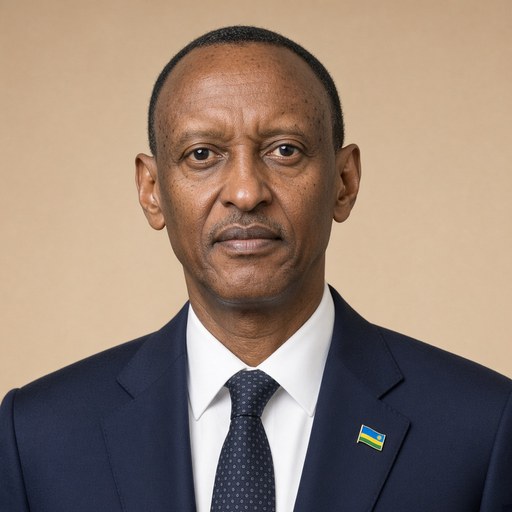
UNGA High-Level Meeting on HIV/AIDS | Remarks by President Kagame | 8 June 2021
 Paul Kagame · President of Rwanda
- Context
- Kagame addressed the UNGA High-Level Meeting on HIV/AIDS on 8 June 2021, presenting Rwanda's progress and calling for a new Political Declaration to end HIV by 2030.
- Main themes
- HIV/AIDS pandemic progress, 90-90-90 targets, new Political Declaration, COVID-19 parallels, health system investment, equity and wealth disparities, PEPFAR and Global Fund, African health infrastructure, scientific research collaboration, vaccine and drug manufacturing capacity in Africa
- Duration
- ~3 min
- Words
- 358
- Sentences
- 23
- Readability
- 66
- Grade
- 8.0
- Syntax
- 3.04
- Vocabulary
- 2.04
The broad sphere of national life a sentence belongs to. Every sentence has an Arena, so it is the denominator the other indices are read against.
Other23 sentences in 17 paragraphs
Since the Political Declaration on HIV/AIDS of 2016, good progress has been made.
Rwanda, like other countries, has achieved nearly all of the 90-90-90 targets. The HIV prevalence rate in Rwanda has been stable at 3 percent since 2005.
But it is not yet time to celebrate. There is still 95 to be achieved, and then 100.
That is the reason why a new Political Declaration is needed, to end the HIV pandemic by 2030.
HIV/AIDS and Covid-19 are both pandemics. One is 40 years old, while the other has been with us for only a year-and-a-half.
But there are common lessons and shortcomings to address.
First, the quality and speed of response is still mostly determined by wealth and poverty.
Waiting to respond to HIV in Africa was a mistake, because the virus was spreading, even though it was treatable.
Some even believed that Africans would not be able take their medicine on time. A decade was lost, and many lives as well.
The turning point in the fight against HIV in Africa was the consensus to invest heavily in national health systems, through key programs such as PEPFAR, the Global Fund, and others.
Indeed, the health systems that Africa has depended on to fight the Covid pandemic, were largely built with HIV funding.
For example, Rwanda’s National Reference Laboratory has performed thousands of Covid tests per day during the pandemic. And it was originally built as an HIV lab.
Even within the framework of combatting a specific pandemic, we can work together as partners to disburse funds in a flexible manner, with the goal of continuing to strengthen health systems.
After all, a maternity wing that treats HIV-positive mothers, may also save the life of a mother with malaria. That is a good thing.
We must also seize this moment to increase scientific research collaboration with Africa, and to invest in drug and vaccine manufacturing capacity on our continent.
I thank the United Nations General Assembly, UNAIDS, the World Health Organisation, the African Union, and all funding partners for the continued determination to end the HIV/AIDS pandemic, once and for all.
Thank you for your attention.