




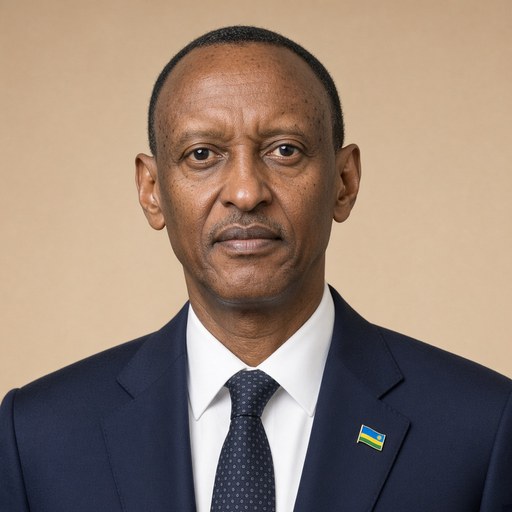
UNSC Debate on Peacebuilding and Sustainable Peace | Remarks by President Kagame | New York, 12 October 2021
 Paul Kagame · President of Rwanda
- Context
- Kagame addressed the UN Security Council debate on peacebuilding and sustainable peace, organized by Kenya, in New York on 12 October 2021.
- Main themes
- Peacebuilding as ongoing process, sustainable peace, national unity and inclusion, root causes of conflict, local needs and institutions, social media and division, Rwanda's post-genocide experience, role of multilateral organizations, civil society and women's leadership, international community reform, African Union, practical partnership
- Duration
- ~3 min
- Words
- 406
- Sentences
- 23
- Readability
- 37
- Grade
- 12.5
- Syntax
- 2.95
- Vocabulary
- 2.23
The broad sphere of national life a sentence belongs to. Every sentence has an Arena, so it is the denominator the other indices are read against.
Other23 sentences in 22 paragraphs
I wish to start by thanking His Excellency President Uhuru Kenyatta, for the invitation to join you today, and for choosing such an important and timely topic for this debate.
Peace is much more than the absence of violence.
The precondition for sustainable peace is a shared understanding of the root causes of a conflict, by a broad range of stakeholders in society.
Allow me to offer a few thoughts on what this may entail, informed by Rwanda’s recent experience.
First, peacebuilding should be understood as an ongoing process, a ‘constant search for solutions through dialogue and consensus, as we say in Rwanda.
It may not be possible to entirely prevent all conflict. In fact, disagreements and grievances will always be there, in one form or another.
But the intensity and impact of conflicts can be minimized, by remaining attentive to local needs and expectations.
This means investing in the capacity of institutions and individuals, so they can deliver the results that citizens expect and deserve.
Second, there is no universal template that can be transferred automatically from one context to another.
External advice and examples can be helpful in encouraging reflection and finding new approaches, and we have benefitted from various partnerships in Rwanda.
Third, we must reckon with the growing power of social media to exploit vectors of division in society, that can quickly weaken the social fabric.
Finally, peacebuilding is not a purely technical enterprise.
It is deeply political and human and must take account of the emotions and memories that various parties bring to the table.
Multilateral organizations such as the United Nations and the African Union have a central role in many situations.
Civil society groups, particularly those led by women, also have a key role, as do business leaders.
However, even though we have had the opportunity to learn lessons from previous failures and successes of peacebuilding processes, the international community’s toolbox has hardly changed.
Rwanda’s post-genocide trajectory is marked by a consistent focus on national unity, inclusion, and service delivery.
There are other positive examples from Africa, and beyond.
Practical and tangible partnership is critical.
Rwanda’s experience is that, no matter how bad the situation appears, success is always an option.
Let’s build on today’s debate, and challenge ourselves to work together to demand better results in international peacebuilding.
Once again, I commend the Republic of Kenya for organizing this debate, and I thank you for your kind attention.