




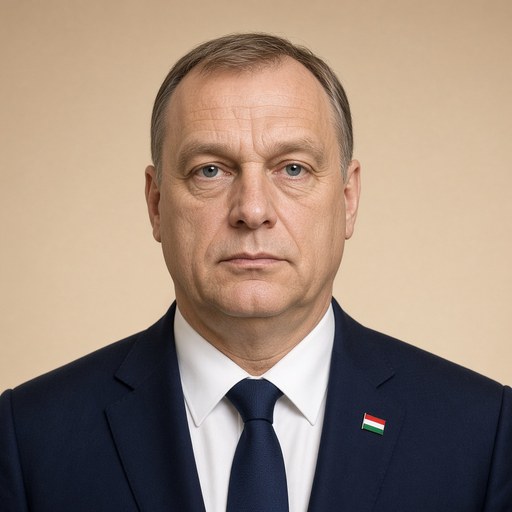
Prime Minister's Speech to mark the laying of the Foundation Stone of the new Knorr-Bremse Production Hall
 Viktor Orbán · Prime Minister of Hungary
- Context
- Orbán spoke at the foundation stone laying ceremony for a new Knorr-Bremse production hall in Hungary on 15 April 2013, celebrating German investment.
- Main themes
- Foreign direct investment, German manufacturing in Hungary, economic reform and debt reduction, job creation and labor respect, R&D and skilled workforce, Hungary's independent economic path, infrastructure and industrial growth, Knorr-Bremse expansion
- Duration
- ~15 min
- Words
- 1,821
- Sentences
- 72
- Readability
- 47
- Grade
- 12.9
- Syntax
- 3.17
- Vocabulary
- 2.14
The broad sphere of national life a sentence belongs to. Every sentence has an Arena, so it is the denominator the other indices are read against.
Other72 sentences in 23 paragraphs
Ladies and Gentlemen!
The workers may not be here with us today, but let us not forget that without them the factory wouldn't operate, the factory could not be successful, and the factory would not generate a profit for its owners and without them could not provide work for a good number of Hungarian technicians and R&D engineers. We speak often of research and development engineers, and rightly so. I'm sure you noted that within the framework of the job protection plan we launched at the beginning of the year, we are providing significant support to enterprises who employ R&D engineers. This is very important, but it should not make us forget the significant manual labour that goes on in the factory, and if these workers are not trained and we do not appreciate them and acknowledge their work, then no matter how many expert R&D engineers we have, no factories will be established in Hungary and they will definitely not be able to operate competitively. And accordingly I am glad that this is an opportunity for the representatives of the factory's owners, the plant's directors, the engineers, the workers who have become technicians and those who operate the machinery to jointly celebrate the fact that people similar to them are being given a new opportunity; owners like the plant's owners, engineers like its engineers and workers just like its workers.
Ladies and Gentlemen!
Of course, this is not what I should be speaking about here today, but instead it is the factory, and I must say that the dynamism with which Knorr-Bremse operates in Hungary, making investment after investment, is unique. Such momentum is very rare among other companies operating in Hungary. This is why I am here again for the second time within a year as a guest of the factory, and why we are able to look back on the years that are behind us. People are always speaking publicly about investor confidence in Hungary. I would simply like to speak to you about a single piece of data. During the three years since the formation of the current Government, over 5 billion Euros in investment has arrived in Hungary from Germany alone, 18 new German factories have been opened in Hungary and the capacities of 22 other German-owned factories operating in Hungary have been expanded over the past three years. And here's the twenty-third!
Ladies and Gentlemen!
The laying of a foundation stone is similar to when you plant a tree. Such an act is tied both to the present and to the future. You can only plant a tree or lay a foundation stone where conditions are given for growth. Let us be proud, let us all be proud together, that in Hungary today, the conditions required for future growth are present.
Ladies and Gentlemen!
When three years ago the voters entrusted us with governing the nation with a majority of two-thirds, it was a clear message: we cannot follow the previous path, because it leads to an abyss. Our partners and allies may often tell us that we should not leave the trodden path for the unknown one, and for this reason it is clear that it is difficult to make them understand that there is no point moving forward on a trodden path that ends in a wall, what we call a dead end. This is a difficult task, but is something we are forced to do because of the European crisis. If we do everything the way we have always done things, we will end up exactly where we eventually found ourselves. We cannot leave the forest along the same path on which we entered it; we can only find the way out by going in the opposite direction, and that means we must leave the well known, trodden path and must tread a new path of our own. In other words, we must make the more old-fashioned half of the world understand that a true change is required throughout Europe, and Hungary is pacing its steps according to this logic.
Ladies and Gentlemen!
Hungary's search for its own path is based on two very simple facts. We believe that the future has two very important prerequisites. The first is that work and production should again be afforded the respect it deserves, and the second prerequisite is that we must escape from the debt trap at whatever cost. On the one hand we had a huge amount of work to do to reorganise the country, while on the other hand we had to launch the war against our mountain of debt. You, who live here with us and have lived through the past three years with us know exactly what difficulties and hardships this meant for the people of Hungary. We can be proud that Hungary was capable of achieving these two things, the reinstatement of the respect of productive labour and the task of freeing ourselves from debt, simultaneously.
Ladies and Gentlemen!
We are by no means at the end of this struggle, but we can certainly state that the struggle was not futile. Our homeland, Hungary, is one of very few European countries that is continuously decreasing its national debt; it is the only European country that has taken over the debt of its local governments fully or to a large extent; it is the only European country which, although perhaps triggering much argument, has taken steps in the interests of finding a solution to the problem of foreign currency debts that are forcing Hungarian families into bankruptcy.
Ladies and Gentlemen!
We have no reason to stop half way towards our goal. And so when we come to a moment of celebration such as this one, in the background lies the huge sacrifice that the people of Hungary have made so that we may create a more liveable and permanently viable nation. Last year, we not only reduced our budget deficit to below the 3% level required by Europe, but in an unprecedented way managed to push it below the 2% mark. Today, we can now state that our homeland, Hungary is a country that has had the strength to stand on its own two feet without needing a crutch. And now that we have managed to stand on our own two feet, there is no reason why we shouldn't begin moving forward, because if we want to be winners in the world following the crisis, then we have no choice but to move forward, just as our host, Knorr-Bremse provides a shining example of this to everyone, including Hungary. Those who reply to the crisis by backing down, are digging their own graves; the right direction for a solution to the crisis is forward.
Ladies and Gentlemen!
Before coming here I opened the Knorr-Bremse website to have a look at the latest company news. It included articles such as "the company is launching a joint enterprise in Russia", or "we have begun a new freight wagon production franchise". There was a sentence there that caught my eye, and it went like this. "Knorr-Bremse is investing in the future." This is exactly what is happening today, ladies and Gentlemen, here in Kecskemét. We would like it if the same thing happened in politics here in Hungary, if we could continuously invest in the future. I would like to allude to the fact, Ladies and Gentlemen, that a little over a year ago, when I was last the guest of this company, I spoke a sentence which I would like to repeat again here today. In 1999, when the first civil government was in power in Hungary, Knorr-Bremse established its first Hungarian research and development centre, and since then, I have always regarded this company, our host, as Hungary's litmus paper. You could call it superstition, or whatever you like, but it is difficult to imagine a better lucky charm for a country than Knorr-Bremse. And so what I would have liked to say, Ladies and Gentlemen, is that I am convinced that if this company invests and realises development projects in Hungary, then the Hungarian economy and Hungarian economic policy are on the right track. This is why this company is our litmus paper, because if this company invests in Hungary, then we provide security, we provide a future, and it is truly worth investing here, because he who invests, invests in the future.
Ladies and Gentlemen!
And now, please allow me to say thank you to the company, its owners and directors, because the Hungarian Government views this company as a correct and reliable partner of the Hungarian economy and Hungarian workers. The company provides a living for some 2000 people here in Hungary, meaning 2000 families, and this latest project will create 111 new jobs - this is the number of families for whom the company will provide a living. As I have mentioned, Knorr-Bremse was the first multinational operating in Hungary to establish a research and development centre here. This company pays particular attention to training the professionals of the future and works in close cooperation with the local government of the city of Kecskemét. I would like to thank his honour, the Mayor of Kecskemét, for being a good partner to this enterprise, or rather this company, which also cooperates with Kecskemét College. In addition, it also provides mid-level technician training in its own independent training workshop. Let us stop here for a moment. Much can be said about the Hungarians, both good and bad, but one thing is certain, and that is that the most important thing for the majority of the Hungarian people is children. By taking part in training, this company is sending us no less of a message than that it cares for our children and builds so strong an emotional relationship over and above simple economics, that creates the foundations for the respect and acknowledgement that the company is given here in Hungary.
Ladies and Gentlemen!
In closing, please allow me to tell you that we believe that the strength of the Hungarian-German economic alliance shall remain unbroken in the future. Hungary must link itself to the German economy well and cleverly, but above all strongly and deeply, and it is my personal belief that cooperation forged between Central Europe and German industry is what will provide the engine for growth within the whole European continent in the decades to come.
Ladies and Gentlemen, Dear Guests, Our Dear Hosts!
When Martin Luther was asked what he would do if there was just one day left before the end of the world, he replied that in that case he would definitely plant an apple tree. When we are now asked what we should do in the midst of the economic crisis that is afflicting Europe, then all we can reply is: let us lay another foundations stone.
Thank you for your kind attention!