




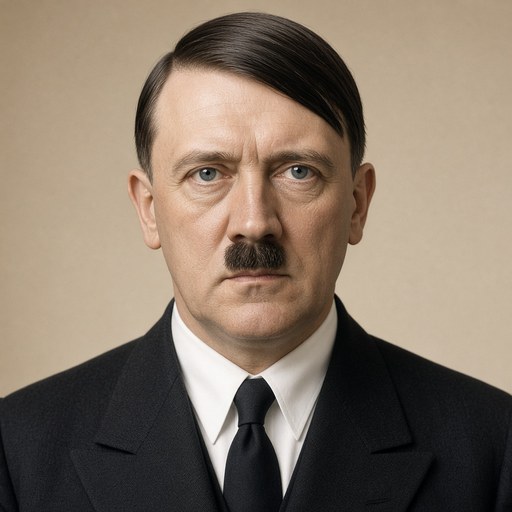
Speech at the Reichs Veterans Day in Kassel
 Adolf Hitler · Führer and Chancellor of the German Reich
- Context
- Hitler addressed veterans at the Reich Warriors' Convention in Kassel in June 1939, as Führer and Chancellor, blaming Allied encirclement for Versailles and the war and urging stronger German military preparedness and soldierly education of the nation.
- Main themes
- Veterans' comradeship, Versailles Diktat and war guilt, British and French encirclement policy, German colonies and trade, failures of pre-1914 state leadership, neglected armament before 1912, strengthening German defensive capacity, education of the nation to soldiership, National Socialism born of the Great War, Grossdeutschland, antisemitic slurs against Jewish writers
- Duration
- ~31 min
- Words
- 3,695
- Sentences
- 151
- Readability
- 51
- Grade
- 12.2
- Syntax
- 3.19
- Vocabulary
- 2.40
The broad sphere of national life a sentence belongs to. Every sentence has an Arena, so it is the denominator the other indices are read against.
Other151 sentences in 37 paragraphs
My Comrades!
It is for the first time today that I partake in a Reich Warriors’ Convention; the first time that I speak before you, the veterans of the old and of the new Wehrmacht.
The Reichskriegerfuhrer of the NS Reichskriegerbund, Comrade Reinhard, has greeted me, on your behalf, both as a soldier of the World War and as the Fuhrer and Chancellor of the German Volk and Reich. In this, my dual capacity, I wish to return this greeting. As the Fuhrer, I greet you as representative of the German Volk in the name of millions of Germans. These have placed their trust, their personal destinies, and hence the destiny of the Reich in my hands. They have done so not because of a constitutional exigency.
This year especially the German Volk is inspired by a feeling of profound gratitude for all those who once fulfilled the most difficult and noble duty.
As an old soldier, I greet you with the feeling of comradeship, which can reveal itself in the deepest sense only to one who in war experienced the noblest transfiguration of this idea. For the magnificent spirit of manly communion discloses itself in the most captivating manner only to him who has seen it stand the test of time in this, the toughest trial of manly courage and manly loyalty.
When I speak to you today, my Comrades, then I myself relive in my memory the violence of those times which now lie a quarter of a century behind us and which the soldiers of the Old Army in particular have felt to be the greatest in their own human existence and which still have them under their spell today.
Nearly twenty-five years now lie behind us since those spellbound, violent weeks, days, and hours in which the German Volk was forced to stand up for its existence after a period of peaceful, well-protected ascent. Twenty years have now passed since, in spite of an unequaled, heroic resistance, a Diktat was forced on us which, in theory, was to bestow upon the world a new order, and which, in practice, bore the curse of destroying any reasonable order founded on the recognition of the most natural rights to life.
The fateful grandeur of those five years from 1914 to 1919! The jolts and mortifications this meant for our Volk! What suffering followed in the wake of our collapse! What depths of degradation, deprivation, and destitution was Germany to suffer! Still, how enormous a change which this doomed Reich underwent in the end-how it pulled itself back from the brink of imminent destruction and moved towards a renewed rise, regarding which we believe that it shall be better and, above all, more lastingly founded than any similar process in German history! When soldiers gather their thoughts, conversations usually turn back to the years shared. Remembrance allows that to arise anew before their mind’s eye which once constituted the shared meaning of their lives. As in epochs of long years of peace, the daily chores with their harsh demands on a sense of duty and on the bodily ability to perform constitute the sum of memories which are recollected at such gatherings, so, with us, these are made up of the memories of the greatest time with which human beings have ever been confronted on this earth. A quarter of a century then begins to pale before us, and the everpresent force of the most difficult, but greatest epoch in our history, casts its spell on us once more. Whatever the individual among us may wish to exchange from the cherished treasure of these, his dearest recollections with others, it is surpassed by what this period in its entirety meant for our Volk, as fateful as this may well have been for our individual lives. For me as the Fuhrer of the German nation, when engaged in critical reflection, time and time again the question presents itself, which I judge as infinitely important not only for the fate we met with then, but also for the correct fashioning of our future, namely, the question of the inevitability of the events back then.
Twenty years ago, a miserable state leadership felt compelled-as it may well have believed-by an irresistible force to place its signature beneath a document which sought to burden Germany finally with the war guilt.
Scientific research in the meantime has revealed this to be a lie and a deliberate deception. I solemnly undertook to erase this signature-given against better knowledgebeneath the Diktat of Versailles-and have thereby paid a formal tribute to honor. Still, beyond this, we all must realize for ourselves: war guilt is inexorably linked to the presupposition of a war aim. No people and no regime will wage war simply for the sake of waging war. That anyone would stride forth into a war merely for the pure joy of killing and bloodshed-such a delusion can take hold only in the brains of perverted Jewish literati. What is decisive in this context is that the German Government not only pursued no war aim in the year 1914, but also, in the course of the war, never managed to arrive at a reasonable or even precise determination of an aim to be pursued. The Peace Treaty of Versailles, by contrast, clearly reveals the true war aims of the British and French encirclement politicians: the theft of the German colonies; the elimination of German trade; the destruction of all bases for German life and existence; Germany’s removal from all positions in power and politics. All in all this added up to precisely the same war aim the British and French encirclement politicians still pursue today.
In Germany at the time, regrettably, there were men who thought they need not pay any attention to the extremist proclamations of English papers and English politicians on the necessity of taking away the German colonies, of eliminating German trade, all goals already apparent in peacetime. The World War and the Peace Diktat of Versailles have instructed the German nation differently. What in former times apparently irresponsible journalists pronounced as the sick products of their own fantasy or hatred, became the goals of British policy, namely, the theft of the German colonies, the elimination of German trade, the destruction of the German merchant marine, the powerpolitical nervous breakdown and destruction of the Reich, and by inference the political and bodily extermination of the German Volk. These were the goals of the British policy of encirclement before the year 1914.
And it is good that we should recall now that when faced with these intentions and war aims of our enemies, later to be affirmed in the Peace Diktat of Versailles, the German state leadership of the day was left without direction and, regrettably, completely without any willpower. And thus it came to pass that there were not only no aims in the war for Germany, but also that the necessary German preparations for the war, in the sense of an effective defensive build-up, were never undertaken. And in this the great guilt of Germany in the World War must be seen. Namely, it is the guilt of having facilitated for the surrounding world (Umwelt), through a criminal neglect of German armament, the propagation of thoughts of the destruction of Germany and the realization of these in the end. In the year 1912, under pretexts incomprehensible to us today, expenditures for the necessary armament were cut; trivial appropriations were stinted; aspiring, honest soldiers banished to the desert; and thereby the convictions of our enemies reinforced the idea that a successful campaign against Germany might well be worth trying. Beyond this, the simple mustering of all men fit for service was conducted only to an insufficient extent and thereby many hundreds of thousands of able-bodied men did not receive training. In critical hours, a high percentage of those who were nonetheless drafted had to pay for this with their lives. All this only reinforces the picture of an incompetent state leadership and therefore the only genuine conception of guilt, not only regarding the outbreak of the war, but, above all, the outcome of the fight.
When in spite of all of this the memory of the World War in particular has become a source of proud reminiscences, this is due not to the all-too-weak armament, the incompetent state leadership, and so on, but to the inner value, the unequaled instrument of the German Wehrmacht then, of the Army, the Navy, and later of the Luftwaffe. In terms of numbers the latter often faced an adversary who was many times superior to it, but who never attained its inner value.
Reflection on and recollection of this great time must make more firm in all of us, my Comrades, one conviction and one resolve:
1. The conviction that the German Volk can only reflect in general on its past with the greatest pride, and in particular on the years of the World War. As the Fuhrer of the German nation, I may never for a second, as a former fighter, admit that anyone in the ranks of our Western enemies has the right to think himself or regard himself as someone superior to us Germans! I do not in the least suffer from an inferiority complex. On the contrary, I regard the memory of the four years of war, which I had the good fortune to experience thanks to a most gracious Providence, as a cause of proud trust in my German Volk and, as a soldier, in my own person, too. Deep inside, these years cause me to long for and desire peace in the recognition of all the horrors of war, and make me all the more convinced of the value of the German soldier in the defense of our rights. Hence threats by whatever party do not impress me in the least.
2. I and all of us have derived from this period the resolve never to allow the interests of our Reich and nation to be as criminally neglected as it was before the year 1914. And now I wish to assure you, my old Comrades, of one thing: whereas the British policy of encirclement has remained the same as before the war, Germany’s policy of defense has undergone thorough revision! It has already changed in that, at the head of the Reich, no longer is a civilian disguised as a major562 seeing to affairs, but rather a soldier who will wear civilian clothes on occasion! There are no more Bethmann-Hollwegs amongst the German state leadership today.
I have taken care that anyone who has anything to do with state leadership is a hundredpercent man and soldier. Should I nonetheless perceive that the behavior of any one person cannot stand up to critical strain, then I shall immediately remove this individual, whoever he may be.
The Peace Diktat of Versailles did not come about coincidentally. It was the goal of those who throughout the years sought to encircle Germany, and who finally realized this goal.
We have no right to doubt that this same policy is being employed in the pursuit of the same goals today. We hence have the duty to tell this truth to the nation, without much ado, and to strengthen it in its resistance and in its defensive capacities to the utmost. I believe that I am hereby acting in the spirit of those comrades who once, regrettably and apparently in vain, had to give their lives for Germany. Just as I believe that now, twenty-five years after the outbreak of the World War and twenty years after the Diktat of Versailles, the German state leadership and behind it the entire German Volk can for the first time step up to the tombs of our heroes with their heads held high. At the very least, some atonement has been made for the sins once committed against them by weakness and a lack of direction and unity. Hence I expect that the policy to strengthen Germany’s defensive capacities should not only be warmly welcomed by the veterans, but should also merit their zealous support. This policy should not conceive of its goal as a temporary recasting of civilians as military men, but rather of the education in principle of an entire nation to soldiership and soldierly behavior. It is no coincidence that National Socialism was conceived in the Great War. For it is nothing other than the suffusion of our entire existence with a true fighting spirit for Volk and Reich. May none of us ever doubt one thing: as soon as the German Volk possesses a totally heroic leadership, it will adjust its own behavior to that of the leadership. It is my irrevocable determination to make certain that the highest political and military leaders of the nation think and act as courageously as the brave musketeer must whose task it is to give his own life, and who does so if he receives orders or necessity dictates as much. The heroic leadership of a nation, however, rests on a conscience compelled by the question whether or not a people shall exist.
When I speak to you in this manner especially, my Comrades, then I can already claim of German history the justification bestowed on him who not only speaks through words, but whose deeds attest to the same spirit and to the same persuasion. And this is why I can share more than any one else in the great comradeship of the eternal German soldiery. And because of this I am happy to be able to welcome you here in Kassel on the Reichskriegertag, as the representative of this soldiership.
Behind us lies the transfigured memory of the greatest time of our Volk and of our own existence. Before us lies the fulfillment of what this time, too, once, albeit unconsciously, struggled for:
Grossdeutschland!
Adolf Hitler – speech to Legion Condor soldiers in Lustgarten Berlin, June 6, 1939 My Comrades!
Finally I can now greet you myself. I am so happy to see you here before me. And, above all, I am so proud of you! And the entire German Volk shares my feelings at this hour. All those millions who over the loudspeakers witness your entry and this reception, they are with you in their thoughts. They have taken you to their hearts, grateful and joyous that you are back with us in the homeland once again.
In the summer of 1936, Spain seemed lost. International forces fanned the flames of revolution there, which was earmarked not only to raze Spain to the ground, but Europe. And even the Christian democracies could not resist supplying weapons, fuel, and so-called volunteers, to this end. A terrible fate hovered threateningly above our continent. The most ancient civilized countries of Europe appeared to be in danger. Tens of thousands of Germans had to flee Spain. Everything they had was destroyed. Many were murdered. What, in a long, laborious, and honest struggle for existence, the Germans there had built up as the basis of their existence, was destroyed and eliminated within a few weeks.
German battleships, which I dispatched to Spain immediately upon hearing cries for help by our Volksgenossen, helped by assuming the protection of life and limb and by evacuating our Volksgenossen to the homeland, insofar as this was possible. And then, ever more clearly, a man rose up in this country, who seemed to be called on, according to the dictates of his own conscience, to act on behalf of his people.
Franco began his struggle for the salvation of Spain. Against him stood a conspiracy fed by all the world.
In July of 1936, I briskly determined to fulfill the request for help which this man directed to me, and to help him to the extent that and as long as the rest of the world lent its support to the internal enemies of Spain.
And thus National Socialist Germany began to take an active part in the struggle for the resurrection of a national and independent Spain under the leadership of this man. I ordered this in the realization that this would not only spare Europe, but also our Fatherland at a later point, a similar catastrophe. I did this also because of profound sympathy for the suffering of a country which maintained a friendly neutrality towards us in the World War despite all English attempts at extortion. I have hereby expressed the gratitude of the German nation. Moreover, this occurred in complete agreement with Italy. For Mussolini, inspired by the same idealistic considerations, had likewise resolved to grant Italy’s assistance to the saviour of Spain in his struggle against the internationally organized destruction of his country. For the first time, we witnessed a practical demonstration of the weltanschaulich solidarity between our two countries.
The international plutocracies were neither capable of comprehending nor accepting these idealistic motives. Throughout the years, British and French papers lied to their readers, claiming that Germany and Italy sought the conquest of Spain, its division, and the theft of its colonies. These trains of thought do appear less unnatural for the representatives of these countries than with us, since the theft of other peoples’ colonies has apparently always belonged to the well-tried methods judged permissible by these democracies. All of us still recall the infamous assertion, disseminated one fine day, that Germany had landed 20,000 men in Morocco in order to occupy it and to take it away from Spain. This libel helped politicians and journalists to stir up their peoples. Time and time again, they tried to have that catastrophe begin in Spain which the encirclement politicians, warmongers, and war profiteers, so eagerly longed for: a new international war in Europe. Now, my Comrades, you have returned from Spain. Today’s festive reception in the Reich capital at the same time signifies the conclusion and the settlement of this mendacious democratic swindle. For I once sent you out to help an unfortunate country, to support a heroic man who, as a passionate patriot, sought to save his people from destruction and who has gloriously achieved its salvation.
You have now returned as the brave executors of my order. I would like to impart to the entire German nation, at this moment, how much cause it has to be grateful to you. You reported for the duty assigned to you, as upright and conscientious German soldiers, who are courageous and loyal and, above all, self-effacing. The high praise which the Spanish freedom fighter gave you can only make the German Volk all the more proud of you. It was painful for all of us to have to remain silent about your struggle throughout the years. However, at the time, I already had the idea, once this war was over, to give you the type of reception which all brave, victorious soldiers deserve.
Today, I have realized this project of mine for both you and myself. The entire German Volk greets you with joyous pride and in heartfelt solidarity. It also thanks all those who, as soldiers, had to sacrifice life and limb, and their health, in the fulfillment of this mission, and, finally, it thanks the survivors who today lament the sacrifice of such brave husbands and sons.
They fell, but their death and suffering will bestow life on countless other Germans in the future. No one appreciates this more than National Socialist Germany which itself, emerging from the struggles of the World War, has made so many sacrifices for the resurrection of Germany in the face of the same enemies. I thank you soldiers of the Legion, as well as the soldiers of the Navy for your readiness for service, your spirit of sacrifice, your loyalty, your obedience, your discipline, and, above all, for your silent fulfillment of duty. Above all, my Comrades, your example will increase the German Volk’s belief in itself all the more. It will strengthen the ties of comradeship to our friends and will leave the world in no doubt that-should the international warmongers realize their plan to attack the German Reich-then their attempt will be repulsed by the German Volk and the German Wehrmacht in a manner at which the imagination of the encirclement propagandists boggles. And in this sense, my Comrades, your struggle in Spain taught our opponents a lesson and, thus, it was a struggle for Germany.
Now that you yourselves have returned as hardened soldiers, this has not only enhanced your appreciation for the accomplishments of the German soldiers in the World War, but has also rendered you capable, to a high degree, of serving as examples and teachers for the young soldiers of our new Wehrmacht. Thus, you have helped to reinforce the belief in our new German Wehrmacht and in the quality of our new weapons.
At this point, we also wish to remember those at whose side you have fought. We remember the Italian comrades, who courageously and loyally gave their blood and life in this struggle of civilization against destruction. And above all, we remember the country itself from which you have just returned. Spain has suffered a terrible ordeal. Soldiers of the Legion, you have seen the destruction with your own eyes. You have further lived to see the cruelty of this fight. But you have also gotten to know a proud people, which has fought with determination for nearly three years, daringly and heroically, to preserve its freedom, its independence, and, hence, its national existence. Above all, you have been fortunate to be under the command of a military leader there, who, with a strength of purpose, staunchly believed in victory and became the saviour of his people. At this moment, all of us have the sincere and heartfelt desire that now the noble Spanish people may be permitted, under the inspired leadership of this man, to effect its ascent anew and with pride.
Legionaries and soldiers! Long live the Spanish people and its leader Franco! Long live the Italian people and its Duce Mussolini! And long live our Greater German Reich! German Volk, long live our German Legion!
Sieg Heil!