





- Context
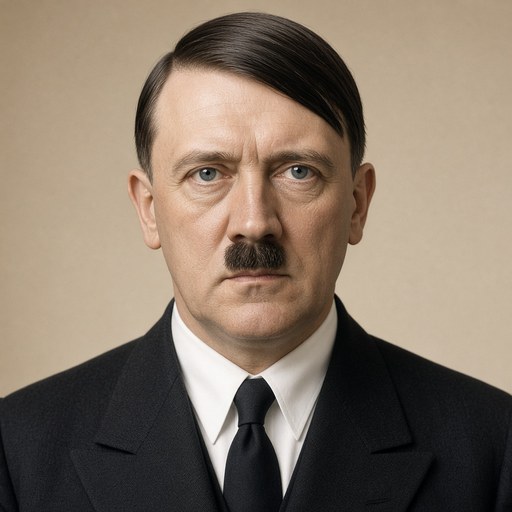
- Hitler addressed a crowd of Volksgenossen in Wilhelmshaven on April 1, 1939, attacking British policy, defending the occupation of Czechoslovakia, hinting at ending the Naval Agreement and affirming rearmament and the Axis with Italy.
- Main themes
- German rise and defeat in the First World War, British encirclement policy, rejection of the Versailles Diktat, annexation of the Czech lands and Hradcany, German Lebensraum claims, Anglo-German Naval Agreement, Wehrmacht rearmament, Axis with Italy, Nationalist victory in Spain, antisemitic and anti-Bolshevik rhetoric, Party Congress of Peace
- Duration
- ~24 min
- Words
- 2,861
- Sentences
- 175
- Readability
- 65
- Grade
- 8.3
- Syntax
- 2.79
- Vocabulary
- 2.25
The broad sphere of national life a sentence belongs to. Every sentence has an Arena, so it is the denominator the other indices are read against.
Other175 sentences in 27 paragraphs
Germans! Volksgenossen!
Whoever seeks to fully appreciate the rise and fall of Germany, has only to look to the history of a city such as Wilhelmshaven. Today resounding with creative activity and work, it was a dead spot not so very long ago-virtually without a right to exist and with no prospects for the future. One does well to reflect on this past every once in a while.
The city experienced its first boom along with the rise of the German Reich after its struggle for unification. This Germany was a Germany of peace. It was a time when many of the so-called peace-loving, virtuous nations were engaged in a multitude of wars while this Germany knew but one goal: to secure peace, to work in peace, to advance the welfare of its inhabitants, and to thereby contribute to human culture and civilization. Internally, this peaceful Germany labored to fashion its life with infinite diligence, ingenuity, and persistence. On the outside, it sought to secure for itself a well-deserved place in the sun by participating in peaceful competition with other peoples.
Although this Germany was the greatest guarantor of peace for many decades, wrapped up in its peaceful pursuits, it was unable to prevent other peoples, especially their statesmen, from looking at our rise with envy and hatred. In the end, they responded with war. Today the historic record tells us how England systematically pursued this policy of encirclement at the time.
No nation can claim the glory of having wrestled us to the ground, least of all those nations whose statesmen do all the talking today! Germany remained undefeated and unbeaten in the struggle on land, in the air, and at sea. And still we lost the war. We know the power which carried the victory over Germany back then. It was the power of lies, the poison of propaganda. It did not recoil before distortion and falsehood. And, unprepared for this onslaught, the German Reich was defenseless against it.
When other statesmen insist that the rule of law should prevail in this world, then one ought to point out to them that their crimes do not constitute law. Their Diktat is neither right nor law. The eternal right to life of all peoples takes precedence over this Diktat. Providence did not create the German Volk so that it might obediently comply with a law, applauded by either the English or the French, but so that it might realize its right to life. And this is what we are here for!
If an English statesman today believes he can resolve all outstanding problems by means of open consultations and negotiations, then this will elicit from me only one comment: There was ample time for this before we came- fifteen years! Apparently, the world today is persuaded it can divide the nations into two categories: those which are virtuous and those which are not. England and France belong to the first category, while Germany and Italy belong to the latter. All we can say in reply is: Is it not best left to the Lord Almighty to determine who is virtuous and who is not? Assuredly, it is not up to us mortals to pass judgment.
Perhaps this English statesman will then retort: “Evidently, the Lord has already passed his judgment, for did he not accord the virtuous nations a quarter of the surface of this earth while he took everything from those which are not virtuous?” Please permit me to ask a question here: Precisely by what means have these virtuous nations appropriated themselves a quarter of the earth? There is only one reply to this: surely these means were not virtuous! For 300 years now, England has acted in a fashion which cannot be described as virtuous. And now, in its old age, it speaks of virtue!
If a British statesman today demands of me that all problems related to Germany’s vital interests first be discussed with England, then I could as well insist that all issues pending in Great Britain had first to be discussed with us. It is entirely possible that the English would retort to this: “The Germans have no business being in Palestine!” Indeed, we do not want to be in Palestine. And just as we Germans have no business being in Palestine, the English have no business being in our German Lebensraum! And now they declare the issues at stake to be general questions of law and legitimacy. This opinion would hold good only if they were universally binding ones. They tell us that we have no right to do this or no right to do that. I would like to ask in turn: What right have the English-to cite only one example-to go about shooting Arabs in Palestine only because these stand up to defend their homeland? Who gives them this right? We in Central Europe, on the other hand, have not slaughtered thousands. We go about regulating our affairs calmly and with order! I should not like to fail to mention one thing here: the German Volk of today, the German Reich of the present are not willing to forsake their vital interests. Likewise they are not willing to stand by and watch the approaching danger without taking action themselves.
When the Allies transformed the political landscape in Europe in utter disregard of practicality, laws, traditions, and reason, we did not have the power to prevent it. But when they expect today’s Germany to stand by patiently until the day their satellite states (Trabantenstaaten) leap on it, states whose raison d’etre lies in their potential to be used against Germany, then they apparently mistake today’s Germany for that of the prewar years! Whoever declares himself willing to pull the chestnuts out of the fire for the great powers should expect to burn his fingers.
We harbor no hatred for the Czech people. For years, our peoples lived alongside each other. The English statesmen know nothing of this. They have no inkling that the Hradcany Castle was not built by Englishmen, but by Germans. Neither did the English built the St. Vitus’ Cathedral. No, Germans had their hands in this, too.
The French were not active in this area either. They do not know that, when England was still a small country, a German emperor was paid homage on this mountain. A thousand years before I stood there, the first German king received this people’s homage. The English do not know about this. They cannot and need not know about this. It suffices that we should know it and that this was the case. For a millennium, this area formed part of the Lebensraum of the German Volk.
Nevertheless, we would not have had anything against an independent Czech state if it had not oppressed Germans and had not been intended as a weapon in the pending attack on Germany.
These days, a former French Minister of Aviation wrote in a newspaper that it is the task of this Czech state to serve as a base, because of its excellent location, for launching aerial attacks on Germany’s industrial heartland. It is easily understood that such a remark is of interest to us. It is equally natural that we draw the proper conclusions from this. It would have been up to England and France to defend this airfield. It was up to us, on the other hand, to prevent such an attack from taking place.
It had been my intention to achieve this in the most natural and simple manner possible. It was only after I had realized that any such attempt was destined to fail and that anti-German elements were gaining an upper hand once more; only after I had also seen that this state had long ceased to be a viable structure; that it had already broken apart internally; it was only then that I determined to reinstitute ancient German law here. Thereby I have reunited what history and geographical position, the rules of common sense, demanded be united. This was not to oppress the Czech people! They will enjoy greater privileges than many of the oppressed peoples in the virtuous nations. I believe I have rendered a great service to the cause of peace because I took timely steps to render useless this weapon which was to be effective against Germany in the event of war.
I do not believe that, when people abroad say that this [the aggression against Czechoslovakia] heralds the beginning of a German attack on the world, this is meant quite seriously. If it is, then this is a sign of a guilty conscience. Perhaps it only reflects indignation felt at the failure of a larger plan? Perhaps it only serves to create the tactical prerequisites for a new policy of encirclement? Whatever the case may be, I remain convinced that I have rendered a great service to the cause of peace.
And it was in this conviction that three weeks ago, I chose the name “Party Congress of Peace” for the upcoming Party Congress. Germany has no intentions of attacking other nations. What we do not want to do without, however, is the expansion of our economic relations. This is our right. I refuse to accept orders from any European statesman on this account, or from any other statesman for that matter! The German Reich is not only an important producer, it also consumes enormous amounts. Just as we represent an irreplaceable trading partner in our capacity as consumers, our role as producers affords us the means to pay for our consumption honestly and fairly. We entertain no designs on other nations, provided they also leave us in peace. In any event, the German Reich is not willing to subject itself to a policy of intimidation and encirclement in the long run.
I once concluded a treaty with England: the Naval Agreement. It was based on the one desire we all share: never to have to go to war against England. This desire must be a mutual one, however. If England no longer wishes this, then the practical prerequisites for this agreement are no longer present. In that case, Germany would not be greatly perturbed. We are so sure of ourselves because we are strong, and we are strong because we are united and, moreover, because our eyes are open.
In this city especially, I can confidently appeal to you, my Volksgenossen: Look at the world and at what is happening around us with open eyes. Do not allow yourselves to be deceived regarding the most crucial condition for life, namely, your own strength. Whoever does not possess might, forsakes his right to live! We have seen this in the past fifteen years. Because of this, I have made Germany strong again and built up its Wehrmacht on land, at sea, and in the air.
Now that other countries openly declare their intent to arm, and to constantly rearm, there is only one thing I can say to these statesmen: they will not wear me out! I have resolved to continue striding forth on this path. And I firmly believe that we shall advance more quickly along it than all the others. No power on earth shall ever take these arms from us again by empty talk. Nevertheless, should some power seek to measure its might against ours by force, then it ought to realize that the German Volk is in a position to take up the fight at any time. It stands prepared and determined! And our friends think precisely as we do. In particular, this feeling is shared by one state closely allied to us. We march alongside it today and in the future, no matter what the circumstances! And when our adversaries’ journalists run out of material to write about, they speak of divisions within the Axis, of signs of its disintegration. May they rest assured that this Axis represents the most natural of political instruments in this world. It is a political combination which owes its existence not only to considerations of reason and a desire for justice, but also to the power of idealism. And this construction will prove itself more durable than the temporary alliances of non-homogeneous bodies on the other side. And to anyone who tells me today that there are no longer any weltanschaulich or ideological differences between England and Soviet Russia, I can only say: Congratulations, gentlemen!
I believe the time is near when it shall become apparent that the weltanschaulich community of Fascist Italy and National Sociaist Germany is of a different mettle than that of democratic Great Britain and Bolshevist Russia under Stalin. Should there really be no ideological differences between them, then all I can say is: how correct indeed my views of Marxism, communism, and democracy were! Why should there be two phenomena when the substance is actually the same? We witness a great triumph and we experience a profound, inner satisfaction these days. A land ravaged by Bolshevism has freed itself, where hundreds of thousands of innocent human beings-men, women, children, and old people-were slaughtered. It has freed itself despite Bolshevism’s ideological sympathizers in Great Britain, France, and other countries. We understand this struggle in Spain only too well. We welcome its success and we congratulate Spain. And, as Germans, it fills us with particular pride that many young German men fulfilled their duty there. As volunteers, they helped to break a tyrannical regime and restore to a nation its right to selfdetermination. We rejoice in observing just how quickly-extraordinarily quickly-the weltanschaulich change of heart of the suppliers of war material among the Reds came about. We are happy to see how well they suddenly understand Nationalist Spain, and how eagerly they engage in economic relations with it, now that their weltanschaulich endeavors have failed. This, too, is a sign of where events are taking us. My Volksgenossen, I am convinced that all states will eventually face the same problems we once did.
State upon state will either surrender to this Jewish-Bolshevist pestilence or will fight it. We fought it and we built up a national German Volksstaat. Its sole desire is to live in peace and friendship with all other states. It will never again allow itself to be wrestled to the ground by any state! Will the world become Fascist? I do not know. Will the world become National Socialist? I do not believe so. Will the world ultimately rid itself of the grave dangers of Bolshevism? I am profoundly convinced of this.
And it is because of this that I believe in a final reconciliation among the peoples [of the world], which will come about sooner or later. Only if the Jewish spirit of discord among people is eliminated, can a lasting cooperation among nations come about, based on mutual understanding. Today, we must rely on our own forces! And we can be satisfied with the results of this selfreliance- both internally and externally.
My Volksgenossen, when I took power, Germany was torn by inner conflicts and impotent. It was a plaything at the mercy of foreign powers.
Today, we are united at home, and our economy thrives. Abroad, we may not be popular, but people respect and esteem us. And this is decisive! Above all, we have imparted the greatest happiness possible to millions of our Volksgenossen: we enabled them to return home to our Greater German Reich. Further, we have imparted a great happiness to all of Central Europe, namely, a peace protected by Germany’s might. And no power on earth shall ever be able to break this might! This shall be our pledge! And thus we realize that two million of our Volksgenossen did not perish in vain in the Great War. Their sacrifices have brought this mighty young German Reich into being. It has held its own in life. And, in view of these sacrifices, we shall never shrink from making sacrifices ourselves, should this become necessary. The world would do well to take note of this! Let them conclude pacts, issue declarations, all they like. I do not rely on papers. I rely on you, my Volksgenossen! We Germans were the victims of the greatest breach of promise of all time. Let us now take care that our Volk shall never again become divided internally. Then no power on earth shall ever be able to threaten us again. And then peace shall be preserved for our Volk. Should it be necessary, we shall force its preservation. Then our Volk will thrive and prosper. It will dedicate itself to works of peace and culture with all its ingenuity, its abilities, its diligence, and its assiduity. This is our desire, this is what we hope for and what we believe in.
Twenty years ago today, when our Party was founded, it was only a small structure. Think of how far we have come since then. Think of the miracle which has come to pass. And, because of this miraculous path along which the German Volk has traveled, believe that it is making its way toward a great future as well.
Deutschland-Sieg Heil! Sieg Heil! Sieg Heil!