




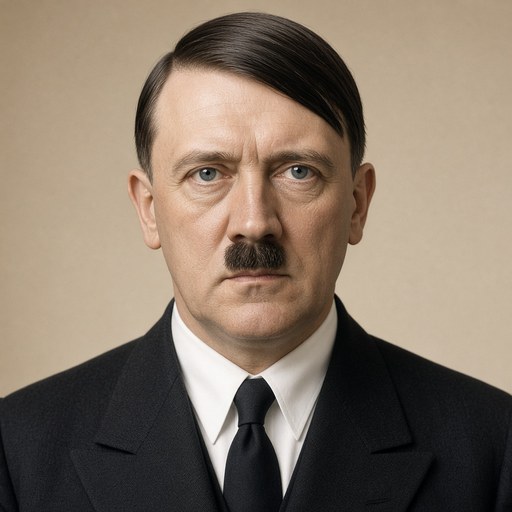

- Context
- Hitler delivered a eulogy for Fritz Todt in Berlin on February 12, 1942, praising his engineering and organizational work and conferring a new German order on him posthumously; the text also appends a separate party-anniversary proclamation.
- Main themes
- Eulogy for Fritz Todt, Todt's early National Socialist loyalty, Reichsautobahn construction, West Wall fortification, Todt Organization in wartime, Reich Ministry for Armaments and Munitions, social conditions of road workers, new German order of merit, winter crisis on the eastern front, antisemitic prophecy of extermination
- Duration
- ~28 min
- Words
- 3,382
- Sentences
- 152
- Readability
- 51
- Grade
- 11.4
- Syntax
- 3.02
- Vocabulary
- 2.31
The broad sphere of national life a sentence belongs to. Every sentence has an Arena, so it is the denominator the other indices are read against.
Other152 sentences in 40 paragraphs
Dear Mourners! Dear Mrs. Todt!
It is very difficult for me to honor a man whose deeds speak more clearly and more powerfully for him than words ever could. When we received the terrible news of the accident in which our dear party comrade Dr. Todt had become a victim many millions of Germans probably felt the same emptiness that we always feel when an irreplaceable man is taken from his fellow men.
The entire German Volk knows that the death of this man means an irreplaceable loss for us. And it is not only the creative man who was taken from us, but it is also the brave man and unforgettable comrade whose leaving hits us so hard.
Dr. Todt was a National Socialist. From the moment he gained knowledge of the movement for the first time, he was a National Socialist not only intellectually but also with all his heart. The first contact with the party in the year 1922, the first meeting with me, immediately directed him internally to me. It also obligated him to stand by what he felt was the only means of a German rebirth. Making the connection between the national and the social idea was neither a problem nor a question for the technician and engineer who was temporarily forced to earn his bread by the work of his hands. Rather, it was a categoric duty for him to fight for a true German resurrection, which had to be more than a mere restoration of a form of state whose collapse had proved it to be outdated. As early as 1922, it was clear to this man that the goal of a German uprising could not be the restoration of broken old forms. Instead, it had to be a revolutionizing of the German spirit, the German Volk, and its internal social order.
When Dr. Todt joined the movement, he was thirty-one years old. His life up to then had included, besides elementary school, studies at a classical secondary school. From 1910 to 1911, he served one year as a volunteer with the Field Artillery Regiment No. 14 in Karlsruhe. From 1911 until August 1914, he studied civil engineering at the Technical Universities of Munich and Karlsruhe. In 1913, he passed the preliminary examination at the Technical University of Munich. When war broke out, it took him to the western front along with the Field Artillery Regiment No. 14. In October 1914, the reserve lieutenant was seconded for duty with the Grenadier Regiment No. 110. In this regiment, he fought until January 1916. Then, he joined the Luftwaffe and became an observer navigator. Finally, he secured command over his own plane formation on the western front until the end of the war. He was injured in an air battle. In 1919, he finished his studies. In the winter of 1920, he passed the examination for his diploma at the Technical University of Karlsruhe. He wrote his doctoral dissertation at the Technical University of Munich: Sources of Defect in the Construction of Highway Surfacing Made of Tar and Asphalt.
On January 5, 1923, this Doctor of Engineering, Fritz Todt of Pforzheim, joined the NSDAP for good through the Ortsgruppe Eitting in Bavaria.
Immediately after the lifting of the ban on the party from November 23 until 1925, he again became a member. In the meantime, he agitated constantly. Not until 1924 were the various proceedings against him suspended. He joined the SA in 1931 and, as a true National Socialist, he began as a simple SA man. He then became Scharfuhrer. That same year, he was promoted to Standartenfuhrer. By 1938, he had risen to Oberfuhrer, Brigadefuhrer, Gruppenand Obergruppenfuhrer. Alas, his activities in the party are not summed up by his service with the SA. In the beginning, he worked for the Kampfbund (Combat League) of German Architects and Engineers in Munich.
Further, he was a technical adviser for road construction in the then NSDAP Office for Economic Technology and Job Creation. In 1932, he became the head of a team of civilengineering specialists, and regional head of the Kampfbund of German Architects and Engineers. In 1934, his section and the Kampfbund of German Architects and Engineers fused to become the technical office and, finally, the National Socialist League of German Technology under his leadership. In 1936, the technical office was upgraded to head technical office because of outstanding accomplishments.
In the meantime, this man entered that sphere of activity that for the first time presented him not only to the German Volk but also to a large part of the world. After the opening of the Automobile Exhibition in 1933, I tried to put into effect the then recently proclaimed principles not only regarding the improvement of the existing German road system, but also the construction of special expressways. This was a general plan, essentially regarding only basic issues. After extensive examination and deliberation, I believed I had found in Dr. Todt the man capable of putting this theoretical intention into practice.
A brochure published by him on new approaches to road construction was submitted to me. It reinforced me in my hopes. After long discussions, on June 23, 1933, I assigned him the task of building a new Reichsautobahn. Further, I entrusted him with a reform of the entire German road-construction system as inspector general for road construction. Through this, this man had found a role that he began to fill in a truly unrivaled and undying fashion. In their design and realization, the German Reichsautobahnen are the work of a uniquely inspired technician and artist.
I cannot imagine the German Reich without these expressways. In the future, these great lines of communication will as a matter of course extend to the entire European transportation system.
So great is the extent of the roads, which in this period were additionally widened, improved, and straightened with their blind bends eliminated, and of the bridges which were built, that only an intensive study can approximate an overall impression that does justice to this achievement. My dear party comrades, you will remember those stirring moments when this inspector general for road construction in Germany, Dr. Todt, spoke at the Reich Party Congresses in Nuremberg, briefly and pointedly summing up the progress on this assignment, which was beginning to surpass by far all engineering construction that the world had seen to date.
It was, therefore, a matter of course that this man was finally appointed plenipotentiary for the regularization of the entire building industry and held a privileged position as inspector general for special assignments in the Four- Year Plan.
Meanwhile, dark clouds on the horizon were beginning to signal the ever increasing threat of war against Germany. When the incessant inflammatory speeches by Churchill and his followers in England made it clear that the unstable situation in the parliamentary democracies might one day lead to a change in the regime controlling these countries and strike peace a blow, I felt compelled to speed up the defense of the Reich and to secure it generously.
I had arrived at a plan that provided for the construction of a large fortification across from the Maginot Line, but built according to different criteria so that, in any event, even if substantial German armed forces were tied down in the east, it would defend the vital west of the Reich against any kind of attack.
There was only one man who was capable of resolving this most [sic] unique engineering problem in the history of the world, and solving it as quickly as possible. On May 28, 1938, I announced my decision to the army and the Luftwaffe. At the same time, I gave instructions to inspector general, Dr. Todt, in cooperation with the appropriate military offices, to take on the responsibility for the construction of the most substantial part of this gigantic project. I stipulated that at least five thousand concrete and armored structures should be ready or ready for use by September 1938 at the latest. The first program was set at twelve thousand items total. This number increased to about twenty-three thousand in barely oneand-a-half years due to a steady expansion in general and, later on, through the structures built by the Luftwaffe as well as by fortress engineers. The current wartime experiences have only reinforced the conviction that no power on earth could have succeeded in breaking through this most gigantic fortification of all time. In its constructional design, in the purely organizational features of the construction, as well as in its technical completion, this miraculous work will for all time remain tied to the name Dr. Todt.
The outbreak of war immediately gave this mightiest organizer of the modern age new, additional tasks. A system of great marshaling routes had to be completed within the shortest time possible in areas of the Reich whose routes of communication in the past had been severely neglected. Thousands of kilometers of roads had to be either built or widened, paved, and rid of dust.
Yes, when the fighting finally began, the units created by this unique organizational talent marched behind or alongside the troops. They removed obstacles, destroyed bridges, improved roads. Everywhere, they constructed new crossings over valleys, canyons, rivers, canals, and so on. In so doing, they complemented the engineering troops in an irreplaceable manner. They relieved them and enabled them to move up closer to the advancing front in order to participate more actively in the fighting, which otherwise they would not have been able to witness.
The victory in Norway and the victory in the west brought new tasks.
Party comrade Todt, who had earlier been appointed Reich minister for armament and munitions and who therefore was responsible for putting a new, truly enormous area in order and under control, took on the additional task of protecting the conquered coasts against enemy attack by constructing new gigantic fortifications. Beyond this, the homeland and the front had to be provided with structures for passive and active air-raid protection. Never before in history had there been anything of this kind. To date, they are unrivaled and they will probably remain so for a long time.
This genius of an inventor and organizer succeeded in constructing, within the shortest time possible, concrete housing structures for numerous U-boats, structures that cannot be destroyed even by heavy bombs.
Gigantic battery sets made of concrete and steel were constructed according to his directions. Air-raid shelters were built for hundreds of thousands of men, some of which have not been equaled in any country on earth.
The war in the east set the Todt organization new tasks. The length in kilometers of the repaired roads and the numbers of the newly built bridges are infinite. With a minimum of helpers, this man mastered this entire tremendous project, in addition to his activities as Reich minister for armament and munitions.
In this respect, he was undoubtedly the greatest organizer that the German Volk has called its own up to now. Far from bureaucratization, he knew how, with the smallest conceivable apparatus of his own, to make use of all the offices and forces that had previously been responsible for the solution of his problems or which appeared useful otherwise. Much of what this man has created will come to the knowledge of the German Volk only after the war and will lead it to admiring astonishment. The creations of this man are so unique that we will never be able to thank him enough.
If I have been speaking of the technician and organizer Fritz Todt up to now, I must now make special mention of the man who was so close to all of us. You cannot characterize his personality better than by stating that this mighty ruler of men in the homeland never had a single enemy in the party or among his coworkers.
I must thank him especially that, despite his workload, he never forgot or abandoned National Socialist ideas and the goals of the movement. On the contrary, he became one of the creators of our ideology. And this applied especially to his attitude toward the social problems of life. The man who led millions of workers was not only intellectually a true socialist, but he was so with all his heart. Fate forced this greatest road engineer of all time to earn his daily bread by working as a common laborer, just as it forced me to do in my youth. He never felt ashamed of this. On the contrary, later on it was always a moment of proud and joyous remembrance when this greatest building supervisor ever known to the world could look at his own picture or show how, covered with dust and dirt, he worked on a road, his work clothes torn, or stood in front of a boiling kettle of tea. Because of this, he loved so dearly his “German road constructors,” as he called his roadmen. He constantly strove to improve their living conditions, which were often very difficult. He wanted to replace their old pitiful tents with modern bedrooms and living rooms and to rid their camps of the atmosphere of cold mass accommodation. Above all, he wanted to instill in the laborers the feeling that road construction-and the building trade in general-was a type of work which every single one of them could be particularly proud of. Not only because it creates products of great importance to man, but also products of great durability. Before Dr. Todt, the work of a roadman was not a very highly regarded profession. Today, the tens of thousands of German roadmen have become a proud community aware of its value. He has made a contribution to National Socialist educational work.
We must be particularly grateful to him for this today. If all human progress needs a model to strive for, then the Todt organization is such an example. It was about to develop further. Slowly, it intended not only to eliminate a social injustice here, but also thoughtless human stupidity for all time.
No matter whether this man was with laborers, ministers, or generals, he always remained the same. He was a self-confident as well as modest leader and the caring friend of all decent working Volksgenossen.
It is hence not surprising that this man, who so dearly loved his Volk, felt the same tender, loving attachment to his wife and children. Every free hour was, if at all possible, spent by this creator of the greatest technological buildings in viewing the great creations of nature, the little house at the lake in the midst of his beloved Bavarian mountains. While the West Wall was being finished, parts of which were already under fire by the enemy, and while the columns of the Todt organization joined up for the first time with the advancing armies in Poland and assured their supplies, I considered awarding him the Knight’s Cross for his role as one of the leading heads of the German resistance and the German will to self-assertion in this war. I changed my mind, because this award-as glorious as it is-could never have done justice to the importance of this unique man. I had already decided earlier to establish a German medal that, founded on the principles of our movement, would in several categories honor the greatest merits that a German could possibly earn in serving his Volk. After the conclusion of the campaign in France, I told Dr. Todt that I would one day acknowledge his unique merits by awarding him, as the first recipient, the highest class of this medal. From modesty, he did not want to hear of it at the time.
Like the National Award for Arts and Sciences, whose bearer Dr. Todt was, and which had first been awarded to the deceased Professor Troost, I confer, in the name of the German Volk and its National Socialist movement, the new order for the first time on our dear and unforgettable Dr. Todt, the inspector general of our roads, the architect of our West Wall, the organizer of our weapons and munitions in the great war of our Volk for its freedom and its future. For my part, I can add only a few words to this. With this man, I lost one of my most loyal assistants and friends. I see his death as a contribution of the National Socialist movement to the fight for freedom of our Volk.
Adolf Hitler – proclamation for the 22-th anniversary of the N.S.D.A.P.
(read by Gauleiter Adolf Wagner)
Fuhrer Headquarters, February 24, 1942 Party Comrades!
For the first time in many years, I am unable to participate in the day of commemoration with my oldest comrades in arms. I cannot well leave headquarters at a time when the winter is ending, a winter on which our enemies have placed all their hopes. From June to October 1941, German armies advanced over a thousand kilometers into the empire of an enemy who intended to destroy our Volk and our homeland for good. This winter-the like of which has not been seen in over a hundred yearssurprised us as early as late November 1941. Snow and frost temporarily halted the triumphant advance of the German Wehrmacht that was unique in history. Our enemies hoped that the German armies would then suffer the same fate as the Napoleonic retreat. This attempt pitifully failed. Above all, it failed because of the bravery and the willingness of our unique men to sacrifice, who side by side with our allies held out during the icy storms of December, January, and February as staunchly as they had before fought for their unfading victories in the heat of June, July, August, and September. Now that the worst cold is over, now that the snow is beginning to thaw in the Crimea and in southern Russia, I am unable to leave my post, as preparations for the final confrontation are being made, to settle accounts with this conspiracy in which the banking houses in the plutocratic world and the vaults of the Kremlin pursue the same goal: the extermination of the Aryan people and races.
This community of Jewish capitalism and Communism is nothing new to us old National Socialists, especially to you, my oldest comrades in arms. As before, during, and after the First World War in our country, so today the Jews and again only the Jews have to be held responsible for tearing apart the nations.
There is a difference, however, if we compare the present world struggle with the end of the war from 1914–1918. In 1919, we National Socialists were a small group of believers who not only recognized the international enemy of mankind but also fought him. Today, the ideas of our National Socialist and Fascist revolution have conquered great and mighty states. My prophecy will be fulfilled that this war will not destroy the Aryan, but, instead, it will exterminate the Jew. Whatever the struggle may bring, however long it may last, this will be its final result. And only then, after the elimination of these parasites, a long era of international understanding, and therefore of true peace, will come over the suffering world. Today more than ever, I am with you in spirit, my old National Socialists, since you were already my followers when, as [is still true] today, being a National Socialist only meant making sacrifices.
On this day, I am personally all the more inspired with the imperturbable confidence and the sacred faith that this mighty fight, in which we are engaged today and for which, back then, on February 24, 1920, we set out from this same hall in which you are now assembled, cannot and will not end differently from our own miraculous struggle for power in the German Reich. Just as Providence has blessed our fight in all those years, it will now let us win it for good! What used to be our party program are now the basis of a new and improving world.
Therefore, receive my greetings, which I convey to you through party comrade Adolf Wagner, as though I were standing in your midst.
In my thoughts, I am with you anyway in these hours!
Adolf Hitler