





- Context
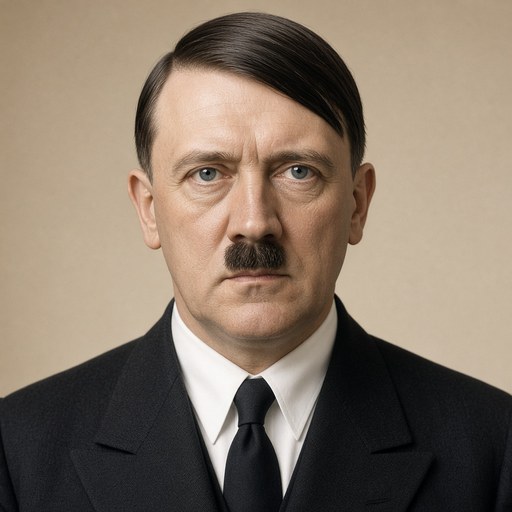
- Hitler addressed a Berlin audience at the Sportpalast on January 30, 1942, the anniversary of the Nazi seizure of power, defending the war, threatening Jews with annihilation, and promising victory after the Russian winter.
- Main themes
- Anniversary of the seizure of power, attacks on Churchill and Roosevelt, claimed National Socialist social achievements, hostility to Britain, prophecy of the annihilation of Jewry, Axis alliance with Italy and Japan, war against the Soviet Union, winter crisis on the eastern front, U-boat war against the United States, winter clothing collection, comparison with Frederick the Great, appeal to German workers
- Duration
- ~41 min
- Words
- 4,908
- Sentences
- 318
- Readability
- 70
- Grade
- 7.3
- Syntax
- 2.81
- Vocabulary
- 1.99
The broad sphere of national life a sentence belongs to. Every sentence has an Arena, so it is the denominator the other indices are read against.
Other318 sentences in 38 paragraphs
My German Volksgenossen! Comrades!
These days, every man may speak to that forum which he feels is most appropriate. One speaks in front of a parliament whose existence, composition, and development we are amply aware of. I believe that, on this day, I should return to where I come from, namely, the Volk! All those who sit before me now are also deputies, the only difference being that they do not collect parliamentary allowances. And I believe that this was probably decisive for the party: any weakling can manage victories, but only the strong can manage blows of fortune.
Providence gives the final and the supreme reward only to those who can handle blows of fortune. At the time, I suffered the first severe blow on a larger scale in the movement. It was overcome a few years later. The men who were close to me at the time know how much work and strength of nerve this cost us.
But I have also preserved this boundless faith, in my person as well, that nothing, no matter what, would ever be able to throw me out of the saddle, would shake me up anymore. Whoever thinks he can frighten me somehow or surprise me is wrong. I have always taken to heart the words of a great German philosopher: “A blow that does not knock a strong man over, only makes him stronger!”
Before I went to war, I had started a gigantic program of cultural, economic, and social work. I had begun it and, in part, I had already finished it.
Everywhere, new plans were being made, new projects being developed by me and my assistants.
By contrast, when I look at my enemies, what have they actually accomplished? It was easy for them to push for war, since they had nothing to show for peace. They had not accomplished anything that might speak for them. This garrulous drunkard Churchill, what has he created that is of lasting worth, this damned liar, this first-class lazy fellow? If this war had not come, then centuries would have spoken of our age and also of my person, as the creators of great works of peace. However, if Mr. Churchill had not managed this war, who would ever have spoken of him? This way, he will live on, as the destroyer of an empire. We are not destroying it, he is. He is one of the most pitiful glory-seeking vandals in world history, incapable of creating anything positive, or accomplishing anything. He is capable only of destroying. I do not even want to speak about his accomplice in the White House, who is only a poor fool.
However, the more we worked, the more we put Germany back in order, the greater the hatred became. To this was brought the narrow-minded hatred of social classes abroad, lest it be possible, under certain circumstances, to apply the German social example there. I often listened to foreigners telling me, “but National Socialist ideas cannot be realized in our countries.” I replied: I do not demand this. On the contrary, I am not here to worry about the happiness of other people. Rather, I feel responsible only for my own Volk. I will not add to my sleepless nights by taking on the burdens of worrying about foreigners. And, in spite of this, they say, “no, the example is already enough, it is the example that corrupts morals.” In this case, morals meant bad habits or vices.
They say, “you sail on your KdF ships; we cannot allow them to land here; that would corrupt our laborers.” Now, why would that corrupt their laborers? I cannot see why. The German laborer has worked more than ever before; why should he not have a rest? Is it not a joke when today the man in the White House says, “we have a program for the world, and this program for the world will give man freedom and the right to work.” Mr. Roosevelt-open your eyes! We have already done this in Germany a long time ago. Or when he says that the sick ought to be taken care of. Please leave the garden of our party program-this is National Socialist teaching and not yours, Sir! This is heresy for a democrat.
Or when he says, “we want laborers to have a vacation.” It is a little late to want this, since we have already put this into practice. And we would be much further along now if Mr. Roosevelt had not interfered. Or when he says, “we want to increase prosperity for the masses of laborers, too.” All these things are in our program! He might have seen them through, if he had not started the war. After all, we did all this before the war. No, these capitalist hyenas do not have the slightest intention of doing this. They see us as a suspicious example. And now, in order to lure their own people, they have to get in on our party program and fish out a few sentences, these poor bunglers. And even that they do imperfectly. We had a world unanimously against us here. Of course, not only on the right, but also on the left. Those on the left feared: “What are we going to do, if this experiment succeeds and he actually makes it and eliminates the housing problem? What if he manages to introduce an educational system based on which a talented boy, no matter who his parents are, can attain God knows what position? And, he is capable of doing it, he is already making a Reich protector out of a former farmhand. What if he really introduces an old-age pension scheme covering the whole Volk? What if he truly secures a right to vacations for the whole Volk, since he is already building ships? And he is bringing all this up to an ordered and secured standard of living. What are we going to do? We live by the absence of this. We live by this and, therefore, we must fight National Socialism.” What the others have accomplished-that, our comrades were best able to see in Russia. We have been in power for nine years now. Bolshevism has been there since 1917, that is, almost twenty-five years. Everyone can judge for himself by comparing this Russia with Germany. The things we did in these nine years. What does the German Volk look like, and what have they accomplished over there? I do not even want to mention the capitalist states.
They do not take care of their unemployed, because no American millionaire will ever come into the area where they live, and no unemployed man will ever go to the area where the millionaires live. While hunger marches to Washington and to the White House are organized, they are usually dispersed en route by the police by means of rubber truncheons and tear gas. Such things do not exist in authoritarian Germany. We deal with such problems without such things-rubber truncheons and tear gas.
In other words, we were truly confronted by a unanimous and hostile world. It was only natural that this hostility would increase with the seizure of power. I tried to initiate a certain foreign policy. You know about it from our time of struggle. I wanted to enter into relations with three countries: England, Italy, and Japan. It was completely pointless attempting to come to an understanding with England. The men there appeared unable to rid themselves of their prejudice, their insane ideology, and their stubbornness. They saw Germany as the enemy. These men were not aware that the world had considerably changed since the days of their great Queen Victoria. They did not realize that, in the end, it was not Germany which threatened their empire and that, if their empire was to be sustained, England would have to tie itself to Europe. On the contrary, they fought with Europe at every opportunity. Above all, one man did this, a man whom I have already mentioned a few times: Churchill. Any attempt to get him to consider an understanding ran aground at his saying, “I want war.” It was impossible to talk with this man and the clique surrounding him, for example, Duff Cooper, and so on. It is sad to name them; they are only zeroes. It does not matter. They are like unbreakable eggs: wherever they fall, they will remain for a while. As often as you like, you can throw them somewhere, even the English can, as for example Wavell. They have simply been ossifying for too long. For centuries, they have been our old, irreconcilable enemies, and I am not talking about the Jews now. They feared that we might thwart their plans or their lives. They hate us just as we must hate them because of this.
We are fully aware that this war can end either in the extermination of the Aryan people or in the disappearance of Jewry from Europe. I said as much before the German Reichstag on September 1, 1939. I wish to avoid making hasty prophesies, but this war will not end as the Jews imagine, namely, in the extermination of the European-Aryan people; instead, the result of this war will be the annihilation of Jewry. For the first time, the old, truly Jewish rule of “an eye for an eye, a tooth for a tooth,” will obtain.
And the more the fighting expands, the more anti-Semitism will spread- let that be said to world Jewry. Anti-Semitism will be fed in every prisoner-ofwar camp, in every family enlightened to the reason why, in the end, it has to make this sacrifice. And the hour will come when the most evil enemy of the world of all time will at least be finished with for the next millennium.
To my profound regret, all attempts to reach an understanding with the English proved futile, no matter what I did, no matter how often I held out my hand, no matter what I offered them.
I was all the more happy when I was able to obtain that relationship with the second state, which we had once striven for. Actually, it is not surprising.
Today, it would be surprising had things come differently. It is not merely a coincidence-I said this to a delegation today-if two people suffer almost identical fates in the course of barely a hundred years. Germany and Italy: in the last century, they fight for their rebirth as a state and its unification, then, for the first time, both states join together. Then, they part company, and their luck runs out. At nearly the same time in both states, a revolution takes place, a revolution whose ideas are as similar as can possibly be imagined for two people. Both revolutions run a nearly identical course. Everywhere severe setbacks, but victory in the end. The program of both revolutions is social and national rebirth. Both staunchly see this program through. Both elicit the hatred of the surrounding world. Both revolutions represent nations whose soil does not yield them their daily bread, in spite of all diligence. Contrary to their will, both nations are one day confronted by the same enemies, by the same international coalition. This begins as early as 1935, as England suddenly turns against Italy for no reason whatsoever. Italy has not taken anything away from England. But England does not want Italy to have its independence. The same goes for us, since England does not want Germany to have its independence.
What are we taking away from England, what from France, what from America? Nothing at all! How many times did I offer them peace?! What else should I be offering them? They are men who say, like Churchill, “I want war.” With them, there is a certain clique. And behind these corrupt, drunk creatures, there are the paying forces of international Jewry. On the other side, there is an old Freemason who believes that through a war he can win time for stabilizing his bankrupt economy again. And so, both states again confront the same enemies for the very same reasons. And they are forced to fight together, to lead the same struggle, which ties them in life and in death.
And there is a fourth element: in both cases, there are two men who come from the people, who have kindled the revolutions and have uplifted their states. In the few free hours I have had these last weeks, I read a lot about the Fascist revolution in Italy. It seemed to me as though I had before me the history of my own party: everything so similar, so much the same. The same struggle, the same enemies, the same opponents, the same arguments-it really is a miracle. And now, we fight in the same theaters of war: Germans in Africa, Italians in the east. We fight together, and nobody should deceive himself: This struggle will be seen through to our joint victory! And finally, a third state joined us. For many years, I have wanted to have good relations with this state-Japan-as you know from Mein Kampf. And so, the three great have-nots are now united. We will see who will be stronger in this struggle: those who have nothing to lose and everything to win, or those who have everything to lose and who cannot win anything. What does England want to win? What does America want to win? They have so much that they do not know what to do with all they own. They need to feed only a few people per square kilometer. They do not have all those worries that trouble us. For us, a single bad harvest is a national disaster. They have the whole world at their disposal. For decades now, they have robbed us, exploited us, bled us white, and still they have not eliminated their own economic misery. They have more raw materials than they could possibly need, and still they have not managed to find a reasonable solution to their problems. We will see on whom Providence will bestow the victor’s laurels in this struggle: on the man who has everything and wants to take even the last bit from the man who has almost nothing, or on the man, who defends the last bit he owns. And when a British archbishop prays to the Lord that He might strike Germany and Europe with Bolshevism as a punishment-then I can only say, it will not come to Germany. But whether or not He will strike England, that is another question.
Then this old sinner and blasphemer can try to avert this danger through his prayer. We never did anything to England, France, or America. In spite of this, a declaration of war followed in the year 1939. And now, it has expanded.
But now you must try to understand my point of view, which is based on my development. I once said something that nobody understood abroad. I said: if war is inevitable, then I prefer to wage it myself. Not because I thirst for sinister glory. On the contrary, I would prefer to do without this type of glory, which is no glory in my eyes. If Providence preserves my life, my pride will be the great works of peace which I still intend to create. On the other hand, since Providence has decreed this battle to be fought out in accordance with its impenetrable will, I believe that I can only ask Providence to entrust me with the burden of this struggle with which it burdens only me. I will bear it and I will not shy away from responsibility. In the hour of want, I will take it upon myself. I wish to bear the entire responsibility, just as I have borne it up to now. I exercise the greatest authority among this Volk. It knows me. It knows of all the plans I had in all the years before the war. Everywhere there is evidence of the beginning of this work and, in some instances, documents of its completion. I know that this Volk trusts me. I am so happy to know this. The German Volk may rest assured of one thing: as long as I live, there will never be another year 1918, because I will never abandon my cause.
I am happy that so many allies have now joined our soldiers: Italy in the south, Finland in the north. Between them, there are all those nations that have also sent their sons east: whether they are Romanians or Hungarians, Slovaks, Croatians, Spaniards, Belgians-yes, even French-they all participate in this struggle. In addition, there are the volunteers of our Germanic states from the north and from the west. Today, it has already become a war of Europe. And, finally, in the east, there is a new ally: Japan, which has already cured one gentleman of his ridiculous plans.
I will say very little on the war itself. History says it plain enough: in 1939, the elimination of Poland, in 1940, Norway, France, and England, the Netherlands, and Belgium, and, in 1941, first the Balkans and, finally, the state which a chatty Mr. Cripps told us a few days ago had been preparing for the confrontation with Germany for years. I understood this the moment I realized that they were putting one over on us. The second I was informed that Churchill had already referred to this new ally in secret sessions, the situation became clear to me. And when the hour came for Molotov to say farewell here in Berlin under the impression that his demands had failed, it was quite certain that there would be a confrontation. I am grateful to Fate for putting me at the head of the Reich, and for granting me the time to deal the first blow fourteen days or three weeks before this. If there has to be a fight, then, in my opinion, the first [blow] may be the decisive one. And we saw this in East Asia, too. We can only congratulate Japan that, instead of allowing these damned liars to provoke it any longer, it struck without hesitation.
Since June 22, our soldiers of the army and the Waffen SS have been fighting a war in the east that will enter history as the heroic epic of our Volk.
At sea, our naval forces and our U-boats will foil the intentions of President Roosevelt. He intended, by ever new declarations on American territorial waters, slowly to drive the German U-boats from the ocean through simple acts on paper. He wanted to force them into a small area that could have been protected by British naval forces.
That, my Volksgenossen, was the reason for the declining number of sinkings. It was not the poor quality or the declining numbers of U-boats. On the contrary, their number has enormously increased. It was not the lack of courage of our crews, nor the impossibility of an attack. It was solely this procedure of restricting our freedom of action by way of declaration. You will understand that it cost me great effort to decide whether to put an end to this fraud and falsehood, or whether, for the sake of peace, to accept one restriction after another. Japan’s attack put an end to our misery. Now they [the Americans] will have to sail in convoy on the oceans, and they will find out how our U-boats work. Whatever plans they may have and whatever these look like, we are ready from north to south, from the coast [sic] to the east. They should realize one thing: they will meet with a Germany different from the Germany of old. They will meet with a Frederican Germany. We stand firm, and where we stand, we will not give up a foot of ground without a fight. And even if we do, we will immediately counterattack the enemy. We are happy to know since yesterday that, at the moment they [the English] all thought that they had beaten him, our Colonel General Rommel, along with his brave Italian and German panzer and motorized units, immediately turned and drove them back. And they will witness this for as long and as often as it takes for this war to end in our victory.
In addition to these forces, there is a third one: the Luftwaffe. Its glory is unfading. The things they have accomplished in the course of the operations in the arctic cold of the north, in the east, or in the heat of the desert, or in the west, it is the same everywhere: a heroism that simply cannot properly be rewarded by medals.
These three forces comprise everything that belongs to them. I cannot single out a particular branch. Nevertheless, there is one force that I must mention in particular: it is our infantry.
Behind these forces, there is a traffic infrastructure with tens of thousands of drivers and railroad workers. They all work hard. They will master the most difficult tasks. After all, it is obvious that it was not easy to shift from a forward strategy to a defensive one in the east. The Russians did not force us to go on the defensive, but the temperatures of thirty-eight, forty, forty-one, and, in part, forty-five degrees below zero. No unit can fight in this cold if it is not used to it, no more than it can fight in the heat of the desert during the warm months. The moment we were forced to make this adjustment, I regarded it as my duty to take responsibility for it on my shoulders. In so doing, I wanted to become even closer to my soldiers. And, at this point, insofar as they can hear me today at this icy front, I want to assure them: I know what you are accomplishing, but I also know that we have the worst part behind us.
Today, it is the thirtieth of January. The winter was the great hope of our eastern opponent. It will not fulfill his hope. Within four months, we have moved almost up to Moscow and Leningrad. Four months of winter in the north are now over. In single spots, the enemy advanced a few kilometers. He sacrificed hecatombs of blood and human life for this. Perhaps this does not matter to him. However, in a few weeks, winter will be over in the south, and spring will slowly move northward. The ice will melt, and the hour will come when the ground will be hard and firm again. Then the German front-line soldier will again be able to operate his equipment on this ground. The homeland will send new weapons. And then, we will beat the enemy and avenge all those who fell victim only to the frost. Let me tell you, the soldier at the front has not lost his feeling of superiority over the Russians at all. It would be an insult to compare him with them. What is decisive is that we succeeded in making this shift from the offensive to the defensive, and I can say: it was a success! The fronts-they stand. And in those instances where Russians did break through and thought that they would be able to occupy small towns, there are no more small towns. There is only a heap of ruins. What does this matter compared with what we do occupy, what we put in good order, and what we will put in order, either in the spring or afterwards? After all, behind this front, there stands today a worthy German homeland. A few days ago, realizing that all our preparations were still insufficient for the defense against the Far East, I directed an appeal to the German Volk. I now want to say my thanks to this Volk. This appeal also represented a vote. While the others talk of democracy, this is real democracy! Just how real has been shown by these last days. I know what many poor people have given, but this time there were many, many for whom it was difficult or for whom it would have been impossible before to give away their valuable furs. But today, they did give them, realizing that even the least important front-line soldier is worth more than their most valuable furs. I have seen to it that things did not go as they did in the World War, when the homeland delivered the copper and one copper-delivery company paid a 2,260% dividend, or when the homeland delivered leather and a leatherprocessing company paid a 2,700% dividend. In the Third Reich, whoever tries to enrich himself during the war dies. Because nobody knows whether there is not a poor little front-line soldier up front whose hand could have been saved by a pair of gloves, or who could have been protected against the frost by a warm coat which somebody at home deprives him of. I will look after the interests of the soldiers here. And, I know that the entire German Volk is behind me on this! So I can assure you of one thing on this January 30. I do not know how this year will end. Nobody can say whether the war will end in its course. But I do know one thing: wherever the enemy makes an appearance, we will beat him, just as we have up to now! It will again be a year of great victories.
And just as I always carried the flag in earlier days, I now hold it high all the more. How different my position is today!
My German Volksgenossen! My Soldiers! We have a glorious history behind us. And one does enjoy making comparisons to this history. In the course of this history, German heroes often fought in spite of a seemingly hopeless inferiority. However, we must not draw comparisons to the Frederician age, for instance. We have no right to do so. We have the strongest army in the world. We have the strongest air force in the world. By contrast, Frederick the Great had to fight against a nearly overwhelmingly superior force. When he fought the first Silesian War, two million seven hundred thousand Prussians confronted a state of at least fifteen million. When, seven years later, he was forced to wage the third one, three million seven hundred thousand or three million eight hundred thousand Prussians confronted around fifty or fifty-four million others. A man with an iron will held high his banner, in spite of all setbacks, and never despaired of his people. Every time that he felt like despairing, he pulled himself together again and took the flag anew into his strong hand. What do we want to say about ourselves today? We confront an enemy who might right now enjoy a numerical superiority over us. However, this will change in the spring again. We will defeat him again. Because then our time will come again. And it will be like this everywhere. But, above all, we have allies today. It is not as in the World War anymore. We cannot assess what Japan alone is accomplishing in the east.
For us, there is no other way than to struggle and to succeed. It may be difficult or it may be easy-but never will it be more difficult than the struggles of our ancestors. We should not expect it to be easy.
In so doing, we have a better comprehension of the sacrifices that our soldiers are making. Having been a soldier once myself, [I say that] nobody comprehends this better than I do. Today, I still think of myself as the first front-line soldier of the Reich. At the time when I was only a soldier, I did my duty. Today, I do it as unwaveringly. On the other hand, I understand the suffering of my comrades; I know how they feel. Therefore, I cannot and will not indulge in windy rhetoric. After all, they would not understand this. I can only tell them one thing: my comrades, the homeland knows what you have to go through.
The homeland knows what it means to lie in snow and ice-at thirty-five, thirty-eight, forty, forty-two degrees below zero-in order to defend Germany.
But, because the homeland knows this, it will do all it can. It wants to work, and it will work! And I have to appeal to you myself: German Volksgenossen at home, work, make weapons, make ammunition, make new weapons, make new ammunition! You will save the lives of many comrades up front. Build means of transportation and work on them so that all this can actually get up front.
Then the front will stand. It will do its duty. Then the German nation can rest assured that the prayer of that satanic priest who wished Europe to be punished by Bolshevism will not come true. A different prayer will come true.
Lord, give us strength so that we can preserve our freedom, our Volk, our children, and our grandchildren. And we will do so not only for our German Volk, but for all the people of Europe. Because this is not a war that we wage only for the German Volk. Rather, it is a struggle for all of Europe and for all of civilized mankind.