





- Context
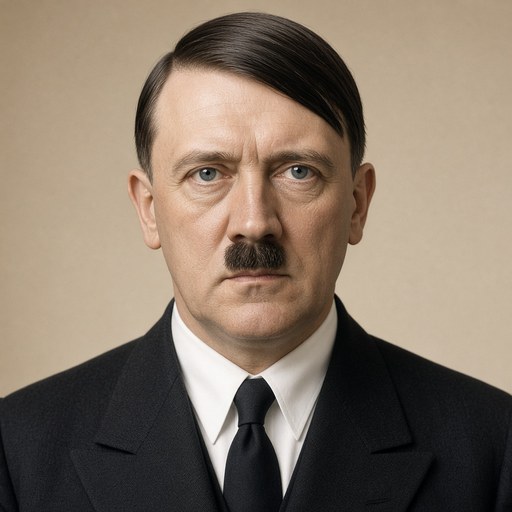
- Hitler spoke in Regensburg on June 6, 1937, to a German audience, asserting state authority over the Churches, citing economic recovery and rearmament, and claiming Germany was peaceful but would defend itself.
- Main themes
- Obedience and authority within the Volk, state authority over the Churches, Volksgemeinschaft and national unity, May Day as day of resurrection, reduction of unemployment from seven million to 800,000, work as the basis of money, German rearmament and the new Wehrmacht, claimed peaceful intent and defence against attack, dismantling of the Treaty of Versailles, religious division and the Thirty Years' War, belief in Providence
- Duration
- ~13 min
- Words
- 1,500
- Sentences
- 68
- Readability
- 56
- Grade
- 10.4
- Syntax
- 2.95
- Vocabulary
- 2.22
The broad sphere of national life a sentence belongs to. Every sentence has an Arena, so it is the denominator the other indices are read against.
Other68 sentences in 12 paragraphs
Though, mind you, former members of the bourgeoisie and former aristocrats also have their place in this Movement. To us it makes no difference where they come from; what counts is that they are able to work for the benefit of our Volk. That is what matters. […] For subordinating oneself is something every person must do. We, too, subordinated ourselves. For nearly six years I was a soldier and never voiced a contradiction, but instead simply obeyed orders at all times. Today Fate has made me the one who gives orders. And this I must demand of every German: you, too, must be able to obey; otherwise you will never be deserving or worthy of giving orders yourself! That is the prerequisite! It is thus we shall train our Volk and pass over the stubbornness or stupidity of the individual: bend or break-one or the other! We cannot tolerate that this authority, which is the authority of the German Volk, be attacked from any other quarter.
This also applies to all the Churches. As long as they concern themselves with their religious problems, the State will not concern itself with them. If they attempt, however, to presume by virtue of any actions, letters, encyclicals, etc. to claim rights which accrue solely to the State, we will force them back into their right and proper spiritual-pastoral activities. Nor is it acceptable to criticize the morality of a state from that quarter when they have more than enough reason to call their own morality into question? 108 The German leadership of state will take care of the morality of the German State and Volk-of that we can assure all those concerned both within and without Germany.
[…] Hence this May Day is the illustrious holiday of the resurrection109 of the German Volk from its disunity and its fragmentation. It is the illustrious day of the erection of a new and great Volksgemeinschaft that unites city and country, workers, peasants and intellectuals above and beyond any divisions, allowing the Reich to stand as sole presider over all in full panoply.
What is, therefore, more logical than for us to again wholeheartedly pledge ourselves to our Volk on this day of all days? We cannot renew this pledge often enough: that we wish to belong to this Volk, that we wish to serve it and will endeavor to understand one another; that we wish to overcome all that divides us and thus defeat the stupid doubters, the mockers and the incessant little cavillers; that today above all we wish to renew our faith in our Volk, our confidence that it is a marvelous, competent, industrious, and decent Volk, and that this Volk shall have its future because we are the ones responsible for that future!
Adolf Hitler – speech in Regensburg June 6, 1937 For us there was the hard choice: either-or! Either relinquishing claim to the remnants of a bad past, remnants that had become as ridiculous as they were harmful-or relinquishing claim to the future of Germany. We would rather relinquish claim to the past and fight for a future! You are standing here in an ancient German city in which a King once erected the Walhalla with the bequest to unite in it all great German men of our history and hence lend expression to the German Volk’s indissoluble bond of blood. We believe that today we have practically accomplished our primary task of creating one Volk; before us stands a goal, and this goal has hypnotized us. It is under the spell of this goal that we march on! Let he who stands in our way not complain if, sooner or later, the march of a nation sweeps over him.
We have not practiced a policy of using cheap popular phrases. We have divested money of its phantom-like traits and assigned to it the role it deserves: neither gold nor foreign exchange funds, but work alone is the foundation for money! There is no such thing as an increase in wages if it does not go hand in hand with an increase in production. This economic insight has enabled us to decimate seven million unemployed to approximately 800,000 and to keep prices almost completely stable for all essential vital goods. Today there is work going on everywhere. The peasant is tilling his fields, the worker is supplying him with manufactured products, an entire nation is working.
Things are looking up!
The German Volk is not a Volk that suddenly starts a war today or tomorrow. The German is not only peaceful and peace-loving in his entire being, but above all peaceable. He wants to work.
In our country there are millions of peasants who want to till their fields and harvest their crops; millions of workers want to pursue their work. This Volk does not want to quarrel, but it equally does not want others to look for a quarrel with it. It wants only its right to live-though, mind you, it does not stand for insult or attack from just anyone who comes along. And to anyone who believes that, since the German Volk is so peace-loving, he can drop bombs on German ships underway on international assignments, we will demonstrate that we know how to defend ourselves.
It is for the protection of our liberty and hence our honor that we have built up this grand, new German Wehrmacht. German man, you no longer need to bow your head; you once again have equal rights and can walk proudly in this world with your head held high. For you know: no one will touch you without the entire Volk coming to your rescue! This equality of rights also constitutes the single prerequisite for the effectiveness of our immeasurable economic labor: would anyone work at all for an economy if he could not be certain that the fruits of his labors can neither be stolen from him nor reduced? Would anyone give thought to the future of financial projects if he lacked the security only liberty can vest in a Volk? There would be no financial enterprise were not the steel shield of the nation’s armor held above it! If anyone tells us we will not be able to wear it in a short time, may he take note: the German shall wear his steel helmet! In any case as long as the others are able to wear it! Yet should ever the time come when the helmets must truly be removed, we will remove ours, too, with honor-but always be prepared, if necessary, to put them back on our heads immediately. I believe this is absolutely the best way to ultimately promote the cause of peace. Only a few days ago I was happy to hear from the lips of an English statesman that Great Britain would only be in a position to enforce peace, if a large stock of arms were placed at its disposal. That is also my opinion with respect to Germany. In scarcely four years, we have dismantled piece by piece the Treaty that was thrust upon us and brought the greatest disgrace upon our Volk; we have liberated the nation and restored to it all the qualities that characterize a free people and a free nation. I will never allow anyone to ever again tear this Volk asunder, to reduce it to a heap of warring religious camps.
We have gone through enough in German history and need not undergo any more such experiences. They have been the sorriest experiences ever. Once our Volk numbered 18.5 million people; after a thirty years’ war, a mere 3.6 million were left. 137 It is my belief that some of those who are dissatisfied with the fact that we have finally created one Volk will attempt to reestablish that situation in Germany, but this attempt, too, will fail: they will never, ever destroy the German Volk and the German Reich.
[…] Generation after generation of our Volk will march on thus in our history, with this banner always in mind, this banner that places us under an obligation to our Volk, its honor, its freedom, and our community-to our truly National Socialist fraternity. They will then consider it only natural that this German Volk takes but the one path Providence has bade it take by giving these people a common language. We, therefore, go our way into the future with the deepest belief in God (Gottglaubigkeit). Would all we have achieved been possible had Providence not helped us? I know that the fruits of human labor are hard-won and transitory if they are not blessed by the Omnipotent (Allmacht). Work such as ours which has received the blessings of the Omnipotent can never again be undone by mere mortals. As long as the pillars of the Movement hold this banner fast in their grip, there is not an enemy alive, no matter how powerful, who will ever be able to wrest it from our grasp.