




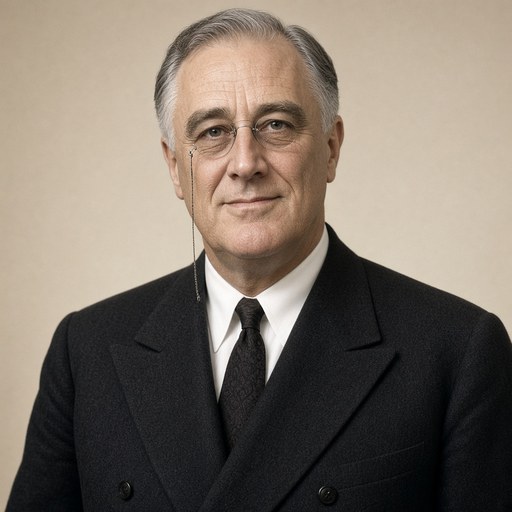

- Context
- Roosevelt spoke from the rear platform of his train at Syracuse, Kansas, on October 12, 1936, addressing local residents on drought relief and the federal program to stabilize farm prices.
- Main themes
- Drought relief in Kansas, federal drought alleviation work, farm price stabilization, wheat prices compared with 1932, speculators and price fluctuations, water table and water supply for farmland, best use of land, agricultural program for the nation, security of farming as a career, national problems solved nationally
- Duration
- ~4 min
- Words
- 459
- Sentences
- 22
- Readability
- 75
- Grade
- 8.0
- Syntax
- 2.74
- Vocabulary
- 1.63
Source: The American Presidency Project ↗
The broad sphere of national life a sentence belongs to. Every sentence has an Arena, so it is the denominator the other indices are read against.
Other22 sentences in 5 paragraphs
My friends, I have been trying to persuade some of the Eastern people on this train that this is not Syracuse, New York. A good many of them I think have never been west of the Mississippi before, but I have been through here a good many times in my life. I am glad to come back.
As you know, I have been watching some of the difficult problems that you have had to face during this past summer. I realize what the drought has done all through this part of the country, and I want to tell you that I am very, very much interested in the work that the Federal Government is trying to do to alleviate drought conditions so that they will not be as bad in the future as they have been this year.
We have an enormous number of national problems which we are trying to solve in a national way. Things certainly are better. At least, people who raised only five or ten bushels of wheat to the acre got more than twenty-five or thirty cents a bushel, which was the price in 1932. Because we know we always have to look ahead with respect to farming or business or anything else, the Federal Government has planned a program for the agricultural part of the Nation which is going to maintain prices. That is a long step. If, in addition to that, we can bring more water to the land where needed by keeping the water table up, and if we insist on using land only for its best purposes, then farming in the days to come will be a much more secure career for anybody than it ever before has been in our country.
The first thing we are trying to do is to stabilize prices. After all, you are not the only people who have been 'farming. I have done it myself both in the North and the South. One of the things we have suffered from most is the fluctuation of prices in the last ten or fifteen years, prices running up and down the scale as much as 400 or 500 percent. I want to be able to know, when I plant a crop, approximately what it is going to bring when I harvest it. That is one of the results for which we are working. When you have these fluctuations, there is only one group which benefits from them—speculators. We want an agricultural system in which the growers of crops make the profits rather than the speculators in crops.
I am glad to get into Kansas again. I wish the train were not pulling out because I would like to say a lot more to you. Good night.