




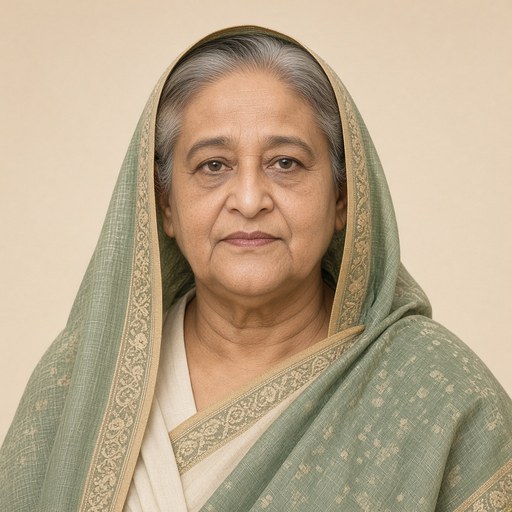
HPM Sheikh Hasina's statement at "South-South and Triangular Cooperation in Scaling up Innovation in Public Service Delivery" seminar
 Sheikh Hasina · Prime Minister of Bangladesh
- Context
- Hasina addressed a UN seminar on South-South and Triangular Cooperation on the sidelines of the 71st UN General Assembly in New York on 21 September 2016.
- Main themes
- South-South and triangular cooperation, public service delivery innovation, Digital Bangladesh, ICT for development, citizen-centric governance, SDGs and Agenda 2030, whole-of-government approach, transparency and accountability, South-South Network of Public Organizations, innovation capacity building
- Duration
- ~4 min
- Words
- 498
- Sentences
- 35
- Readability
- 31
- Grade
- 12.4
- Syntax
- 2.59
- Vocabulary
- 2.66
The broad sphere of national life a sentence belongs to. Every sentence has an Arena, so it is the denominator the other indices are read against.
Other35 sentences in 15 paragraphs
Excellencies, Distinguished Guests, Ladies and Gentlemen.
Assalamu Alaikum and a very good morning to you all.
It is my pleasure to join you all. I am delighted to see my colleagues – both from the North and the South –present here to share their valuable perspectives.
South-South and Triangular Co-operation have demonstrated their effectiveness to inspire international solidarity in achieving the MDGs. There remains a huge potential of this cooperation in realizing SDGs as well. This, however, calls for sincere commitments, deeper engagements and action-oriented approaches among the parties involved.
Excellencies,
In Bangladesh, we have brought transformative changes to the government, as we respond to rapidly growing expectations of our citizens. We are committed to developing a citizen-centric and inclusive government. We have adopted a three-pronged approach in this regard.
First is to develop the innovation capacity of providers, more importantly government officials. Thousands of officials have undergone ‘empathy training’ to eliminate age-old complex processes from the system. This has considerably reduced time, cost and frequency of visits – known as TCV – to improve services access by the common people.
Second is to extensively utilize ICTs for decentralizing service delivery to elevate Bangladesh to a middle-income country by 2021. We call this vision as ‘Digital Bangladesh’. We have introduced thousands of one-stop service delivery outlets, known as ‘Digital Centres’ to bring both public and private services to the doorsteps of millions of people. We have created government information portals, virtually uniting 43,000 government offices.
Third is to increasingly taking a whole-of-government approach to address problems, rather than following the traditional silo approach by the ministries and agencies. The a2i programme at my office is spearheading this initiative. I appreciate the support of UNDP and USAID in this endeavour.
This three-pronged approach has led to hundreds of innovations that ensured qualitative changes in sectors like agriculture, health, education and land use. Service Innovation Fund has been launched to encourage innovators to bring creative solutions to development challenges.
Social media platforms are being used to redress citizens’ grievances in a significant way. This has not only made public service delivery efficient and cost-effective but also guaranteed greater transparency, accountability and quality of the service. This has also contributed to strengthening of trust and confidence between the government and the citizens.
Ladies and gentlemen,
Attaining an equitable and sustainable development would remain a distant reality, if we fail to ensure governance and encourage innovation. Bangladesh has already signed MoUs with Maldives and Bhutan to collaborate on promoting and scaling up public service innovations. In this context, we propose to establish a ‘South-South Network of Public Organizations’ to develop a broader understanding and exchange of public sector innovations among the global South. It would also facilitate generating ideas, sharing experiences and learning from each other. I urge my friends from the South to positively consider this proposal and friends from the North to support this initiative within the Agenda 2030 framework. I thank you all.
Khoda Hafez
Joy Bangla, Joy Bangabadhu.