




PRESIDENT ISAIAS AFWERKI’S INTERVIEW WITH LOCAL MEDIA OUTLETS (Third and Final Part)
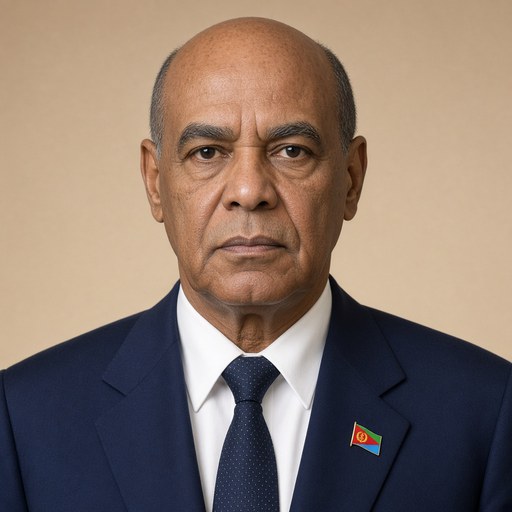
 Isaias Afwerki · President of Eritrea
- Context
- Afwerki gave the third part of a local media interview in January 2026, detailing Eritrea's 2026 domestic development agenda covering infrastructure, water, and energy.
- Main themes
- National development priorities, infrastructure development, water development and access, energy and electricity, road and transportation networks, renewable energy, regional peace and stability, nation-building, resource mobilization, rural and marginalized communities, decentralized mini-grid systems, water conservation and dam construction
- Duration
- ~16 min
- Words
- 1,927
- Sentences
- 126
- Readability
- 9
- Grade
- 15.8
- Syntax
- 2.77
- Vocabulary
- 2.38
This is an interview, press conference or exchange with other speakers. It is split into sentences and counted in the corpus, but its sentences are not tagged on the twelve indices.
126 sentences in 36 paragraphs
Q. 6: Mr. President, turning to domestic affairs, you have repeatedly stated that, under all circumstances, national development remains our foremost priority. In your previous interview, you noted that inclusive, well-organized national development initiatives are planned for 2026 to strengthen implementation effectiveness. Can you provide a comprehensive illustration of these initiatives?
PIA: As stated, peace and stability are essential preconditions for national development. In this respect, the precious sacrifices we paid during the liberation struggle to secure peace and stability were immense indeed. Ascertaining our independence was crucial for embarking on unencumbered development. But even during the liberation struggle, the task of development was never postponed. In many respects, the nation-building that follows liberation is more complex. It requires time, material resources, institutional capacity, and sustained coordination, particularly in a fragile region such as ours.
Compared to many others, Eritrea enjoys internal stability, which provides a vital opportunity for vibrant nation-building in comparative terms. To sustain this peace, we must foster integration and solidarity within the region. Despite global and regional instability, nothing will deter our developmental agenda. Under all conditions, development remains our priority. While specific sectoral priorities may be affected by prevailing circumstances, the overall national development program will remain unaffected.
Infrastructure
As we transition from 2025 to 2026, infrastructure remains a central priority. Large-scale programs in road and building construction have been implemented. However, outcomes have not yet met expectations, and assessments indicate the need to improve organization, resource mobilization, and implementation capacity.
The importance of infrastructure – particularly road networks – in driving economic development cannot be overstated. Accordingly, 2026 will focus on comprehensive interstate and intrastate transportation programs. Beyond asphalt roads, the construction of durable unpaved roads will also be expanded to improve accessibility for communities in remote and marginalized areas.
Compared to previous years, implementation in 2026 will be supported by enhanced organizational capacity, increased availability of machinery, equipment, construction materials, and skilled labour.
Water Development
Water development stands at the forefront of national priorities, even exceeding infrastructure in urgency. Water is indispensable for drinking, sanitation, agriculture, livestock, and industrialization. Although it has long been a national priority, progress to date has been unsatisfactory and requires our intensified, sustained efforts. Technical tudies conducted by GIS on water and soil conservation provide a comprehensive foundation for future interventions, including the construction of minor and major dams, catchment systems, and enrichment planting to control water flow and restore watersheds.
Our strategy goes beyond water-storage infrastructure alone. Expanded water-flow recovery initiatives, improved control systems, and the integration of modern technologies are necessary to enhance efficiency. In parallel, pipe-based distribution networks will be extended to reach all localities.
Our immediate priority is to ensure that marginalized communities get reliable access to clean water for domestic use, agriculture, and livestock. Whether sourced from wells, rivers, or desalinated seawater, dependable supply systems must be established. This is not a new undertaking but an integral component of the long-term national water strategy. The 2026 initiatives – focusing on increasing water capital, flow recovery, and distribution – represent one phase within this broader plan.
Energy
Following water development, energy – particularly electricity – constitutes the next strategic priority. In the beginning electricity generation was largely reliant on the Hirigigo power plant, but its capacity was already diminished and was inadequate to meet industrial, agricultural, and other developmental demands. For years, only repair and maintenance services were provided. However, over the past three to four years, a cohesive national energy master plan has been formulated.
To provide inclusive electricity access across all regions of the country, decentralized mini-grid systems have been identified as more practical than the reliance on a single national grid. Accordingly, the program will be launched with twelve independent mini-grid power centers.
Regarding energy sources, thermal generation using fossil fuels remains insufficient for long-term sustainability. Renewable alternatives are being prioritized and can replace thermal services with hybridized sources. Solar energy is a primary option, supplemented by wind power, while geothermal energy represents a highly sustainable source. Eritrea’s position along the Great Rift Valley provides substantial untapped geothermal potential that must be developed. Nuclear energy can also be a long-term possibility; notably, feasibility studies conducted during the establishment of the Kagnew Station in Asmara once proposed the development of a small nuclear plant to address energy needs. Even though such options may seem distant, they are technically feasible.
The initial target is to develop 360 megawatts through 12 mini-grids, each gradually expanding to 30 megawatts. These grids will then be interconnected to form a national grid. What is being constructed now represents the foundational phase of that system. Once all grids are interconnected, the national grid is projected to increase from 360 megawatts to approximately 2,000 megawatts.
This energy program is being implemented in accordance with the national master plan. Timelines and operational modalities are defined within a structured schedule, and implementation is already underway. Of course, articulating such plans is far easier than executing them. Therefore, the acquisition of advanced technologies to accelerate progress will remain one of our key priorities.
Equally essential is professional human capital. The success of this program depends not only on financing and technology but also on the availability of skilled personnel to operate, maintain, and expand these systems sustainably. In earlier phases, solar street lighting was introduced as a pilot program, and although its reliability was initially uncertain, these trials tested technological effectiveness, familiarized stakeholders/ institutions with advanced systems, and developed local technical capacity aligned with modern energy infrastructure.
Other Sectors
Beyond the priority programs mentioned, detailed sector-specific initiatives are underway in infrastructure, water-flow recovery, and energy, alongside additional national development programs that must not be neglected. Transportation services require expanded material and human resources, as well as continued road improvement. Residential housing remains a key concern. Marine resource development, agriculture, and mining projects are likewise progressing as part of a comprehensive national development agenda.
Education and Human Capital
The principle expressed in the proverb “ ኬድካ ኬድካ ካብ ጉይይ ምውዓል ክሳድ ምሓዝ ”, (which roughly translates into: “ better to focus on pivotal node than meandering around”, remains especially relevant because sustainable progress depends on steady, cumulative effort.
Education is the foundation of all development. Ultimately, whether infrastructure, water, energy, housing, transportation, mining, or industry, every sector depends on capable human resources. Material assets and financing yield results only when matched with skilled and competent professionals. No development program can succeed without education. If there is one priority above all others, it is education.
Accordingly, vocational, technical, and professional education must be elevated to the highest level. Development programs require a workforce with practical, applicable expertise, not merely academic certification. Employment in key sectors must be organized to sustain continuous operations and operate across multiple shifts, supported by both qualitative and quantitative human resource capacity. Skilled professionals play an indispensable role in advancing national development.
Despite limitations, progress has been made in developing human capacity. But the outcomes have not yet met expectations. A realistic sector-by-sector assessment indicates that annual advances in human-resource development remain below required levels. For this reason, comprehensive restructuring of the education system is imperative. The 2026-2030 agenda is closely linked to educational reform, from kindergarten to the tertiary levels. The core challenge is not proposal design or asset availability, but the development of capable human capital. Strengthening the education system to produce competent professionals, therefore, stands as the foremost national priority.
The 2026-2030 development roadmap divides programs across six regions, alongside national-level initiatives coordinated by central institutions. Regional programs emphasize community participation and strengthened administrative capacity. Regarding specific regional plans for 2026, it is most appropriate for regional administrators to present detailed information on completed activities, planned initiatives, community engagement mechanisms, preparation processes, priorities, and implementation strategies. These matters are best addressed directly by them.
Q. 7: Mr. President, is there a plan for the Eritrean diaspora to invest and contribute, in their capacity, to the projected national development programs?
This issue is vital and cannot be treated as a single or isolated topic. Mobilizing the public, both at home and in the diaspora, is a complex undertaking. Diaspora engagement is not new to us; their contributions during the armed struggle was indispensable, and their patriotism and national commitment remain strong in the post-independence period. Their role remains significant and cannot be overlooked.
Over the past three years, a structured plan has been drafted to facilitate diaspora participation in nation-building and economic development. Implementation has been delayed due to the need for careful and studied requisite preparations. It was necessary to establish a clear working framework before proceeding.
Diaspora participation can be broadly categorized into two areas. The first concerns national defense in its political, diplomatic, and media dimensions. While this has long been part of diaspora engagement, greater organization is now required. Members of the diaspora must strengthen their associations, expand networks, and build partnerships to raise awareness about Eritrea’s positions and challenges. Diplomatic engagement is not conducted only through embassies; it is the responsibility of every citizen abroad. Media engagement is equally essential in countering disinformation, defamation, and distortion in today’s information landscape. It’s important to note that such efforts already exist, but improved coordination is necessary to achieve greater effectiveness.
The second area is development. A conducive environment must be created for the diaspora to participate in national development programs across mining, agriculture, marine resources, water, energy, infrastructure, and service sectors. Opportunities should be available for investment and engagement, individually or collectively. To ensure effectiveness and practicality, clear guidelines and a roadmap are needed to provide a structural framework for diaspora investment and participation.
Beyond financial contributions, the diaspora’s knowledge and skills are especially critical. Those with educational and professional expertise play a central role in strengthening human resource development and educational programs. The potential contribution of the diaspora in research, advanced professions, technology transfer, and curriculum development is substantial and should be systematically harnessed. Much of this work can and should be done by them.
The central challenge is not identifying areas of engagement but in their effective participation. This requires reliable data. A comprehensive database must be developed to identify locations, educational backgrounds, professions, qualifications, and potential fields of contribution. Where collective engagement is required, appropriate platforms must be created to facilitate coordination. Monitoring and evaluation likewise depend on accurate, reliable, and well-administered data systems. It is impossible to design and implement a meaningful plan without such data infrastructure. Moreover, given contemporary cyber security risks and concerns, system architecture must be carefully designed to protect private, personal information and prevent misuse. It would be naïve to assume the absence of saboteurs. Secure platforms must therefore be established before collecting detailed personal data. Members of the diaspora can contribute significantly in this area and have already contributed to these preparatory efforts, and this work will continue to be refined.
Ultimately, the objective is to provide the diaspora with concrete opportunities and responsibilities to invest across different sectors, enabling maximum contributions to national development, especially in strengthening human capital. This is not a rhetorical or symbolic engagement. Eritrea faces unique circumstances and challenges, and our national organization, both at home and abroad, must reflect this reality. Participation must be measured not only in numbers but in quality and impact.
In that vein, we will proceed deliberately rather than hastily. A roadmap for diaspora participation within the 2026- 2030 national development plan has already been prepared. Its implementation will begin in 2026 and will be evaluated at the end of the year to ensure objectives are being met.
Thank you, Mr. President .