




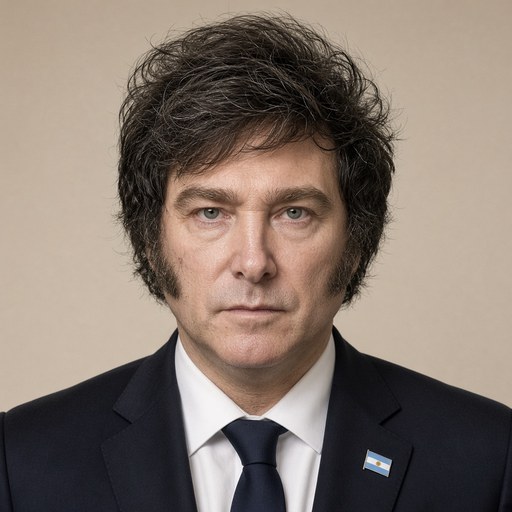
Words of President Javier Milei at the Hispanic Inaugural Gala, after receiving the LWS 2025 Titan of Economic Reform award, Washington DC.
 Javier Milei · President of Argentina
- Context
- Milei addressed the Hispanic Inaugural Gala in Washington DC on January 18, 2025, accepting the LWS Titan of Economic Reform award and outlining Argentina's liberal economic reforms.
- Main themes
- Economic reform in Argentina, Austrian School of economics, libertarianism and free market principles, anti-socialism, shock therapy vs gradualism, political reform, Argentine economic crisis, fight against collectivism, rejection of political gradualism, titan of economic reform award
- Duration
- ~13 min
- Words
- 1,584
- Sentences
- 86
- Readability
- 55
- Grade
- 10.0
- Syntax
- 2.78
- Vocabulary
- 2.13
Translated from Spanish
The broad sphere of national life a sentence belongs to. Every sentence has an Arena, so it is the denominator the other indices are read against.
Other86 sentences in 9 paragraphs
Hello everyone. I never thought I would feel as at home as I do now. Good evening to all. I want to thank those present and the organizers who have made this evening possible. It is an honor for me to be here and to receive the Titan of Economic Reform award on this day.
For those who do not know me, I am an economist who has been honored with the task of leading the destinies of my country. Throughout my life, I have been a lover of economic theory. And the facts, the theory, and my own history have led me to embrace the ideas of the Austrian School of Economics and, in particular, the ideas of freedom. As such, my commitment to the ideas of freedom, that is, to the defense of the right to life, liberty, and property, is unwavering. And having lived most of my adult life in a country consumed by socialism, being honored with this distinction fills me with pride. I have already said on other occasions that socialism is a disease of the soul, which attacks and corrodes the human being in its fundamental values, and if not confronted in time, can lead to misery as has happened in my country. However, the silent majorities are awakening, and as a result, the course of history is changing.
Today, I am honored with the distinction of Titan of Economic Reform, and I must say that the title is truly fitting, as the task we have been undertaking in Argentina for a year is truly titanic. Not only because of the dimension, complexity, and depth of the reforms we are carrying out, but also because we must fight against the extortion and sabotage of the corporate interests entrenched in the power of the old regime. Therefore, I want to take this opportunity to share with you some ideas about what we are doing, which some are already calling the Argentine miracle. But also some fallacies of traditional politics, because the battle is long and we need the right intellectual tools to win it.
First of all, our battle is against the ideas of gradualism. Argentines are accustomed to disappointment, as a result of having lived in a country infected by socialism for a hundred years. There have been dictatorships and democratic governments, but the only constant has been collectivism in some of its forms. There have also been, it is true, reformist experiences, but until now all had failed. None had been able to make the transition from impoverishing socialism to the redemptive capitalism of the poor. This cycle of illusions and failures over decades has caused many Argentines to choose to emigrate if they had the opportunity. Or to settle for surviving if they did not. This has been repeated throughout the 20th century, with the consequence of destruction of wealth and capital that it entailed, characterizing what we have called the century of Argentine humiliation. Government coalitions elected to implement reforms quickly failed, and the vicious circle started again. The question that many asked for decades was: Why? Why have reformist coalitions failed in Argentine history? The reason is simple; until now, no government, with the exception of Carlos Saúl Menem's, if one wants, had dared to apply the recipes of liberalism in full and without fear. This happens out of fear. Fear of losing support, of breaking agreements, of social protest, or losing the next elections. This is because politicians, regardless of their party, have as their primary mandate to stay in power at any cost. Only after do they think about making the changes they promised. Just as a businessman seeks to maximize the shares of his company, a politician has a primary driver above all else: to maximize the time he is in power and the size of the budget he manages. It is out of this fear of losing support that they adjust their ideas to maintain them in such a way that gives them the false sense that they will stay in power longer. As such, under whatever excuse, even those who want to make changes or reforms opt for gradualist reforms, which inevitably end up failing. This paradox is interesting. We could call it the paradox of the reformist politician: convinced that the most important thing for a country to change is their permanence in power, they produce their own failure. Well, we are reformists, but not politicians. We do not operate under the premise that the most important thing is our permanence in power, but rather that for us, the most important thing is to implement our reforms. We govern without fear, applying shock measures to generate confidence in society and the market. Not only because they are our convictions, but also because empirical evidence supports us. Since 1952 onwards, all shock programs, except for the one in '59, were expansive of activity and employment; and all gradualist programs ended badly.
Second: we do not reach consensus with the enemy. The other fallacy that reformist politicians tend to apply is that of consensus. Most reformist experiences clash against a political class that tells them they should reach consensus on their reforms with them. However, if the politicians one faces represent an ideology opposed to one's own, which has caused all the ills, there is no possibility of agreement, nor can there ever be. There can be no agreement between good and evil, because we work for antagonistic interests. The terms of a reform cannot be negotiated with those who live off preserving their privileges.
On the other hand, thirdly, one must simultaneously address both the urgent and the important. We assumed office in an absolutely critical context, knowing that the urgent thing was to stabilize the economy, but that the important thing was to dismantle the collectivist Leviathan that had been built in Argentina over the last hundred years. Therefore, our second economic measure had to do not with the urgent, but with the important. Decree 70/23 was the beginning of a set of structural reforms that will open our markets, bring us closer to the rest of the world, and indeed, it is already doing so. Shortly after that decree, we sent the Bases Law project to Congress, which together represents a state reform eight times larger than that carried out by Carlos Saúl Menem's government. That is to say, we have made the largest structural reform in all of Argentine history, reversing 123 years of decline. In other words, we not only cared about the urgent, which was to stabilize the economy, but we also embodied the most ambitious reform project in the history of our country. We did everything simultaneously, because the urgent is not a justification for postponing the important.
Fourth point. And above all, very important on a global level: shrink the state. The idea I want to leave you with is that reforming the state means returning the power that was taken from the citizenry. And the only way to do this is by shrinking the state. There is no other. I say this in response to those who advocate for a large but efficient state. I know it may sound nice or well-intentioned, but believe me, when a politician tells you he wants an efficient state, he is advocating for better mechanisms to rob citizens of their wealth. The only acceptable state is the smallest possible, to return to the taxpayer what is theirs and to end the sale of favors. There is no better method than eliminating state bureaucracy so that there is no possibility of selling those favors. People's lives cannot be subjected to the criteria of a bureaucrat behind a counter. Deregulation is the only successful path; it is the path of the chainsaw. Because a state that arrogates tasks that do not belong to it ends up failing to fulfill its basic responsibilities. As Murray Newton Rothbard, the inventor of anarcho-capitalism, said: “The larger the size of the state, the fewer resources will be used to satisfy the desires of consumers who have contributed to production, and more resources will be used to satisfy the desires of consumers who do not produce.” That is, the parasites. The friends of politicians.
Finally, even having made all the changes we have made in this first year of government, which has also been almost unanimously classified as an absolute success, since we have achieved in the first year a fiscal surplus in 123 years, we have reduced wholesale inflation from 54% to 0.8%, we have reduced poverty from 55% to 38% in one year, we already have better levels of activity and growth than when we took office. And we have only been in government for a year. Furthermore, Decree 70/2023 and the Bases Law have only been the tip of the iceberg. We still have 3,200 structural reforms ahead of us. Because our goal is arduous, but simple: we want to make Argentina the freest country in the world. Because we know that freedom generates prosperity. Because we know that our ideas work. Because we have proven it throughout this year. This has only been the beginning; the best is yet to come.
And also, I want to thank you for this recognition. May God bless each one of you and the Argentines. Let us make Argentina and the United States great again. And may the forces of heaven accompany you. Long live freedom, damn it! Thank you very much.
The original Spanish. The tags above are read on the English translation's sentences.
Hola a todos. Nunca creí que me iba a sentir tan en mi casa como me siento ahora. Buenas noches a todos. Quiero agradecer a los presentes y a los organizadores que han hecho posible esta velada. Es un honor para mí estar aquí y recibir el premio Titán de la Reforma Económica en este día.
Para quienes no me conocen, yo soy un economista que ha sido honrado con la tarea de conducir los destinos de mi país. Durante toda mi vida he sido un amante de la teoría económica. Y los hechos, la teoría y mi propia historia me han llevado a abrazar las ideas de la Escuela Austríaca de Economía y, en especial, las ideas de la libertad. Como tal, mi compromiso con las ideas de la libertad, es decir, con la defensa del derecho a la vida, a la libertad y a la propiedad, es inclaudicable. Y producto de haber vivido la mayor parte de mi vida adulta en un país consumido por el socialismo, ser honrado con esta distinción me llena de orgullo. He dicho ya, en otras oportunidades, que el socialismo es una enfermedad del alma, que ataca y corroe al ser humano en sus valores fundamentales y si no se enfrenta a tiempo puede llevar a la miseria como ha ocurrido en mi país. Sin embargo, las mayorías silenciosas están despertando, y producto de ello el curso de la historia está cambiando.
Hoy me honra con la distinción de Titán de la Reforma Económica, y debo decir que el título es realmente acertado, ya que la tarea que estamos llevando adelante en Argentina hace un año es verdaderamente titánica. No solo por la dimensión, la complejidad y profundidad de las reformas que estamos llevando a cabo, sino también porque debemos luchar contra la extorsión y el sabotaje de los intereses corporativos enquistados en el poder del antiguo régimen. Por eso, quiero aprovechar para compartir con ustedes algunas ideas sobre lo que estamos haciendo, que algunos ya están llamando el milagro argentino. Pero también algunas falacias de la política tradicional, porque la batalla es larga y necesitamos las herramientas intelectuales adecuadas para ganarla.
En primer lugar, nuestra batalla es contra las ideas del gradualismo. Los argentinos estamos acostumbrados a la desilusión, producto de haber vivido en un país infectado por el socialismo durante cien años. Ha habido dictaduras y gobiernos democráticos, pero la única constante ha sido el colectivismo en alguna de sus formas. También ha habido, es cierto, experiencias reformistas, pero hasta ahora todas habían fracasado. Ninguna había podido hacer la transición del socialismo empobrecedor al capitalismo redentor de los pobres. Este ciclo de ilusiones y fracasos durante décadas ha provocado que muchos argentinos opten por emigrar si tenían la posibilidad. O se contenten con sobrevivir si no la tenían. Esto se ha repetido a lo largo de todo el siglo XX, con la consecuencia de destrucción de riqueza y capital que implicaba, caracterizando lo que hemos llamado el siglo de la humillación argentina. Coaliciones de gobierno elegidas para implementar reformas, rápidamente fracasaban y el círculo vicioso volvía a empezar. La pregunta que muchos se hicieron durante décadas era: ¿Por qué? ¿Por qué las coaliciones reformistas han fracasado en la historia argentina? La razón es simple, hasta ahora ningún gobierno, con excepción del de Carlos Saúl Menem, si uno quiere, se había animado a aplicar las recetas del liberalismo de cuajo y sin temor. Esto sucede por miedo. Miedo a perder apoyo, a romper acuerdos, a la protesta social o perder las próximas elecciones. Esto es porque los políticos, sin importar su partido, tienen como primer mandato mantenerse en el poder a cualquier costo. Recién después piensan en hacer los cambios que habían prometido. De la misma manera que un empresario busca la maximización de las acciones de su empresa, un político tiene un driver principal ante cualquier otra cosa: maximizar el tiempo que está en el poder y el tamaño del presupuesto que maneja. Es por ese miedo a perder apoyo que acomodan sus ideas a mantenerlas tal que les brinden la tranquilidad, equivocadamente, que así se quedarán más tiempo en el poder. Como tal, bajo la excusa que sea, aún los que quieren realizar cambios o reformas optan por reformas de tinte gradualista, que inexorablemente terminan fracasando. Es interesante esta paradoja. Podríamos llamarle la paradoja del político reformista: convencido que lo más importante para que un país cambie es su permanencia en el poder, producen su propio fracaso. Pues bien, nosotros somos reformistas, pero no políticos. No operamos bajo la premisa de que lo más importante es nuestra permanencia en el poder, sino que para nosotros lo más importante es implementar nuestras reformas. Gobernamos sin miedo, aplicando medidas de shock para generar confianza en la sociedad y el mercado. No solo porque son nuestras convicciones, sino porque además la evidencia empírica nos acompaña. Desde 1952 en adelante, todos los programas de shock, sacando el del 59, fueron expansivos de la actividad y el empleo; y todos los programas gradualistas terminaron mal.
Segundo: no consensuamos con el enemigo. La otra falacia que suelen aplicar los políticos reformistas es la del consenso. La mayoría de las experiencias reformistas se chocan contra una clase política que les dice que deberían consensuar sus reformas con ellos. Sin embargo, si los políticos a los que uno enfrenta representan una ideología opuesta a la propia, que ha sido la causante de todos los males, no hay ni puede haber nunca posibilidad de acuerdo. No puede haber acuerdo entre el bien y el mal, porque trabajamos para intereses antagónicos. No se pueden negociar los términos de una reforma con quienes viven de conservar sus privilegios.
Por otra parte, en tercer lugar, hay que ocuparse simultáneamente, tanto de lo urgente, como de lo importante. Nosotros asumimos en un contexto absolutamente crítico, sabiendo que lo urgente era estabilizar la economía, pero que lo importante era desarmar el Leviatán colectivista que había sido montado en Argentina durante los últimos cien años. Por eso, nuestra segunda medida en materia económica tuvo que ver no con lo urgente, sino con lo importante. El decreto 70/23 fue el inicio de un conjunto de reformas estructurales que abrirán nuestros mercados, nos acercarán al resto del mundo, y vaya que ya lo está haciendo. Al poco tiempo de dicho decreto, enviamos el proyecto de Ley Bases al Congreso, que en conjunto representa una reforma del Estado ocho veces más grande que la llevada a cabo por el gobierno de Carlos Saúl Menem. Es decir, hicimos la reforma estructural más grande de toda la historia argentina, revirtiendo 123 años de decadencia. Es decir, que nosotros no solo nos preocupamos por lo urgente, que era estabilizar la economía, sino que también encarnamos el proyecto de reforma más ambicioso de la historia de nuestro país. Lo hicimos todo en simultáneo, porque lo urgente no es justificativo para postergar lo importante.
Cuarto punto. Y sobre todo, muy importante a nivel global: achicar el Estado. La idea que les quiero dejar es que reformar el Estado implica devolverle el poder que le fue quitado a la ciudadanía. Y la única forma de hacerlo es achicando el Estado. No hay otra. Lo digo en respuesta a quienes abogan por un Estado grande pero eficiente. Sé que puede sonar lindo o bienintencionado, pero créanme que cuando un político les dice que quiere un Estado eficiente, está abogando por mejores mecanismos para robarles la riqueza a los ciudadanos. El único Estado aceptable es el más chico posible, para devolverle al pagador de impuestos lo que es suyo y terminar con la venta de favores. No hay mejor método que eliminar la burocracia estatal para que no exista la posibilidad de vender esos favores. La vida de la gente no puede estar sometida al criterio de un burócrata detrás de un mostrador. La desregulación es el único camino exitoso, es el camino de la motosierra. Porque un Estado que se arroga tareas que no le competen termina por incumplir sus responsabilidades básicas. Como decía Murray Newton Rothbard, el inventor del anarcocapitalismo: “Cuanto mayor sea el tamaño del Estado, menos recursos se utilizarán para satisfacer los deseos de los consumidores que han contribuido a la producción, y más recursos se utilizaran para satisfacer los deseos de los consumidores que no producen”. O sea, los parásitos. Los amigos de los políticos.
Finalmente, aún habiendo realizado todos los cambios que hemos hecho en este primer año de gobierno, que además ha sido catalogado casi unívocamente como un éxito absoluto, ya que hemos logrado en el primer año el superávit fiscal en 123 años, hemos bajado la inflación mayorista del 54% al 0,8%, hemos reducido la pobreza del 55% al 38% en un año, ya tenemos mejores niveles de actividad y crecimiento que cuando asumimos. Y recién llevamos un año de gobierno. Además, el Decreto 70/2023 y la Ley Bases han sido solamente la punta del iceberg. Aún nos quedan 3.200 reformas estructurales por delante. Porque nuestra meta es ardua, pero simple: queremos hacer de la Argentina el país más libre del mundo. Porque sabemos que la libertad genera prosperidad. Porque sabemos que nuestras ideas funcionan. Porque lo hemos comprobado durante todo este año. Este ha sido solo el comienzo, lo mejor está por venir.
Y además, quiero dar las gracias por este reconocimiento. Que Dios bendiga a cada uno de ustedes y a los argentinos. Hagamos nuevamente grande a la Argentina y a Estados Unidos. Y que las fuerzas del cielo los acompañen. ¡Viva la libertad, carajo! Muchísimas gracias.