




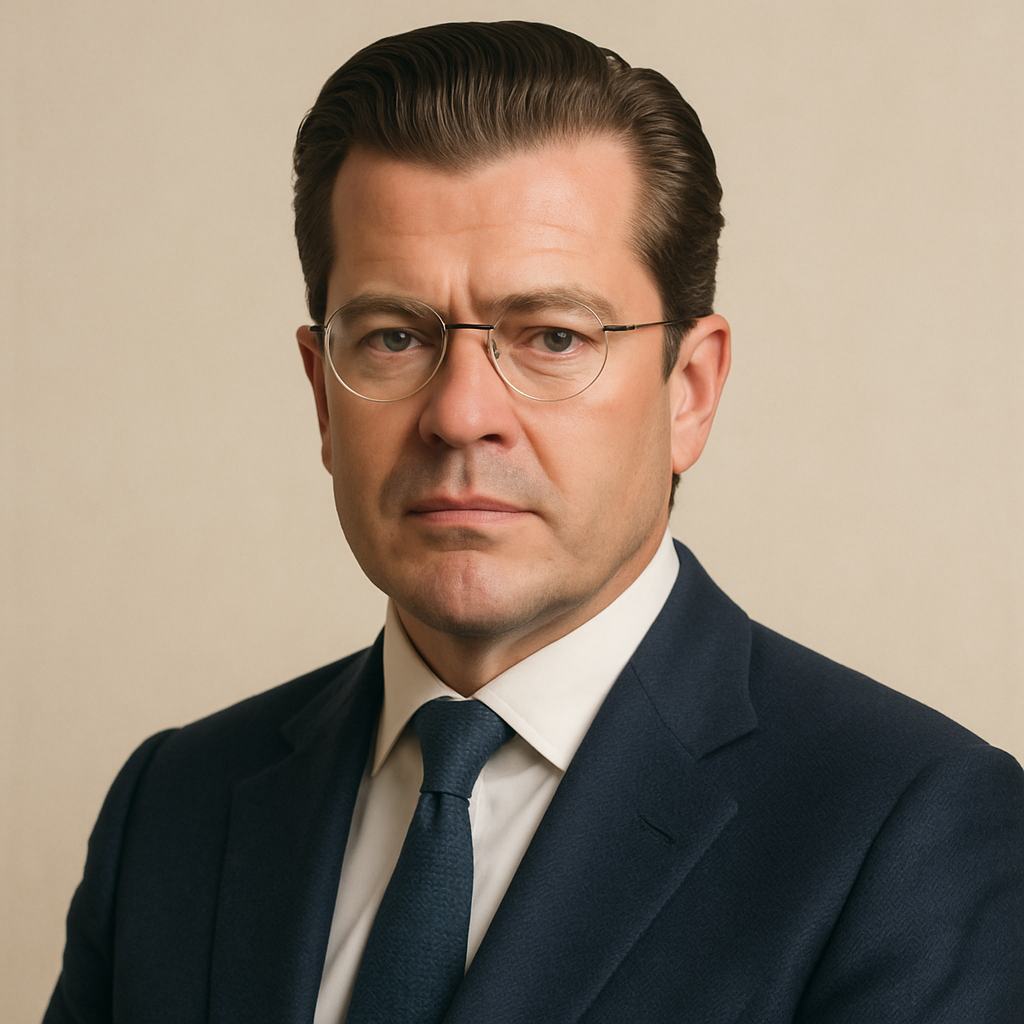
MSC 1966 — Karl Theodor Freiherr von und zu Guttenberg
 Karl Theodor Freiherr von und zu Guttenberg · Member of the Bundestag (CSU)
- Context
- Karl Theodor Freiherr von und zu Guttenberg did not deliver a speech at the Munich Security Conference in 1966, as he was born in 1971.
- Main themes
- NATO reform, US nuclear guarantees, European nuclear power, Atlantic Alliance crisis, Soviet Union relations, non-proliferation treaty, flexible response strategy
- Duration
- ~19 min
- Words
- 2,282
- Sentences
- 96
- Readability
- 27
- Grade
- 15.1
- Syntax
- 3.23
- Vocabulary
- 2.34
The broad sphere of national life a sentence belongs to. Every sentence has an Arena, so it is the denominator the other indices are read against.
Other96 sentences in 47 paragraphs
State Secretary in the Ministry of Defense of the Federal Republic of Germany
Karl Theodor Freiherr von und zu Guttenberg spoke at the 3rd Wehrkunde Conference to address the constant state of crisis in Europe and its dependence on US nuclear guarantees.
The Atlantic Alliance is in a state of perpetual crisis. There seems to be a general consensus about the need to reform NATO. However, there are significant disagreements about the nature and objectives of this reform.
While some advocate greater integration, others seek at least a partial dissolution of current arrangements. Some believe the Alliance’s military responsibilities should extend to other continents, viewing this as not only possible but necessary. Meanwhile, others aim to limit even the existing scope of joint political activities. Similarly, while some wish to orient the Alliance around a strategy of “flexible response,” others advocate a strategy of nuclear prioritization, including corresponding armaments and organizational changes.
The reasons for this crisis, as well as the accompanying reform discussions of recent years, are manifold. It is not my intent here to analyze these reasons in detail, but they may be briefly outlined as follows.
These reasons are both military and political in nature. It is futile to ask whether military causes have triggered political ones or vice versa since both are inextricably linked. Among the key factors contributing to NATO’s current crisis — frozen in its structural form since the late 1950s — are the following:
The nuclear stalemate that has developed between the two principal powers, the United States and the Soviet Union.
The increasing military and political engagement of the United States on non-European continents.
The cessation of the Soviet Union’s crisis-driven policies in Europe following the acute Berlin Crisis.
The intensifying rift between Communist China and the Soviet Union, as well as a certain loosening of the European Eastern Bloc and the relative resurgence of European states.
In addition to these concrete changes — and partly as a result of them — factors rooted in mere assumptions or even hopes play a significant role in current discussions about the Atlantic Alliance. These factors can carry more weight in an alliance of democratic states subject to public opinion than facts themselves. For instance, such dynamics are evident where the American public increasingly perceives Communist China as the primary threat or where both American and European audiences depict the Soviet Union as a changed power, more inclined toward cooperation.
No one would seriously deny the possibility — or even the historical likelihood — that the revolutionary, aggressive nature of Soviet Communist politics could eventually transform. Likewise, no one can ignore that the brutal, terroristic methods of Lenin and Stalin have given way to a relatively milder form of Communism across the Soviet Union and its European sphere of control.
But what guarantees are there that this development might not one day be at least partially reversed? And who could argue that this change in methods has, to date, altered the ultimate objectives of Communist policy? To speak concretely: while one may debate the likelihood of an imminent revival of the Berlin Crisis, there can be no doubt that such a scenario remains possible and that we must therefore be prepared. It is even conceivable that the disintegration of the Communist bloc — a development welcomed for many reasons — could itself directly provoke the resumption of crisis-driven policies by Moscow.
Who does not know examples where a dictatorial regime, facing internal challenges, seeks a solution in the form of an “escape forward”?
Whatever changes the world situation has undergone in recent years, those concerning the balance of power remain the most significant for the Atlantic Alliance. It is not the visible or assumed intentions of the adversary that must serve as the starting point and standard for shaping the alliance, but rather their actual power. This will remain the case as long as there is no guarantee that the adversary has definitively ceased to be a threat.
This means — particularly for the European NATO states and especially for the Federal Republic of Germany — that the Atlantic Alliance has not lost any of its importance or weight. On the contrary, the NATO alliance finds itself in a significantly more precarious position today than during the first decade of its existence. It now faces an adversary of substantially greater strength, one that has achieved a state of parity with the Western superpower — a situation which, militarily speaking, can be characterized as “mutual deterrence” or mutual paralysis.
This unsettling reality cannot simply be dismissed with the common refrain that the balance between East and West — whether referred to as the “balance of terror” or the “balance of power” — has been maintained overall. I do not dispute this claim; on the contrary, I affirm that the overall balance of power between NATO and the so-called Warsaw Pact remains numerically in favor of the West. However, the critical issue lies beyond the simple arithmetic of missiles, warheads, divisions, aircraft, and warships. The calculation must also account for two enduring elements of strategy: space and time.
When these factors are integrated into the balance of power equation between East and West, it becomes clear that Europe’s security now rests on what has been aptly termed an “asymmetric equilibrium.” While there exists a balance of terror — and arguably of power — between the Euro-Asian power of the Soviet Union and the Atlantic power of the United States, no such balance exists between the Soviet Union and Europe. Europe’s future peace rests, pointedly stated, on the assumption that the Soviet Union remains convinced that America will risk everything to defend European territory, including taking on the ultimate risk of a nuclear exchange on its own soil.
As long as American troops remain stationed on the European continent, face-to-face with the Soviet Army, the Soviet Union must consider the possibility that any military conflict in this region could escalate into a direct nuclear confrontation with the United States. Nevertheless, there remains the risk that a more aggressive Soviet policy — perhaps driven by internal pressures — might gamble on the idea that a limited military campaign in Europe would not prompt the U.S. to commit its full strength, thereby avoiding the risk of nuclear strikes on the American mainland.
While there is no immediate reason to fear the withdrawal of U.S. troops from Europe, which seems unlikely in the foreseeable future, no European government can guarantee that this will never happen. More importantly, it would not be responsible European policy to indefinitely accept this “asymmetric equilibrium,” which leaves Europe wholly dependent on Atlantic security guarantees and perpetuates the reality that Europe remains an object of decision-making by non-European powers.
I see this one-sided dependence of European security on American nuclear guarantees as the primary source of NATO’s crisis. The debate over the French Force de Frappe, the unfortunate back-and-forth over the ill-fated Multilateral Force (MLF) project, British indecision regarding nuclear strategy, the proposal for a global non-proliferation agreement, and other developments must all be viewed against the backdrop of this “asymmetric equilibrium,” where the two superpowers hold each other in check, but Europe must place its security in the belief that America will not hesitate to act decisively on Europe’s behalf.
To be clear, I am speaking here about military power dynamics and strategic considerations, but I am primarily concerned with politics. One hallmark of the nuclear age, in my view, is that while the actual risk of war between nuclear powers — and, to a lesser extent, between their non-nuclear allies — has diminished to a minimum, the military balance of power continues to heavily influence politics, either through direct threats or the mere perception of potential conflict.
This is why the de facto continuation of the American nuclear monopoly remains the defining structural element of NATO. It is also why the American policy of maintaining and institutionalizing this monopoly represents the most significant factor in considerations about NATO’s future. As long as this monopoly remains intact, there can be no reform of the alliance that would shift this “asymmetric equilibrium” in Europe’s favor.
Whatever responsible American proposals for nuclear “sharing” or “co-determination” within the alliance may have been made thus far, their implementation would not alter the ultimate responsibility of the U.S. leadership for the deployment of nuclear weapons. Given the current circumstances, one must understand the rationale behind this American policy. By what criteria could the transfer of nuclear weapons to national control within the alliance be regulated? Which member states of the alliance would “deserve” such trust, and which would not? How could an alliance function in which numerous states might develop their own nuclear strategies — or, in a crisis, choose to abstain from action altogether?
On the other hand, it is necessary to move away from the illusion that non-nuclear powers could secure “access” to the nuclear weapons of others through technical constructs such as the MLF (Multilateral Force) or ANF (Atlantic Nuclear Force). Such projects would not truly alter the current monopoly situation; they would only incur significant costs, create confusion, and stir up unnecessary commotion. The notion that the USA could be “forced” in this way to deploy a “multilateral” nuclear weapon under American veto, when they would otherwise simultaneously deploy their own weapons against the same targets, strikes me as outright absurd.
Atlantic “integration” in the nuclear field is both a misleading concept and a pipe dream. It is misleading because “integration” should imply the creation of a new sovereignty formed by the “integrated”; however, the USA does not intend to make even the slightest concession regarding its nuclear sovereignty. It is a pipe dream because such “integration” — for instance, under the MLF model — would, in truth, institutionalize the existing monopoly or dominance within NATO.
In the short term, there is no fundamental way to alter the unsatisfactory state of nuclear defense in Europe. However, this certainly does not mean that German policy should refrain from:
Seeking greater influence on the development of American nuclear strategy.
Gaining a stronger voice regarding the deployment and selection of weapons, among other factors.
Ensuring that target determination in areas of its own interest is better aligned with its priorities than before.
At the same time, German policy must clearly abstain from striving for “physical co-ownership” of other nations’ nuclear weapons, as this would not enhance security but would significantly worsen Germany’s political standing worldwide.
Additionally, a project like the MLF would become an obstacle to the only feasible long-term solution to NATO’s nuclear dilemma. The “unequal equilibrium” can only be resolved if Europe itself eventually establishes itself as a second nuclear power within NATO, alongside the United States. However, projects implemented under the guise of so-called “Atlantic integration,” but in reality serving to entrench the current monopoly situation, would hinder the goal of future cooperative partnership between the USA and a unified Europe.
From this perspective, Europeans must also consider the possibility of an American-Soviet accord on a “non-proliferation treaty” for nuclear weapons. Such an agreement between the two major nuclear powers, accompanied by their invitation for NATO states to join, would pose serious challenges for Europe. If the European states signed such an agreement, it would condemn Europe to remain, for an unforeseeable period, subject to the decisions of non-European nuclear giants.
Even if, as American policy asserts, such a non-proliferation treaty allowed for the formation of a joint enterprise similar to the MLF, the outcome would remain unchanged: the “unequal equilibrium,” with all its risks for Europe, would become immutable. The emergence of a European nuclear power would face insurmountable barriers.
Although the draft “Non-Proliferation Treaty” presented in Geneva by the USA contained a clause interpreted by some as permitting the future creation of a joint European nuclear power, it only allowed for the transfer of an already existing nuclear capacity — such as that of the UK or France, or both combined — into a joint organization of European states. Simultaneously, however, another article prohibited any support from any state for the nuclear weapons development of this organization, effectively banning collective European efforts to establish such a European nuclear power.
I have stated that, in my opinion, there is only one lasting solution to the problem of Europe’s nuclear security: namely, the establishment of a joint European nuclear power within the framework of NATO, and thus in alliance with the United States. It must again be emphasized that this is a long-term goal. Indeed, no one can say with certainty whether it will ever be achieved. However, the idea of a European nuclear power under European authority is undoubtedly a more realistic notion than that of an Atlantic nuclear power under Atlantic sovereignty could ever be.
What German policy should pursue today, in my view, is to openly articulate this goal, to oppose anything that could hinder its realization, and to resolutely commit to the gradual implementation of the necessary political prerequisites. The world must come to understand the German concept for NATO reform. The keyword for this concept was provided by President Kennedy, who spoke of the Atlantic partnership between the global power of the USA and the emerging “global power” of Europe.
Photo credit: MSC / SZ
Related content
Chapter 1: The Formative Years (1963–1979) More
Chapter 1: The Formative Years (1963–1979)
Helmut Schmidt (1967) Photo credit: Roger Jackson & Peter Cade/Central Press/Hulton Archive/Getty Images More
Helmut Schmidt (1967)
Photo credit: Roger Jackson & Peter Cade/Central Press/Hulton Archive/Getty Images
John G. Tower (1970) Photo credit: Dave Mathias/The Denver Post via Getty Images More
John G. Tower (1970)
Photo credit: Dave Mathias/The Denver Post via Getty Images