




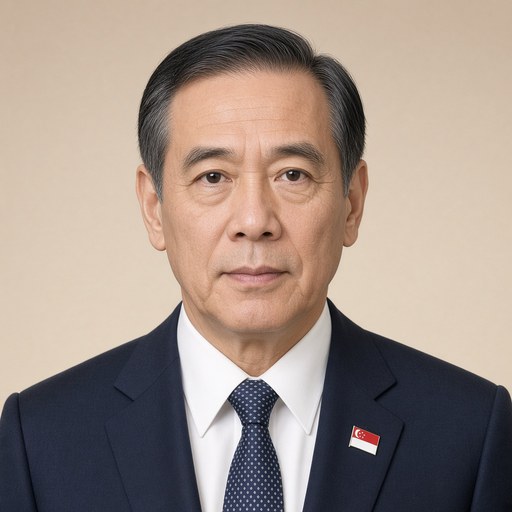
SM Lee Hsien Loong at the SCCC-SFCCA Spring Reception 2025
 Lee Hsien Loong · Prime Minister of Singapore
- Context
- Lee addressed the SCCC-SFCCA Spring Reception 2025 on 31 January, celebrating Chinese New Year and reflecting on Singapore's 60 years of independence and the Chinese community's role.
- Main themes
- Chinese New Year celebration, Singapore's 60th independence anniversary, Chinese clan associations, social cohesion and multiracialism, new immigrant integration, Singaporean Chinese cultural identity, community renewal and transformation, social fabric and unity, Chinese community's nation-building contributions
- Duration
- ~11 min
- Words
- 1,287
- Sentences
- 75
- Readability
- 41
- Grade
- 11.8
- Syntax
- 2.95
- Vocabulary
- 2.29
The broad sphere of national life a sentence belongs to. Every sentence has an Arena, so it is the denominator the other indices are read against.
Other75 sentences in 27 paragraphs
“Building our Future Singapore as one Community”
Mr Thomas Chua, President, Singapore Federation of Chinese Clan Associations; Mr Ng Siew Quan, Chairman, Singapore Chinese Cultural Centre; Distinguished guests; Good morning
A very happy and prosperous Chinese New Year to everyone. I last attended SFCCA’s Spring Reception 13 years ago, in the previous Year of the Dragon. Happy to be here again to welcome the Year of the Snake with all of you.
This is a significant year for Singapore. As we commemorate 60 years of independence. Now, at the start of the year, it is timely for us to reflect on the past and look to the future: to remember the contributions of the Chinese community, especially how it helped to build our harmonious and prosperous multiracial society. We should also ponder the Chinese community’s future, and how it can help Singapore scale greater heights.
Chinese clans: reinforcing our social fabric
First, let me highlight one important pillar of the Chinese community: our clans. Over the past two centuries, clans have been an important part of Singapore’s social fabric, and have contributed much to Singapore’s development. In colonial times, clan associations established by various dialect groups gave support and financial assistance to fellow clansmen, helping these new arrivals to settle down in Singapore. Clans also contributed generously to social and charitable causes, promoted education and Chinese culture, and strengthened social unity.
Through the efforts of the various clans, many of our forefathers eventually made Singapore home. In the 60 years since Singapore’s independence, they and their local-born descendants gradually developed a Singaporean national identity, and also a unique Singaporean Chinese cultural identity.
But as the landscape evolves, clan associations must renew themselves. Some smaller clans have faded away. Fortunately, more of them have successfully transformed to meet society’s evolving needs.
Quite a few Singaporeans are now deeply interested in their roots and Chinese culture. Many clans have embraced this trend by offering programmes to help them explore these interests. For instance, the Singapore Hokkien Huay Kuan Cultural Academy offers various arts and cultural programmes.
Some clans are also helping local enterprises seek new business opportunities in Greater China. With their networks and familiarity with the region, they are well-poised to help our enterprises venture into these markets.
When it comes to social support, some clans now avail financial assistance to any Singaporean in need, including bursaries and scholarships. This spirit of not differentiating between clans or races helps to promote social cohesion and unity.
At the same time, clan associations have continued to help new immigrants integrate into our society. Over the past decades, some new immigrants have also established their own clans. However, the needs of new immigrants are now very different from those in the past. They no longer require support for basic needs. Rather, they need help navigating our societal culture and norms, especially in learning how to get along with other racial groups, and showing them mutual respect and understanding.
This year, the SFCCA is celebrating its 40th anniversary. One of its key thrusts for the future is to promote our social values, and strengthen our ties with new immigrants, to help them forge a sense of shared identity.
But clans cannot do this alone. Singaporeans should continue to open our hearts to these new arrivals, and help them become part of our Singapore family. Of course, new immigrants themselves must also make the added effort to assimilate, as well as respect and accept local norms, cultural practices, and values. This is essential for them to foster a sense of belonging to Singapore, and harmonious relations with local-born Singaporeans. I have found that many of those who have spent more than a decade here generally share similar worldviews and lifestyle habits as local-born Singaporeans. Therefore, with everyone’s efforts, I am confident that new immigrants, just like our forebears, will become rooted to Singapore, and add to the vibrancy of our society and unique Chinese culture.
The Chinese community: an integral part of our multicultural society
The Chinese community has always prioritised our national interests and the bigger picture, and supported inclusive policies for a multiracial Singapore. In the early days of nation-building, our pledge to be one united people, regardless of race, language, or religion, seemed like a distant, if not impossible ideal. The older generation would still remember vividly the racial strife that rocked Singapore back then. Fortunately, our founding fathers held firm to their beliefs and, together with successive generations of Singaporeans, we gradually turned this lofty ideal into reality. As the largest community, the Chinese played a crucial and leading role in this endeavour. While maintaining their own cultural traditions, they also respected other races and cultures, and understood that for Singapore to achieve long-term stability and peace, we must all stand equal as Singaporeans.
I understand the importance that the Chinese community places on passing on our cultural heritage. Enriched by tradition and nurtured in a multicultural environment, our Chinese culture has developed its unique spirit and characteristics. Over the years, many local artists have won accolades through their songs, paintings, poems, films, and dramatic works, which demonstrate strong local flavour. This has given us a sense of cultural confidence. In 2017, under the SFCCA’s leadership and with strong support from the Chinese community, we established the Singapore Chinese Cultural Centre (SCCC). Since its inception, the SCCC has showcased the development of local Chinese culture, by providing a platform for artistic groups to perform and create, and by actively promoting local culture. It has also set up a permanent exhibition on Singapore's Chinese culture, which has received more than 300,000 visitors to date. Last year, it also launched the bilingual Culturepaedia online repository, which offers a comprehensive introduction to the development and characteristics of local Chinese culture. It is worth mentioning that the Ministry of Education plans to incorporate Culturepaedia in its teaching materials, to strengthen the cultural and national identity of the younger generation.
Reflecting on SG60
There will be a full slate of Chinese cultural initiatives this year, as we commemorate our 60th year of independence, e.g. Singaporeans can look forward to two new travelling exhibitions by SCCC. SFCCA will incorporate SG60 elements into the Annual River Hongbao, and will hold a Singapore Talent Night to commemorate this special year.
These activities lend a special touch to our nation’s 60th birthday.
Conclusion
For the Chinese, 60 years marks the completion of one sexagenary cycle. For individuals, reaching 60 years old is a significant life milestone. But for a country, it is just the beginning, with a long way to go. Over the past 60 years, we have defied the odds to become an economic success story. More importantly, we have built a harmonious, inclusive, and resilient multicultural society. And become a shining little red dot that we can all be proud of.
60 years on, a new Prime Minister – Prime Minister Lawrence Wong – and his 4G team have taken over. They are leading Singapore into a new era with the Forward SG effort, refreshing our social compact, and building a better future for Singapore.
Whether this little red dot can continue to shine in the next 60 years depends on whether Singaporeans can continue to strive for excellence and forge ahead. I urge the Chinese community to continue playing a leadership role and work with the Government to strengthen our multicultural fabric, social cohesion and unity.
Therefore, my New Year's wish, and my wish for Singapore, is for everyone to unite in writing our new chapter together. May this be a year of peace and prosperity for our nation. And good fortune in the year of the Snake for all.
Thank you!
Explore related topics