




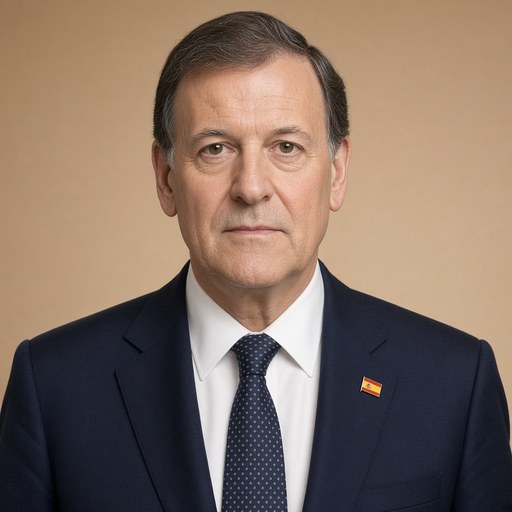
Speech by the President of the Government at the round table discussion entitled "Europe in the Global Context" at the World Economic Forum
 Mariano Rajoy · Prime Minister of Spain
- Context
- Rajoy addressed a World Economic Forum round table on 'Europe in the Global Context' in April 2012, discussing the Eurozone crisis and Spain's reform efforts.
- Main themes
- Eurozone sovereign debt crisis, Spain's economic reforms, global economic recovery, European fiscal policy, credit crunch in Europe, Latin America economic impact, financial market instability, structural economic imbalances, oil prices and geopolitical risk, ECB intervention
- Duration
- ~17 min
- Words
- 2,050
- Sentences
- 70
- Readability
- 38
- Grade
- 14.8
- Syntax
- 3.21
- Vocabulary
- 2.13
The broad sphere of national life a sentence belongs to. Every sentence has an Arena, so it is the denominator the other indices are read against.
Other70 sentences in 32 paragraphs
Ladies and gentlemen,
Good afternoon to you all once again and, as I did at the start of my first speech of this plenary session, I would like to reiterate my gratitude to President Calderón for inviting me here and for his warm welcome. I would also like to thank the Executive President and founder of the World Economic Forum, Professor Klaus Schwab, who asked me if what we are doing in Spain is enough. I have to say that, yes, it is enough and I will now try to back this up by explaining why.
I will talk about Europe. That is what I was asked to talk about so Europe will be the subject of my speech. However, I will also offer a few comments about the global situation. I am going to talk about Spain, among other things, because Spain is my country and because, according to what I just heard, Spain currently finds itself in the eye of the hurricane. I will also talk about Latin America.
I will place particular emphasis on economic issues and I will begin by confirming something that I believe should indeed be confirmed so as to set us in good stead for, from now on, starting to take decisions: the global economy has not yet recovered from the crash and spread of the 2008 financial crisis because, in spite of an improvement in global growth during 2010, the slow-down reappeared in 2011 and it is highly likely that rates close to 3.5% will be seen in 2012; way below the growth rates we were seeing before the crisis began.
Furthermore, this recovery has been associated more with the implementation of macroeconomic policies of an expansive nature than with a definitive solution to the structural problems of the world economy. Therefore, global growth continues to be unbalanced and exposed to significant risks; some of which are inherent to the financial crisis itself and others linked to new geo-political tensions that can be translated into a highly prejudicial increase in oil prices.
The financial markets have not returned to a state of normality either and they are still failing to correctly steer savings towards investment, especially in developed economies, although the effects of this can also be seen in the world's emerging nations.
This is the context in which, last summer, we witnessed a new rise in tension in the Eurozone sovereign debt markets. The response from the European authorities, the intervention by the European Central Bank through long-term refinancing transactions, the signing of the "fiscal pact" and the far-reaching economic programmes undertaken by certain Member States enabled that tension to be eased at the time. However, the situation in the Eurozone is a delicate one - you need only look at the development of the debt markets in recent days to see that. You don't have to go any further back than that.
As you are aware, this situation has been particularly harsh on Spain and Italy recently and could go on to affect more countries. I'm talking about Spain and Italy; two countries that are nonetheless firmly committed to implementing far-reaching reforms in their economies. Spain especially is convinced that, current tensions aside, its economy needs to undertake a process of adjustment and transformation that will enable it to move forward on more solid ground and return to the path of economic growth and job creation.
However, it has been clear since the summer that the confidence held by economic stakeholders in the Eurozone as a whole has shrunk, and that means higher financing costs for the banking sector, less credit and less growth. We are facing another "credit crunch" in Europe that has sent the Eurozone economy back into recession with an estimated fall in GDP for 2012 of 0.5%. This may well climb to 0.7% during the first half of the year.
What's more, the effects of this tension are being carried over to other parts of the world to varying degrees of intensity via two channels basically: trade exchanges; and financial relations. Logically, the economies most affected by the current Eurozone climate via both these channels are the other non-Eurozone European economies, economies that are much more closely linked in terms of trade and financial relations with the Eurozone than the rest of the world.
Nonetheless, Asia, Latin America and the United States have felt an impact, albeit to a somewhat lesser extent. However, it should be stated that any intensification of tension could undoubtedly have much greater effects than those seen thus far. The financial channel is especially strong and could have a particularly noticeable effect on the emerging economies if there is a sudden increase in global aversion to risk.
Allow me to say a bit more by way of analysis of these effects on the Latin American economies. According to available forecasts, these economies will experience slightly slower growth in 2012 than in 2011. Therefore, the impact of the tension in the Eurozone has been relatively moderate so far due to the nature of the financial ties between Latin America and the Eurozone and the composition of Latin American exports.
From the financial perspective, the Eurozone banks and particularly the Spanish banks are maintaining a high volume of assets in Latin America. These banks are currently going through a process of deleveraging and restructuring in terms of their balance sheets but this process is not being felt in Latin America. The Spanish banks, the main European presence in the region, have continued to expand their business in the region, providing loans to families and companies, and contributing to the economic dynamic.
Banco Santander, the leading Spanish bank, last year increased its credit in the region by 18% to 140 billion euros. Latin America accounts for 51% of Banco Santander's profits. It has twenty-five million customers in Latin America and 9.3 million customers in Mexico. BBVA, the second-largest Spanish bank, also expanded its operations in Latin America in 2011, excluding Mexico, by 22.8% to a volume of 63.44 billion euros in assets and maintains a leadership position in Mexico through BBVA Bancomer, where it has 74.28 billion euros of assets.
On a more general note, I would like to point out that the Spanish banks are operating in the region through subsidiaries of a legally independent nature, financing themselves locally and issuing loans in accordance with local legislation.
Within this context, the strengthening of the Spanish financial system that is being carried out will not harm the subsidiaries in the region and, in any case, should have a positive effect through increased confidence and credibility.
From the trade perspective, Latin America has very little dependence on its exports to the Eurozone. Its trade ties to Europe are once again linked to Spain.
My country is fully aware of the stimulating effect on growth played by trade and investment through such exchanges but we are also aware of the transfer of technology that these exchanges lead to, particularly for Latin America. It is for that reason that, as I said before, Spain is firmly defending the EU free trade agreements with countries in Latin America. It is always necessary, but especially in times such as these, as I also said before, to avoid protectionist tendencies.
Referring back to my statement in response to the question put to me here, I want to reiterate that Spain's commitment in this area has been reflected by the existence of a stable and secure legal framework in the vast majority of countries in the region, among them (and I quote these two because I am going to Colombia tomorrow) Mexico and Colombia, countries that, again, I will be visiting over the course of the next few days.
Our companies have committed themselves to Latin America and they have done so, as I said before, with the intention to stay, create jobs and contribute to development and growth; with the one exception that you are all aware of.
In short, the Eurozone tensions have so far spread to the rest of the world in moderation; the greatest impact is currently being felt within the Eurozone itself. However, the uncertainty remains and is dragging down the growth perspectives for our economies, constitutes a serious obstacle to economic recovery and jeopardises growth in other regions.
So, overcoming this situation and restoring confidence among the economic stakeholders requires the European Union as a whole, I must insist on that - the European Union as a whole, as well as the Member States on an individual basis, to act in a coordinated and firm fashion to re-establish public finance discipline and implement decisive reforms to increase the competitiveness and flexibility of our economies.
This is the only way back to a path of economic growth and job creation. And I can tell you here and now that my Government is convinced of the importance of undertaking the necessary reforms that will enable the fears regarding our economy to be cast aside and to return us to that path of growth. Our economic strategy is very clear and based on two key aspects: fiscal discipline and improved flexibility and competitiveness for the economy.
On the issue of fiscal discipline, we are aware - indeed very aware - of the difficulty involved in consolidating our accounts in a time of recession such as this, but the excessive discretional use of fiscal policy in the past, which also had little effect in terms of growth, leaves us no other option and becomes essential for regaining international credibility.
Spain has taken the opportunity to introduce changes in its legal structure. We have even amended the Spanish Constitution to constitutionalise the principle of budgetary stability and we did so to create a framework that can guarantee the application of that principle of stability by all public administration services, local councils and regional authorities. We have approved expenditure reduction and revenue enhancement measures, and a new Budget that will enable the deficit reduction target of 3% in 2013 to be met. The goal is to reduce the Spanish economy's need for financing, to free up resources for the private sector and to adjust spending to the new economic status quo.
On the issue of improved flexibility and competitiveness for the economy, we have undertaken important, far-reaching reforms that have been put off for a long time (I would have liked them to have been done a while ago), such as the labour reform and the financial reform. We are currently working and decisions will be taken at the Council of Ministers meeting on Friday in Madrid on reforms in healthcare, education and public services.
Ladies and gentlemen,
If any of you know of any other government in the Eurozone or anywhere outside of the Eurozone that has taken as many decisions in only three months of such importance as the ones taken in Spain, I would be glad to hear which - if for no other reason than to try and do even better.
In any case, I hope that all these reforms and the others to come will enable the Spanish economy to regain growth and macroeconomic stability. But, to do so, Spain must have sufficient liquidity to protect those reforms in a context of growing mistrust and financing difficulty.
The European Union is working hard, it really is, to provide itself with mechanisms to guarantee sufficient liquidity and the G-20, whose presidency is held this year by the President of the United Mexican States, is also working to provide suitable liquidity instruments at a global level.
I am absolutely convinced that all our efforts, both the collective efforts and the individual efforts, will enable the Eurozone to regain stability and contribute to global and regional economic prosperity. We will need a great deal of determination, a great deal of courage, we will need to educate the people, explain the reasoning behind each decision, and that those decisions need to be taken. We will also need, and I hope there is no shortage of this, an awful lot of common sense. Seeing as none of that will be lacking, I will be back here soon to tell you - assuming that I get invited back - that Europe is growing just as Mexico is growing today.
Thank you very much.