




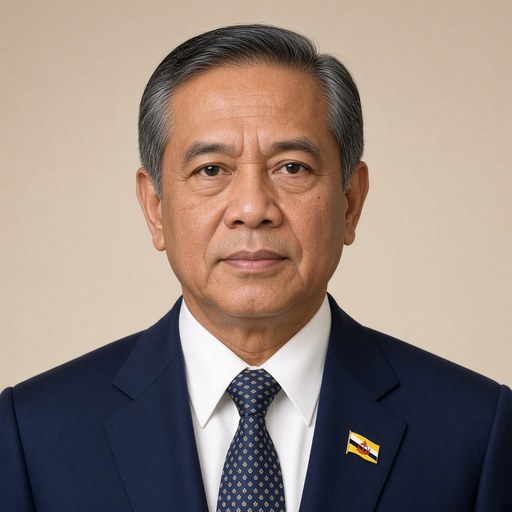
Brunei Darussalam — Statement to the General Debate of the 53rd Session of the United Nations General Assembly (1998)
 Mohamed Bolk Iah · Minister for Foreign Affairs
- Context
- Mohamed Bolk Iah delivered the statement of Brunei Darussalam in the general debate of the 53rd session of the United Nations General Assembly in 1998.
- Main themes
- Globalization and unemployment in developing nations, Palestinian refugees and prolonged suffering, victims of civil war and ethnic violence, natural disasters in Asia and the Pacific, Non-Aligned Movement and developing world concerns, Secretary-General's call for leadership and political will, people-centered policy-making and development, United Nations field work and reform
- Duration
- ~6 min
- Words
- 734
- Sentences
- 28
- Readability
- 43
- Grade
- 13.6
- Syntax
- 3.29
- Vocabulary
- 2.11
UN General Assembly Translated from Malay
The broad sphere of national life a sentence belongs to. Every sentence has an Arena, so it is the denominator the other indices are read against.
Other28 sentences in 5 paragraphs
I extend my congratulations to Mr. Opertti on his election and my appreciation to the former President for all his work over the last year.
In looking back over the year, I think we would agree that it has been extremely disturbing for most developing nations. At best, it has been one of troubling uncertainty and a deep sense of frustration. At worst, it has seen terror and despair. It is the uncertainty felt by millions in our own region, caught unprepared by the process of globalization and ending up unemployed. It is the frustration experienced by those like the current, third adult generation of Palestinian refugees who declare with understandable defiance that they have suffered enough. It is the terror of the innocent victims of bombings; of those who flee from civil war; or of those, such as the people of Kosovo and Rwanda, who have experienced savage inhumanity. It is the despair of our neighbours in China, Bangladesh and Papua New Guinea, stricken by devastating natural disasters. For many, many millions of people, the end of this century is not a time for any millennial celebrations. It is a time of enormous human suffering. As many of us remarked at the recent summit of the Non-Aligned Movement, at a time when technology presents greater opportunity for human development than ever before and when the power of globalization offers us unique chances to work together, how can this possibly be?
In trying to answer this question, the Non-Aligned Movement recently spoke of a primary need to voice the suffering of the billions it represents. It also spoke of this Assembly as the only forum in which that voice can be heard with the strength and insistence it deserves. That is why I would like to thank our SecretaryGeneral, not just for attending the Non-Aligned summit, but also for displaying heartfelt concern for the special problems faced by developing nations. Above all, I would like to thank him for what I feel is crucial in the developing world today, and that is the call he has made for leadership: leadership in ending local hostilities; leadership in making peace processes work; and, perhaps most important of all, leadership in summoning the political will to translate policies made at the national, regional or global level into day-to-day real benefits for ordinary people. It is leadership, in short, aimed at encouraging two things: first, tolerance in the acceptance of differences and the need to resolve all disputes peacefully, no matter how hard this may be; and, secondly, in placing people at the core of policy-making.
As the Secretary-General has stated, the United Nations is a place where the connection can be made — one which is so often neglected elsewhere — between economic and social development on the one hand and international peace and security on the other. We entirely agree with him. His observations reflect the need for us to address not policy positions, but ordinary people's problems — jobs, education, food and security — and to address them from their own perspectives and needs. That is why we very much appreciate the fact that the various conferences this body has hosted within the last 12 months have been directed towards recognizing people and their day-to-day concerns. This is also very much in agreement with the strong appeal we made last year, when, in the context of United Nations reform, we stated that, whatever we do, we have to be sure that nothing weakens what the United Nations does well for ordinary people. By this I mean its work in the field. It is this which gives the Organization meaning to billions. It is the fundamental reason for the existence of the United Nations today, a body founded in the name of "we the peoples".
So, in commending our Secretary-General's efforts, I would also like to give him our full support in fulfilling the peoples' need for economic prosperity and social development, and in ensuring that these two concerns remain firmly connected. This will place the emphasis in the United Nations on work which will reinforce peace and stability, reject violence and confrontation and strengthen the foundation of social development. In other words, nothing in the interests of ordinary people can be solved by violence and war. If they have to exist, let the violence be directed against despair and the war be made on suffering.