




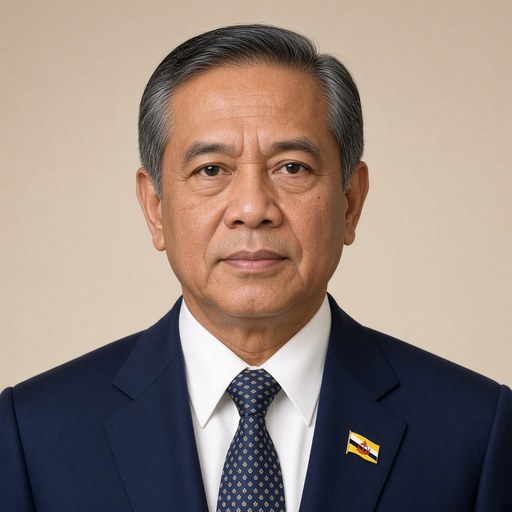
Brunei Darussalam — Statement to the General Debate of the 55th Session of the United Nations General Assembly (2000)
 Mohamed Bolk Iah · Minister for Foreign Affairs
- Context
- Mohamed Bolk Iah delivered the statement of Brunei Darussalam in the general debate of the 55th session of the United Nations General Assembly in 2000.
- Main themes
- Congratulations and appreciation for leadership, Secretary-General's Millennium Summit report, international community and collective responsibility, distinction between immediate and long-term issues, transnational problems facing developing nations, globalization and development policies, practical UN field work in education and health, preventing twentieth-century conflicts from hindering development, implementation of the Summit Declaration
- Duration
- ~7 min
- Words
- 799
- Sentences
- 43
- Readability
- 51
- Grade
- 10.7
- Syntax
- 2.93
- Vocabulary
- 2.00
UN General Assembly Translated from Malay
The broad sphere of national life a sentence belongs to. Every sentence has an Arena, so it is the denominator the other indices are read against.
Other43 sentences in 11 paragraphs
Mr. President, I should like to offer you my congratulations on your election and my best wishes for the coming year, and also to convey my great appreciation to your predecessor, Mr. Theo-Ben Gurirab, for his fine work and guidance over the past year.
I would like to start by thanking our SecretaryGeneral for his report to the Millennium Summit. It is comprehensive, ethical and most impressive. We have never had anything like it before. One effect it has had is to give deep meaning to the expression the international community. I think that in the past, we have often used this term far too lightly. Now we know what it stands for. It is spelled out in the final Declaration made by our heads of Government, which is now a textbook for the coming year. Its great ideas still echo in this Hall, and its noble aims light up the future.
In our view, it has given precise targets that can truly help developing nations. For the first time, we can distinguish clearly between immediate issues and longterm ones. This is very important, because many of the things on which we spend so much time and so many resources are not, in fact, today's issues. They are sad legacies passed on by the twentieth century. Obviously, they are important. Each one is tragic in the consequences it has for ordinary peoples' lives.
But they are all primarily the responsibility of Governments and regional organizations. The more they dominate the affairs of the United Nations, the more they stop us from concentrating on the deepseated problems of developing nations. Those problems are the ones that can truly be called today's issues. As the Secretary-General highlighted in his Summit report, they are becoming very serious indeed. We have even had to give them a new name: transnational issues. They each have academic titles: technological problems; demographic problems; socio-economic problems; and environmental problems.
But take away the grand language, and they all add up to a simple fact: they are far too big for individual Governments to deal with, or even regional organizations.
It is all too clear that they will not be solved in the marketplace, either. The solutions will not trickle down. In fact, the global market economy has lengthened their list and created its own set of special problems.
It would all be very depressing indeed but for one thing. The Summit Declaration has clearly invited us all, as Members of the United Nations, to accept a joint international responsibility to find solutions. Naturally, we may differ on how to go about it, but what is most important is that we have to recognize and accept the need for new priorities. Consequently, we highly value the assessment made by the Secretary-General of where these lie.
For example, we appreciate his timely advice that globalization requires policies and measures that are sensitive to the needs of developing nations. We are pleased that he has upheld the peoples' right to development as fundamental. We join him in recognizing the special concern of our friends and colleagues on the African continent. We support all that he is trying to do to improve the efficiency and effectiveness of the United Nations, because this should enable it to concentrate on what it does best and is best equipped to do.
By this I mean the practical, urgent work done by its organs and agencies and its professionals and volunteers, in the field, close to the people. Much of this represents development in areas such as education and training, which are absolutely critical if the people of developing nations are to move beyond a day-to-day struggle for basic food, shelter and medicine and take part successfully in the new global economy. It means that the work of agencies such as the United Nations Educational, Scientific and Cultural Organization (UNESCO), the United Nations Children's Fund (UNICEF) and the World Health Organization (WHO) is vital. It needs to proceed urgently and not be held back because essential funds are diverted to solving ancient problems.
The vital tasks of the United Nations today should not be held hostage by the twentieth century. It has urgent new work to undertake for developing nations. This work can be simply summed up. It is to ensure that the phrase developing nations actually does mean nations that are developing rather than what they too often tend to be, just a polite expression for the very opposite.
The Summit Declaration offers us all the chance to do just this, in friendship and cooperation, and I hope that we will do everything we can to implement its provisions. It would be the best form of appreciation we could offer to the Secretary-General and his staff at the end of a remarkable year's work.