




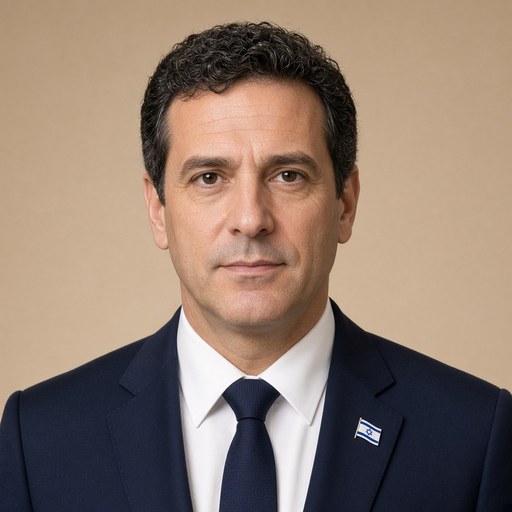
PM Bennett Addresses the IDF Officer's Course Graduation Ceremony
 Naftali Bennett · Prime Minister of Israel
- Context
- Bennett addressed graduating cadets at the IDF Officer's Course Graduation Ceremony on February 24, 2022, offering leadership advice from his own military experience.
- Main themes
- IDF officer leadership, military service and duty, care for soldiers, navigational skills, personal excellence and high standards, love of country and history, command confidence, journaling and self-improvement, Israel Defense Forces ethos, graduation and new chapter
- Duration
- ~6 min
- Words
- 732
- Sentences
- 56
- Readability
- 72
- Grade
- 6.5
- Syntax
- 2.63
- Vocabulary
- 2.02
The broad sphere of national life a sentence belongs to. Every sentence has an Arena, so it is the denominator the other indices are read against.
Other56 sentences in 14 paragraphs
Dear cadets,
I am very moved to return to this place. I learned a great deal about leadership here, about being a leader, about enduring hardships. This place shaped me and many others, and prepared us for the most significant chapter of our lives, as officers in the Israel Defense Forces.
Each of you leaving here today is beginning a new chapter, not only in your military service, but an important chapter in your overall lives. Each of you will be able to say at the end of the day, given the hundreds of actions, large and small, taken by an IDF officer every day, 'Today I contributed something to the security of the State of Israel.' This is a tremendous privilege. In my opinion, there is no feeling more profound.
Today you are graduating from the school for leadership. The people who will follow you will compel you to rise above your age. You have no choice; you will have to grow up quickly. A good commander is also a father and a mentor; he is distant, but also close.
Here in the IDF, commanders go into battle with their soldiers, at the head of the force. In every unit, commanders are supposed to be those who work the hardest, who invest the most time, who give one hundred percent of themselves.
Here is some advice I gathered during my long years as an IDF commander. Some will seem obvious, and some, I hope, you will remember for later.
First, and the most trivial and simple: Learn to navigate. In a world with Waze and GPS, this basic skill – which is so important – is fading away. Turn off the GPS, grab a map. You'll get lost once, get lost again, but eventually, you'll find your way. An IDF officer must know how to reach the destination.
Second, take care of your soldiers as if they were your children. If a soldier comes to you with a personal request, get back to them. Not in a week; within 24 hours. Give them the feeling that someone is listening to them and sees them.
Another tip: Aim high. Set your soldiers a high bar for excellence and difficulty. You did not get to where you are to wallow in mediocrity. We don't all understand what we're capable of. Your job is to point to somewhere up there and guide your soldiers there.
Another point – keep a journal with the lessons you have learned. Not a 'Dear Diary' kind of thing, but rather a notebook in which you summarize each exercise, each action, and draw conclusions: what worked, what needs to be improved. Ahead of the next exercise, implement what you learned.
The fifth point is this: There is room for doubt in terms of your superiors, but never with regard to those lower in the chain of command. What do I mean? You received an order, and it doesn't seem clear enough or maybe even seems wrong. Try to change it. If you don't succeed, don't infect your soldiers with doubt. Convey confidence and clarity.
Sixth point, and one at the heart of the IDF's ethos, engage the enemy. Let's say you were assigned a mission to protect a community. Not the most fascinating task in the world. I would initiate navigation missions in the area. I would invest in teaching the area's history to the soldiers. It's sounds burdensome, but in the end, that is what people will remember and what will enrich them. Initiate all the time.
Lastly, love of country. Teach your soldiers to love the country, the Land of Israel and the Bible. Educate yourselves, fill yourselves with knowledge, so that you have something to give. For example, if you happen to pass Latrun? Tell your soldiers about Joshua's battles in the Ayalon Valley, and about Judah Maccabee, and the battles during the War of Independence. We are not here coincidentally. Without the Land of Israel, without the Bible, without the connection to our history, there isn't a lot of meaning to what we're doing here.
I would like to summarize and say to you: Good luck. You have an opportunity that not many young people in other countries in the world get: to educate, to train and to lead soldiers in defense of their land. I love you, and the people of Israel salute you.