




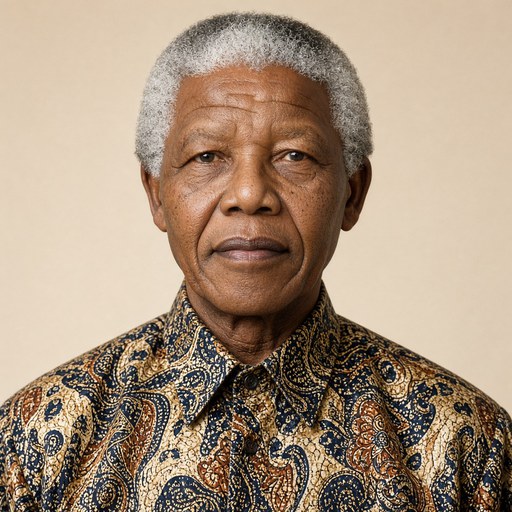

- Context
- Mandela, a retired former president, addressed Afrikaans-speaking business leaders of the AHI at a lunch on March 1, 2002, urging cross-sector partnerships and making private-sector action against HIV/AIDS a top priority.
- Main themes
- Partnerships between government, business, labour and communities, Afrikaans-speaking business community, unity in diversity, school and clinic building programme, Dalindyebo Senior Secondary School, shift from nationalisation to free-market policy, South Africa's macro-economic management, unemployment and lack of job creation, HIV/AIDS national strategy, private sector role in fighting HIV/AIDS, Danie Theron monument unveiling
- Duration
- ~8 min
- Words
- 948
- Sentences
- 46
- Readability
- 54
- Grade
- 10.8
- Syntax
- 2.94
- Vocabulary
- 2.33
Source: GitHub DRChivers/Nelson-Mandela-Speeches-Sentiment-and-Topic-Modelling-Analysis ↗
The broad sphere of national life a sentence belongs to. Every sentence has an Arena, so it is the denominator the other indices are read against.
Other46 sentences in 18 paragraphs
It is a great honour to be able to share these few moments with some of the luminaries from the Afrikaans-speaking business sector. It is not every day that I have the opportunity to rub shoulders with such important people any more. And, as I often say, it is a particular privilege for a retired pensioner to be treated to lunch.
Dit is toevallig so dat ek hierdie week meer as een geleentheid sal hê om tyd deur te bring met die Afrikaanse gemeenskap. Later in die week het ek die voorreg om op te tree by die onthulling van die Danie Theron-monument.
Dit is vir my nie net 'n voorreg om hierdie geleenthede te kan deel nie. Dit is ook 'n teken van hoe ons besig is om één Suid-Afrikaanse gemeenskap te word. Dit is waaroor ons vryheidstryd gegaan het: om 'n land te skep waar ons verenigd kan wees in ons verskeidenheid.
It gives me great satisfaction to observe how far we have in fact progressed towards becoming such a united people. We sometimes forget that we are a mere eight years into our democracy and tend to become impatient with ourselves. What we have achieved in these eight years in terms of overcoming the legacy of our past, is indeed remarkable.
I often refer to the school and clinic building programme that I have been involved in as an example of this changed attitude amongst our people. Ever since I was released from prison and long before I became President of the country, I started to approach business people to join me in bringing such services as schools and clinics to the most disadvantaged areas of our country. Almost without exception they responded positively to my requests.
Today there are numerous such schools and clinics all over the country, standing and functioning as signals to the fact that we are becoming a compassionate society in which we care for one another.
The AHI has been no exception in this regard. Amongst other things, you worked with us to upgrade the Dalindyebo Senior Secondary School. We, but particularly the community served by that school, are very grateful to you for your generous efforts.
If we are to build our country into the winning country that it can be, it will require exactly such partnerships between all sectors of our society. We have to work hard at overcoming the racial and ethnic divisions of our past. But we have to work equally hard at creating partnerships between different sectors of our society. Government and the private sector, labour and business, the private sector and communities - these are but a few examples of the kinds of partnerships we need to further build and develop our country.
I recently had occasion to reflect upon how the economic policy of the liberation movement changed when we approached the stage of preparing to govern. The hard facts of a globalised world taught us that the former policies of nationalisation would no longer be appropriate, and we had to recognise the imperatives of a free market if we were to grow our economy and create prosperity for our people.
Today South Africa is generally recognised as one of the best-managed economies amongst the emerging markets of the world, in fact amongst all countries in the world. The macro-economic policies of the government are universally hailed, and our Minister of Finance is regarded as one of the best in the world.
You, the business people of the country, have played your part in building and growing our economy. Amidst all the gloom that often meets one when discussing the state of the world economy, South Africa has managed to maintain a growth rate that outranks many. Of course, it is not as high as we would have wished; but once again, we should recognise and acknowledge our achievements.
The one factor that of course continues to be the most worrying, is the lack of job creation to accompany our economic growth. There can be few things as demoralising to a human being than being unable to find employment when one wishes to work. Many of our other social problems are related to unemployment; and it must remain one of our greatest challenges to create jobs and so help build a better life for all our people.
We have over the years, and particularly again in recent months, spoken quite frequently about the grave threat of HIV/AIDS facing our nation. In that regard too, we emphasise the importance of partnerships across all sectors of society. This is a war that requires a combined national effort.
Our government is doing very well in leading this campaign. It has some of the best and most comprehensive policies and strategies in the world for combating HIV/AIDS. But it requires the co-operation and assistance of all in this war. Business has a particularly important role to play in this regard.
We need you in the private sector to have the combating of HIV/AIDS as a top priority in your business plans. We know that much is already being done by many of our corporations. In the coming years we need to see all of our efforts co-ordinated in one comprehensive national strategy.
Unless we do so and redouble our efforts, we shall see the good work done in the schools and clinics you built so generously, being undone by the scourge of HIV/AIDS.
Our Foundation will be playing its role in facilitating the co-ordination of these national efforts. We look forward to the contribution of our private sector.
We thank you for today, and we thank you for what you have meant to us in the past.