




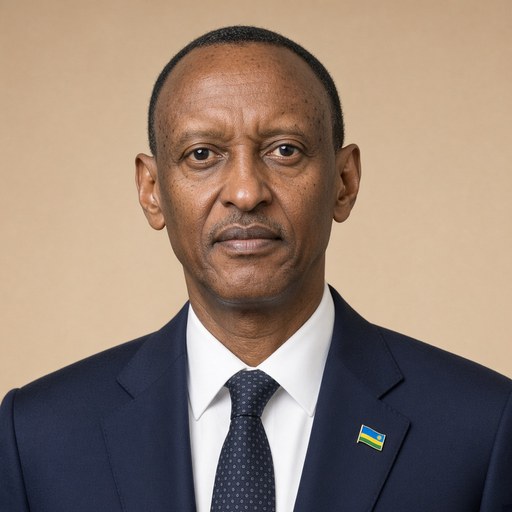
Address by President Kagame at the Retreat of the Heads of State and Government
 Paul Kagame · President of Rwanda
- Context
- Kagame addressed the AU Heads of State Retreat in Addis Ababa on 29 January 2017, presenting recommendations on African Union institutional reform as mandated by the Kigali Summit.
- Main themes
- African Union institutional reform, self-financing and new import levy, implementation crisis, pan-African unity, freedom of movement, regional integration, ECOWAS leadership, governance and accountability, African identity and solidarity
- Duration
- ~22 min
- Words
- 2,602
- Sentences
- 146
- Readability
- 46
- Grade
- 11.3
- Syntax
- 2.79
- Vocabulary
- 2.11
The broad sphere of national life a sentence belongs to. Every sentence has an Arena, so it is the denominator the other indices are read against.
Other146 sentences in 109 paragraphs
Addis Ababa, 29 January 2017
Good morning and thank you for setting aside the time to participate in this retreat.
Six months ago, at our last Summit in Kigali, we made two important decisions.
The first was to institute a new levy on eligible imports, to finance the budget of the African Union.
The second decision, directly related, was to complete the ongoing institutional reform of the African Union, to ensure that our money is put to good use.
As mandated by the Assembly, I am honoured to report back to you today, with some recommendations on the proposed reforms, to build an African Union that is fit for purpose.
Let me start by thanking all who put their trust in the process, beginning with the Chairperson of the African Union, my brother, President Idriss Deby.
I particularly appreciate the many Heads of State, who took the time to offer invaluable input and advice. This was a great encouragement, and I thank you.
Among the many experts and officials who were consulted, I would wish to particularly acknowledge the Chairperson of the Commission, Dr Nkosazana Dlamini Zuma, and the President of the Pan-African Parliament, the Honourable Roger Nkodo Dang, for sharing their counsel and experience. Thank you very much.
To better carry out the mission entrusted to me, I sought the expertise of a pan-African advisory team. I wish to thank them for their hard work and their committed service to our continent. Many have kindly joined us here today.
The previous landmark studies of the African Union’s organs and institutions served as the starting point of the review, notably the 2007 Adedeji Report and the 2016 Mekelle Report.
Three observations stood out.
First, the institutional quality of the African Union has been a concern for a long time, virtually since its founding in 2002.
Indeed, the problems documented then are not so different from those on our minds today, namely poor execution, lack of focus, overdependence on external funding, an unclear division of labour with other continental organisations, and a perception of irrelevance for African citizens.
Second, there is no shortage of sensible ideas for reform.
In many cases, despite the passage of time, the recommendations are as relevant as ever.
Third, these proposals have had almost no impact.
Despite wide consensus about their merit, as reflected in adoption by the Assembly of Heads of State, the agreed reforms were simply never implemented.
In other words, serious problems were repeatedly identified. Solutions were found. Decisions were made to apply the solutions. And very little happened.
This realisation signalled that the present study would require a fundamentally different approach. To complete the institutional reform of the African Union, the crisis of implementation must first be addressed.
But before that, it is important to take a step back and be proud of being African.
We have the capacity for change, and the African Union, by virtue of how it has emerged from our historical experience, is actually a part of that positive endowment.
For more than a century, the idea of the fundamental unity of Africans has sustained all of us through countless struggles.
Whether to liberate ourselves from foreign domination or to set our people on a path to dignity and prosperity, we had no choice but to come together as Africans in shared purpose and action.
Out of that necessity, we are fortunate to have inherited a set of institutions, notably the African Union and its predecessor, which are anchored in the values of respect, tolerance, and solidarity that we share as Africans.
As a result, and on that basis, there has often been good progress in terms of the well-being and security of our citizens, which would have been unattainable working as individual entities.
Proof that we can do it is not hard to find.
For example, ECOWAS and the East African Community have already made freedom of movement a reality within those regions.
Therefore, there is no technical obstacle to extending this practice more widely, as we have agreed to do with the African passport.
Another example is how the recent crisis in Gambia was handled.
The leaders of ECOWAS agreed on the simple principle that the rights of Gambian citizens had to be respected.
The effort was successful for two reasons. They worked closely and patiently together to find a just and peaceful resolution, and they put the interests of the people first, rather than those of this or that individual.
As a result, an exceptional service has been obtained for the Gambian people and actually for all of us in Africa.
I want to commend ECOWAS, and all of the leaders involved, especially President Alpha Conde of Guinea, President Mohamed Ould Abdel Aziz of Mauritania, President Macky Sall of Senegal, and President Muhammadu Buhari of Nigeria.
I want to say that you made us proud by demonstrating that the ideals we always talk about here in the African Union really do mean something.
Not only was a human catastrophe averted, but we can now gather here for our retreat, bearing in mind this powerful example of what can be achieved by acting in solidarity.
Nevertheless, the unfortunate truth is that Africa today is generally ill-prepared to adequately respond to current events.
Disturbing developments impinge on us from around the globe, in the form of climate change, mass migration, violent extremist ideologies, and political upheavals taking place in many states.
Without an African Union that delivers, the continent cannot progress, and we face the likelihood of yet another generation of lost opportunity.
This shows that Heads of State were correct to push to accelerate the institutional reform of the African Union as part of the effort to make it financially independent.
Yet it has always been Africa’s moment. The demeaning anecdotes that infect the portrayal of Africa deepen cynicism amongst our own youth who internalise the idea of a helplessly dysfunctional continent.
We should take responsibility for the part we have contributed to these negative images and work to change perceptions by coming together in real solidarity to transform our approach to the business of developing and protecting this continent.
The question at any given time is whether we choose to be present and put in place the institutional capacity needed to seize whatever advantages are available.
Continuing to defer necessary reforms to the future is an implicit decision to do nothing. It means accepting our conditions as inevitable and Africa’s subordinate place in the community of nations as natural.
Looking around Africa, any of us can give examples of situations that hurt deeply because we know they would not exist if we had acted much earlier, as we agreed to do so many times over the years.
There are lives lost in childbirth, villages filled with uneducated children, people locked in refugee camps for decades because of who they are, and countless families who lack the means to guarantee basic dignity.
As noted in the report submitted to you, tens of thousands of young African bodies have been swallowed by the sea, or abandoned in the desert, in pursuit of a decent life for which they are prepared to risk everything, because they believe there is no hope at home.
They testify to the urgent need to act.
Mr Chairman, Excellencies, Brothers and Sisters:
Before briefing you on the proposed recommendations, I first want to speak to you from the heart.
The effectiveness of the African Union is our business and our responsibility.
Reform does not start with the Commission. It starts and ends with us, the leaders, who must set the right expectations.
The Assembly has adopted more than 1,500 resolutions. Yet there is no easy way to determine how many of those have actually been implemented.
By not following up to ensure that our decisions are implemented, we are effectively saying that they don’t matter.
As a result we have a dysfunctional organisation with limited credibility among member states, global partners, and citizens alike.
The reform agenda will come to nothing unless we resolve to do things differently at the level of our values and mindset in terms of taking responsibility and ownership.
It is not about feeling responsible for causing those bodies in the Mediterranean or the low level of trust that too many citizens have in our public institutions.
Playing the blame game does not solve problems. The kind of responsibility I am talking about is about addressing problems head-on and finding solutions, regardless of how they were caused.
A related issue is the persistence of divisive politics amongst ourselves. We can be inclusive without forcing people into categories. We have to all pull together. African solidarity cannot be a mere slogan.
Aside from it being counterproductive and contrary to our ideals, these divisions expose us to various forms of manipulation by others.
Africa is large and complex. But even the biggest and strongest country among us is not really very big in the global context.
Even if it were possible for some of us to go it alone, it is also true that we are better off having a highly-functional entity, like the African Union, and going forward together.
Just look at how other regions are organised, where states with more economic production than much of Africa combined find benefit in joining together with neighbours to go even further.
We are hard-pressed to embrace change and in fact, seen from the vantage point of the present, we are already too late. We cannot avoid reckoning with the hard truth of previous failures, otherwise the same mistakes will keep coming back.
But acknowledging where we have fallen short, does not mean being bound by it. The only mistake would be to allow the situation to become cyclical.
Instead we should own up, accept it, and most importantly keep trying with more chance of success based on a clearer understanding of where we went wrong in the past.
As we have seen, we have everything needed to succeed.
To fail Africa again would therefore be unforgivable.
Against that background, the imperative to strengthen our Union is very clear.
Mr Chairman, Excellencies:
Let’s now turn to the recommendations that emerged from our consultations.
We have to do the following four things:
Allow me to take a few moments to present the specific recommendations proposed in the report under each of these areas of action.
Having clear focus in terms of priorities remedies the African Union’s fragmentation while providing a formula for a better division of labour with Regional Economic Communities.
The point is to think strategically about which organisation at which level is the best placed to take the lead in a given case.
With clarity of focus, an understandable rationale emerges to guide the process of re-aligning the African Union’s dozens of distinct structures and institutions in terms of efficiency and ability to deliver.
This process must be conducted with due care and diligence.
Certain organs and institutions require special attention.
For example, although NEPAD has been incorporated into the Commission as a technical body, in practice it has not been fully integrated.
The Constitutive Act specifies that the Permanent Representatives Committee is “charged with the responsibility of preparing the work of the Executive Council and acting on its instructions”.
However, in practice the PRC has assumed the role of supervising the day-to-day work of the Commission. Consultations suggest that this activity has increased the Commission’s inefficiencies.
Moreover, some decisions of the Assembly of Heads of State and Government have been delayed by the PRC or even disregarded, suggesting that the PRC has taken on an unwarranted role in the decision-making process.
Re-aligning the African Union is also about better connecting with citizens.
We must also manage the business of the African Union more efficiently both at the political and operational levels.
The African Union Summit’s working methods are inefficient and impede decision-making and implementation.
Summit sessions are often delayed and marked by overloaded agendas that do not focus on the strategic issues requiring the attention of Heads of State.
There is limited opportunity for leaders to achieve consensus on key issues before the plenary session, and consultation with Regional Economic Communities is inadequate.
It is recommended to reform the working methods of the Summit in the following ways.
On operational management, the following recommendations should be considered.
The fourth area is the one we started with: financing the African Union. We have agreed that we have to pay for ourselves. It is a question of independence and dignity and the ability to set our own agenda.
Our programmes are 97 per cent funded by external donors — 97 per cent — and as of December 2016, less than half of member states had paid their assessment in full.
The resolution on financing last July was also the catalyst for this study on institutional reform. That is not an accident. Once you’re the one paying, you automatically become more concerned about getting good value for money.
But neither can we solve the issue by coming to depend disproportionately on the bigger states amongst us. We all have to contribute our fair share to ensure that the African Union stays focused on our interests and priorities.
In addition, some complementary measures to re-inforce the Kigali Decision should also be considered.
The final element applies equally to all the points raised. We need to implement.
However we decide to proceed, we cannot leave the implementation of the reforms to chance or treat it as routine. Both in the Assembly and in the Commission, the responsibility for delivery of the reform agenda must be clearly assigned.
There is a clear expectation outside this room, that we will not defer the difficult reforms to the future anymore.
Even if we can’t fix everything at once, let’s agree to move forward and do what we can. That way the reform process will gain momentum as awareness is built that more is possible than we realise.
No one should be afraid of losing anything they have. That is not what this report or process is about. It’s about getting more for all of our people.
Instead, we should be very worried about continuing to miss opportunities that could transform the lives of our people. We need to feel challenged by that.
Critique the details in the report, as you see fit, Your Excellencies. It is about what is best for Africa, not about who produced which idea. The verdict is yours.
What is important are the overarching objectives that have been captured, describing the place we need to get to, following on from an increased sense of urgency about the cost of doing nothing.
What remains is for us to evaluate, improve, decide, and then do it.
Some items we can agree to do immediately. Others require further study and consultation, for the medium or long term. It is up to us to sequence things and set the next steps in motion.
Let’s also face the fact that the way in which we have recorded our decisions up to now has not been effective. Perhaps a more explicitly binding mechanism is needed to get these reforms done, something with real consequences for non-compliance where appropriate.
It has been my humble and honourable task to pursue this assignment, as best as possible.
The recommendations and analysis offered here are intended as input to our discussion on the way forward.
If we do our part, we can expect a realigned and re-energised African Union to perform significantly better and to continue improving year upon year.
I thank you very much, Your Excellencies.