




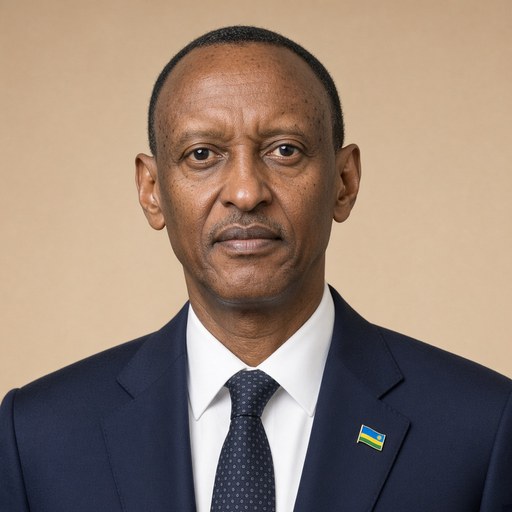

- Context
- Kagame addressed the Next Einstein Forum Global Gathering in Dakar, Senegal on 8 March 2016, promoting African science, innovation, and Rwanda's role in building a knowledge economy.
- Main themes
- Science and technology education in Africa, innovation and knowledge economy, human capital development, research and development investment, Kigali Innovation City, African Institute of Mathematical Sciences, women in STEM, pan-African collaboration, public-private partnership, Rwanda's science policy, catching up with industrial revolutions, shared prosperity
- Duration
- ~5 min
- Words
- 588
- Sentences
- 39
- Readability
- 45
- Grade
- 10.7
- Syntax
- 2.66
- Vocabulary
- 2.20
The broad sphere of national life a sentence belongs to. Every sentence has an Arena, so it is the denominator the other indices are read against.
Other39 sentences in 26 paragraphs
Dakar, 8 March 2016
I am pleased to be back in Dakar and I wish to express my appreciation to our host, President Macky Sall, and the Government and people of Senegal for their usual warm hospitality.
I would also like to thank the African Institute of Mathematical Sciences and the Next Einstein Initiative in partnership with the Robert Bosch Foundation, for organising this important forum.
I can think of few missions more essential than enabling “Africa’s brightest students to flourish as independent thinkers”. This is important and urgent work. Africa was largely bypassed by the last three industrial revolutions.
The pressure is on to catch up and keep pace so Africa is not left in the wake of technological progress.
This starts with a change in our mindset. We really cannot be satisfied with just ending extreme poverty. Our aim is shared and sustainable prosperity. And the key to that is science and innovation, bound by research.
Technology and skills are the lifeblood of economic growth and competitiveness. We must continue to invest in the necessary education and infrastructure, including broadband.
The challenges on our continent are well-known.
We lack sufficient numbers of science and technology professionals; and too often those that we do have waste their talents in unconducive environments.
We do not invest enough in research and development.
The share of higher education students enrolled in science and engineering is too low.
Women comprise less than one third of researchers and even fewer scientists and engineers, which means we are not using our human resources to the full.
In our national and regional institutions there are plans to address each of these issues. Where we often come up short is implementation and collaboration.
There is also need for closer partnership between scientists and the private sector. I am therefore encouraged to see many industry and business leaders participating here.
Rwanda’s national science policy aims to contribute to economic growth by strengthening knowledge creation and building a culture of innovation. To that end we have developed joint initiatives with partners from around the world and are always open to new collaborations.
We will soon launch the Rwanda chapter of the African Institute of Mathematical Sciences, and establish the global headquarters for both AIMS and the Next Einstein Forum in Kigali.
We are excited to host these valuable institutions in our country. We also look forward to welcoming you to Kigali for the next Forum in 2018.
A key initiative we will launch this year is Kigali Innovation City, which brings three critical functions together in the same location.
First, tech clusters for start-ups and established firms.
Second, a research and education campus anchored by Carnegie Mellon University and AIMS
Third, an Innovation Fund that brings together government and private sector capital.
Africa cannot accumulate wealth merely by consuming technologies produced elsewhere. The purpose of initiatives like Kigali Innovation City is to unlock value by better adapting technology to our economic and social context, as well as our current and future needs.
Building on that, we will develop entirely new technologies that are both beneficial and commercially viable.
Africa is young and growing, and that is our strength. Our continent’s wealth tomorrow depends entirely on what we put in our children’s heads today. They will lighten the world’s burdens, not add to them.
Rwanda is pleased to be associated with this Forum, which brings global partnership and a truly pan-African spirit to the task of building a knowledge-based African future.
I thank you for your kind attention.