




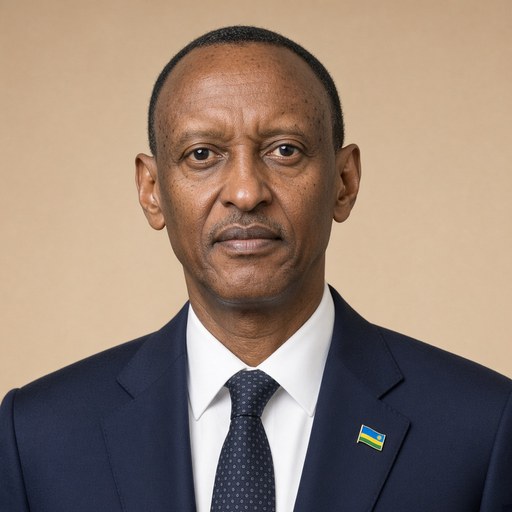
Speech at 18th Africa Business Conference – Harvard Business School
 Paul Kagame · President of Rwanda
- Context
- Kagame addressed the 18th Africa Business Conference at Harvard Business School in Boston on 27 February 2016, speaking on homegrown models for Africa's prosperity.
- Main themes
- Homegrown models for African prosperity, unity and economic transformation, public-private partnership, entrepreneurship and innovation, Rwanda's development story, role of government in business, regional and continental integration, pan-African multinational growth, colonial legacy and post-independence challenges, long-term investment mindset, youth and talent in Africa's future
- Duration
- ~5 min
- Words
- 560
- Sentences
- 43
- Readability
- 50
- Grade
- 9.5
- Syntax
- 2.85
- Vocabulary
- 2.11
The broad sphere of national life a sentence belongs to. Every sentence has an Arena, so it is the denominator the other indices are read against.
Other43 sentences in 32 paragraphs
Boston, 27 February 2016
Let me start by thanking the organisers of this year’s Africa Business Conference, for your kind invitation. I trust the last two days, have been productive.
I see no way to improve upon your chosen theme: “Unite. Innovate. Disrupt: Homegrown Models for Africa’s Prosperity”.
Really, everything we need to know, is said in those few words.
For example, one question I am often asked, at events like this, is how Rwanda managed to transform its economy.
The answer lies in the idea of “unity”.
As in many other countries, Rwanda’s public institutions, have been at the centre of development efforts, functioning in the interests of citizens, by making them an integral part of the search for solutions, and their implementation.
The goal is to nurture a culture of entrepreneurship and creativity, and also help new initiatives to succeed.
It was not always like this.
During the colonial period, urban centres were only for rulers, and their associates.
Business activity by “natives” was viewed with suspicion, and success generally resulted in expropriation.
The place of Africans was on the land, to remain scattered, poor, and dependent.
After independence, these policies were maintained, and indeed intensified, in many countries, and Rwanda was no exception.
There was therefore no civil society around business in our country, and little awareness, of how it contributes to the public good.
We are continuing to build a new culture, guided by our own context, and applying useful lessons from elsewhere. The starting point, was a new, healthier politics marked by constant dialogue and inclusion.
However, when we started, we could not afford to leave everything to market forces, which hardly existed.
Sometimes, it is appropriate and necessary, for the government to directly share risk with private capital, to kickstart new industries and initiatives.
That is how, Rwanda got a mobile phone network in the 1990s, and launched 4G broadband service, in 2014.
We have world-class conference facilities, and the fastest-growing airline i n Africa, RwandAir.
These investments, are now the cornerstone of our growing service sector. But they would not have happened, without public-private partnership.
Therefore, elevating commerce, does not mean diminishing government. Each has a role to play.
The state’s role is to maintain a good business environment, and ensure safety, rule of law, and public integrity.
Success lies in a close working relationship between government and business, marked by a commitment to problem-solving.
After all, we are not members of rival tribes. We are part of the same society, and share a vision, for our common future.
Even the most advanced economies, started with immutable class divisions, and grinding poverty.
Massive government support, played a decisive role, in their respective development stories, and it still does.
Business is more than trading, it is about unlocking a future-oriented mindset, focused on long-term planning and investment.
For instance, we have not fully exploited the potential of regional and continental integration. The growth of pan-African multinational companies, is also lagging behind.
This room is filled with talent, imagination, and ambition.
You are the ones, who have to think beyond the “now”, for Africa. Otherwise, someone else will be doing it, on our behalf.
We are counting on you. And I hope you are not going to fail yourselves and Africa.
Thank you very much for your attention. I am looking forward to our conversation.